To watch Hungarian director Ildikó Enyedi‘s “Silent Friend” is to sit in deep, Zen-like meditation; much like its trio of protagonists, whose existential malaise each centers around the same ginkgo tree planted in the botanical gardens outside Germany’s Marburg University, we’re invited to contemplate not just our connections with each other, but with the nature from which we sprung. How do we communicate? What does connection look like, on a molecular level? Does history, gender, and civilization find ways to separate us from our natural state? And how can we return to that—if it’s even possible?
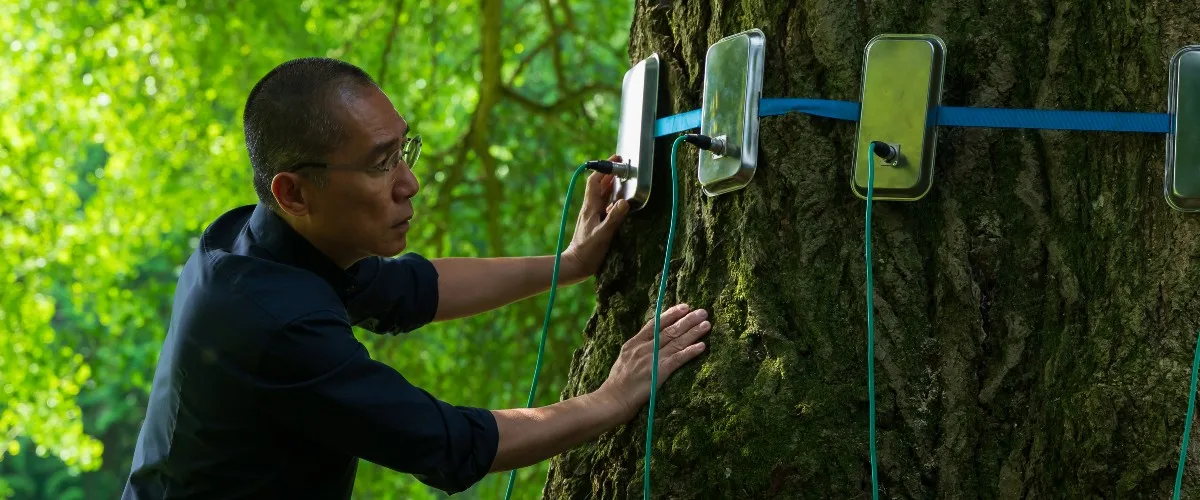
Enyedi, who came to prominence with her Oscar-nominated 2017 feature “On Body and Soul,” seems similarly interested in the rhythms of biology here, whether fauna or flora (or both). The film is bookended with microscopic closeups of a plant sprouting from a seed: humble beginnings, mind you, but with time and care, it can grow into something as mighty as the tree around which our characters fixate. The first of these literal and subtextual tree-huggers is Dr. Tony Wong (the inimitable Tony Leung Chiu-wai), a steady but lonely neuroscientist professor whose nascent project at Marburg University is set back by the 2020 COVID pandemic. With all his fellows and research cut off, and only a tetchy relationship with the university’s suspicious caretaker Anton (Sylvester Goth), Wong retreats into isolation, sinking himself into the study of the gingko tree’s biochemical signals using improvised scientific devices. His previous work was in studying the brainwaves of pre-natal babies; he sees similar potential in the gingko.
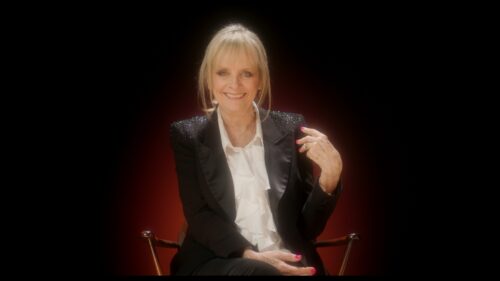
As stately and serene as those scenes are—Gergely Pálos’ crisp digital photography highlighting the verdant greens of the forest contrasted with the isolating whites and earth tones of the university—it’s but one part of the story. Enyedi also flits through the past century to see other cases of humanity’s fascination with the scientific: In a black-and-white 1908 Germany, scientific hopeful Grete (Luna Wedler) applies to become the first female student in Marburg’s history; the cadre of all (old, white) male board members treat her ambition with skepticism, and turn her interview with them into a barely-coded critique of her presumed sexual promiscuity.
Meanwhile, Enyedi also switches to 1972, filmed in beautifully grainy 16mm, as a naive young college student named Hannes (Enzo Brumm) sublimates his unrequited crush on his dormmate Gundula (Marlene Burow) by agreeing to help her study the geranium on her windowsill. She, like Wong after her, believes you can communicate with plants with the right electrical signal. Hannes, besotted with her, isn’t hard to persuade on that front.
Filled with quiet moments and no small amount of academic theorizing (conversations about Goethe and Rilke fly as fancifully as discussions of early photograph technology and modern neuroscientific instruments), “Silent Friend” is hardly the kind of pulse-pounding thriller, or even eventful drama, one might expect from something more conventional. Characters often feel like mouthpieces for politics, poetry, or science, but in a way that feels natural; these are academics, after all, folks innately concerned with what makes us tick, both in and out of the natural world.
It helps, of course, that the performances bring such dry-on-paper characters to life; Leung has spent a career writing entire volumes of emotion with those probing eyes, that contemplative visage; stuck in his German setting searching for connection across six feet of cafe, or on a laptop commiserating with a fellow scientist played by Léa Seydoux is as riveting as any of his turns in a Wong Kar-wai film. Wedler also holds up her third of the picture quite capably, headstrong but vulnerable as a woman searching for intellectual purchase in a world that would rather see her as a harlot.
But much like the gently swaying tree at its center—fun fact, gingkos are one of the oldest species of trees in the world; they’re even older than dinosaurs—it’s a film content to move at its own rhythms, to simply observe rather than resolve. Don’t expect traditional plot beats for any of its protagonists, or dramatic revelations that send these people down new realizations about themselves or the universe. Instead, Károly Szalai’s elliptical editing blows us back and forth in time with all the gentleness of a breeze, as if all three stories are happening concurrently, one universal yearning for connection across time, science, and fate. To expect answers, Enyedi’s film argues, is folly. Just immerse yourself in the curiosity.
Trees, like people, are deeply connected to the world around them. We, like they, pick up on signals, receive and interpret them, and respond in kind. “Silent Friend” offers the gentlest of those signals to us, in the form of its own hypnotic, mesmeric filmmaking. Pick up on those signals, let them rattle around in your head, and you’ll be richly rewarded.