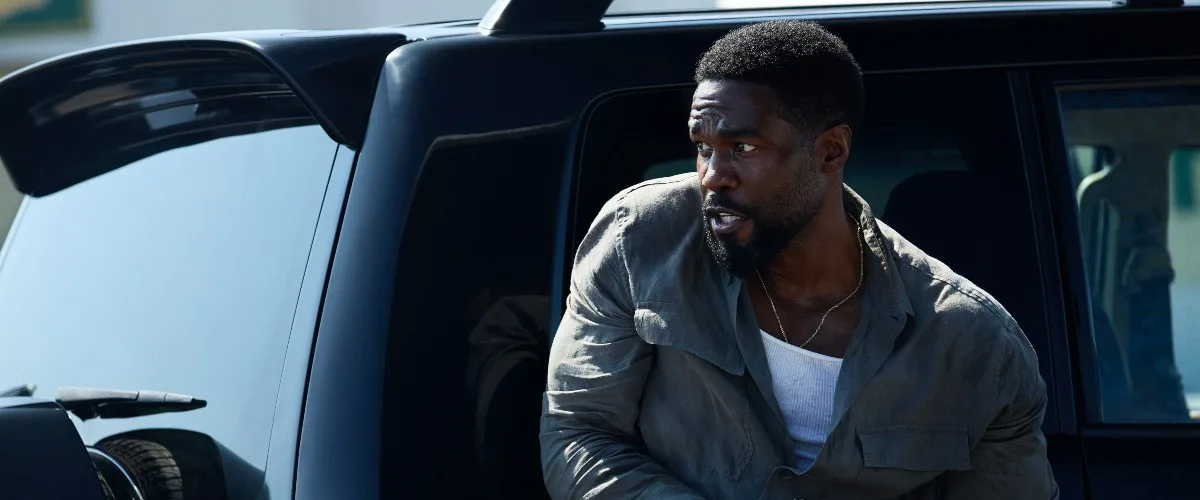
Based on the A. J. Quinnell’s novel of the same name, which was then adapted into the 1987 and 2004 films, Netflix’s “Man on Fire” follows ex-mercenary John Creasy (Yahya Abdul-Mateen II) after a whirlwind mission that leaves all his teammates dead. Haunted by his past, he’s now covered in scars, dons a disheveled beard, and has taken to drinking copious amounts of alcohol to cope with his frequent nightmares. After he attempts to take his own life, Creasy is taken in by his estranged best friend, Paul Rayburn (Bobby Cannavale), who needs his help to dismantle a group of terrorists.
Just when it seems like the sunny skies of Rio de Janeiro may be able to help Creasy heal from his trauma, his life is once again turned upside down when the skyscraper where Rayburn lives is destroyed in an explosion. With Rayburn dead and his daughter, Poe (Billie Boullet), left alone, Creasy becomes her sole protector, as the same terrorists who Rayburn wanted to stop come after her. While the series sets up the main conflict to be between Creasy and the goons who attempt to track him and Poe down, the real conflict is evidently between Creasy’s haunted past and his unpredictable future.
“Man on Fire” is most compelling when it attempts to explore the intricate inner workings of Creasy’s deteriorating mental health. We watch time and time again as Poe attempts to get closer to her new protector, who, after losing everyone he loves, continues to shut down her attempts at getting closer. Yet, because of the circumstances of Rayburn’s death, Creasy’s responsibility for her physical well-being continues to clash with the emotional bond Poe is so desperate to form. Abdul-Mateen II is captivating as usual, although at times, it feels as if the script is too afraid to really push him beyond the boundaries of Creasy’s stoicism.
The walls Creasy has been forced to put up are softened at times not just by Poe, but also with the help of Valeria Melo (Alice Braga), a driver who gets tangled up in their world. Each of their respective traumas has forced these characters to isolate themselves in a prison that is, at times, of their own making, and as their lives become more at risk, they’re forced to protect each other and eventually lean on each other. The three characters mesh well and are far more compelling when they’re on screen together than when the plot splits them up, which it unfortunately often does.
“Sometimes you meet someone…it’s like you see a piece of yourself in them,” Valeria ponders at the series’ halfway point, hammering home what this adaptation of Quinnell’s novel is trying to achieve. There are glimpses of this manifesto present, often when the gunfire quiets long enough for our three core characters to actually converse and share memories of their lives before they were forced to go on the run. Yet, more often than not, the intriguing chemistry between them is broken up by dull action sequences, and government plots that unspool further with each episode, and threaten to overtake the show’s more intimate moments.
As adaptations of famous novels and remakes of popular films become the norm for streaming entities like Netflix, it feels like it becomes harder each year for series like this to exist without the reminder of the versions of these stories that came before. Unfortunately, as “Man on Fire” spirals out of control, it becomes impossible not to think of the better versions of this tale that exist. There are inklings of a more tender story here, one that focuses on its characters’ shared and individual traumas, but it is more often than not stifled by garish lighting, dull action sequences, and nonsensical political storylines.
Throughout its seven-episode run, I couldn’t help but wonder why this adaptation was made into a series, rather than a film. By the end, its characters never truly reach the heights these actors are so desperate to carve out of a dull script, and the action feels so lackluster that it may as well not exist at all. Adaptations are meant to breathe new life into stories that once charmed or intrigued audiences, bringing them to new audiences. Instead of achieving this, “Man on Fire” unfortunately turns out to be another case of pondering the existence of an adaptation entirely.
All episodes were screened for review. Currently streaming on Netflix.