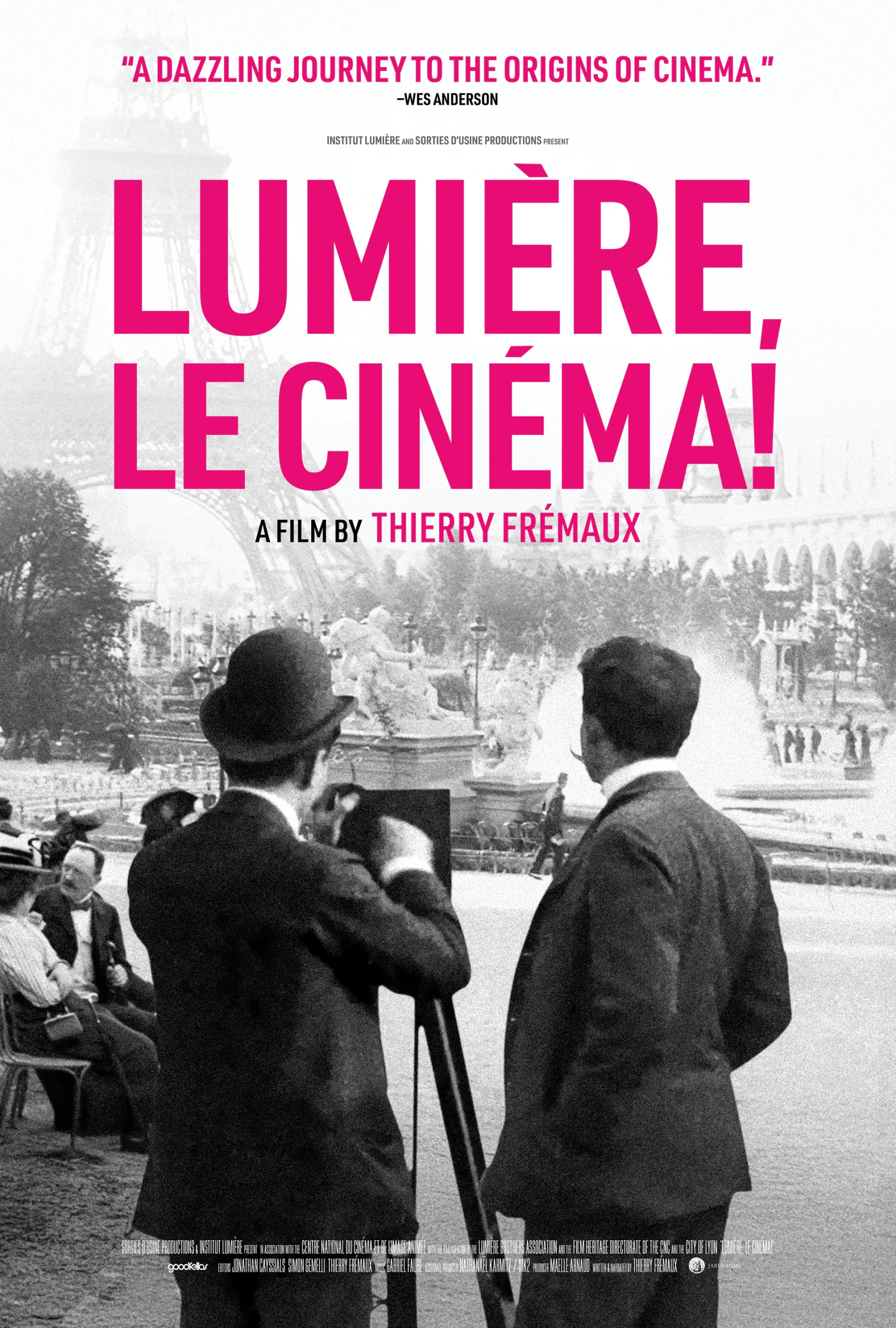
Motion pictures have been part of our collective lives for about 130 years. That’s long enough to make it impossible to fully appreciate what it must have felt like to watch flickering images projected onto a wall in a dark room for the first time, when your previous experience of represented reality had come from reading prose or looking at illustrations, paintings, and still photographs. It probably felt miraculous. We take moving pictures for granted now. We can’t go back. But the film “Lumière, Le Cinema!”, about the gradual rollout of the automated motion picture projector and the goals of its inventors, Louis and Auguste Lumière, is a very good try.
Directed by Thierry Frémaux, the head of the Institute Lumière in the brothers’ hometown of Lyon, France, this is sort of a feature-length essay film, with contextual narration overlaid on a few dozen silent short pieces from the Lumière archives, all captured just before and after 1895. That’s when the Lumière brothers went to Paris to show fellow scientists a new invention they called the cinematographe, which could be used as both a projector and a camera (to make additional prints of a finished work shot earlier with regular motion picture cameras).
By that point, on the cusp of a new century, images had been projected for 400 years in one form or another. And the public was no longer amazed by still photography, which had been invented about 70 years earlier, also in France, by Nicéphore Niépce. But this new technology was a dazzling leap in sophistication. The earliest cameras and projectors were both hand-cranked, which meant the operator had to have stamina and near-perfect timing, and it guaranteed that projections would be inconsistent from one venue to the next. Louis Lumière’s great contribution was the motorized projector, which standardized projection worldwide and helped transform movies into a viable, long-term business.
The approach here is simple: just show very short works from the archives, in whole or in pieces, backed by bittersweet classical music composed by Gabriele Foure, one of the Lumière brothers’ contemporaries, and a narrator offering bits of information and observations. Some of the latter is purplish and gaseous and feels as if it’s needlessly hyping the importance of something that is already considered important by anyone who would want to watch a movie like this. But there’s a lot of solid information in there as well, even though it skimps a bit on proper names, locations, and other facts that might further orient us.
And the main show, of course, is the work itself. Another thing that’s hard for us to imagine is how exciting it must have been to go into a theater and see a place you’ve never visited, or a job or process you’ve never seen depicted in detail, cast on wall in a room full of people. This was about thirty years before sound came in, which meant the only noises in the room would have been the audience’s reactions and the flickety-flickity of the projector. Before narrative cinema took root, the main appeal of this new art form was discovery. Want to experience the unveiling of a monument in London, the ride from Harlem to Lower Manhattan on an elevated train, or a bare-knuckle boxing match in Atlantic City? There it was, flickering on a wall in a school auditorium in Scranton, a synagogue in Ft. Lauderdale, or the side of a barn in Kansas.
The very first demo reel shown publicly by the brothers was “Factory Exit,” a record of men and women spilling through the front gates of the Lumières’ factory in Lyon at closing time. This might also be the first film that led future generations of scholars to argue over which version was shown, because the Lumières filmed the exit three times; we see all three placed side by side for comparison. “Boarding for the Ride” shows a family in Lyon—possibly relatives of the Lumiere bros, though the narration doesn’t say—piling into a rowboat moored to a dock. It’s a home movie, essentially, preserving not a historically significant event, but a record of a mundane event in the life of a family that lived and died long ago.
There’s a shot of a train entering a tunnel, seen from the roof of the locomotive, giving viewers a perspective they would never have in their own lives. It’s a common shot now—millions of digital dashcams do it every day – but in the Lumieres’ era, it must have boggled viewers’ brains. Perhaps action cinema as we know it began with this shot? And maybe the “slow cinema” works of directors like Béla Tarr started here, too. For phone-scrollers with tiny attention spans, watching ordinary things happen in real time without edits or sound for a few seconds to a minute is low-level torture.
But if you can commit to the process, keep your eyes focused on the images, and block out unrelated, intrusive thoughts, it’s hypnotic. You find yourself thinking about things you wouldn’t otherwise think about, like the stark beauty of a train rolling through a tunnel, the concentric black tunnel creating its own in-camera iris around the scenery beyond the exit.
This sort of thing goes a long way towards restoring the sense of wonder that must have been a big part of the movie-watching experience in the 1890s. It makes it easier to imagine what it’s like to experience things in a truly new way, so mind-blowing that it changes your perception of reality, history, the connections between strangers of different nations and cultures, and your place in the universe. The audio portion of the experience pales in comparison to the visual, but the images are more than enough reason to put this movie in front of you and stare at it.