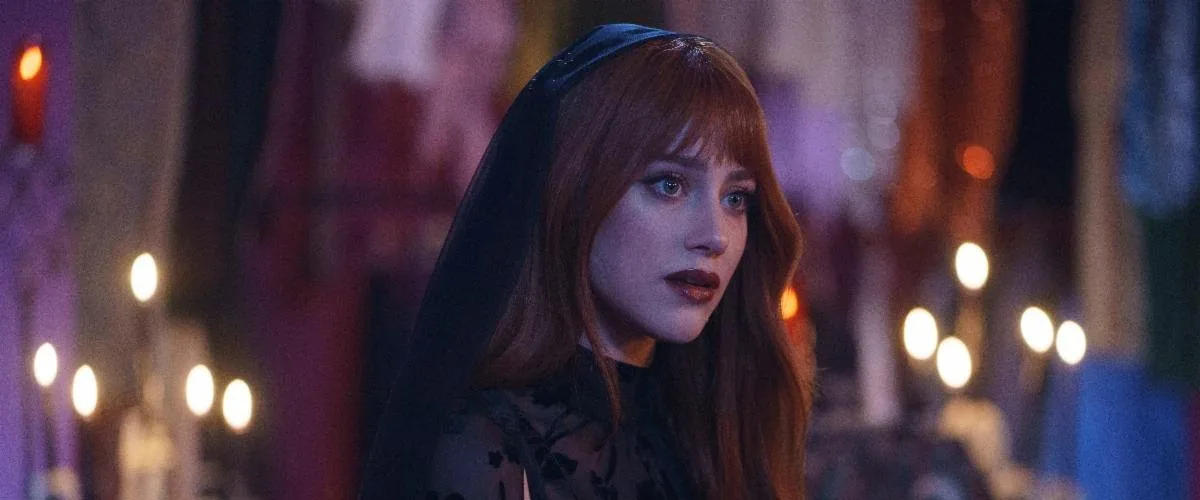
From the very first moments of Meredith Alloway’s “Forbidden Fruits,” which sees one of its characters, Apple (Lili Reinhart), throw her scalding latte on the penis of a bystander crudely jerking off to her, it’s clear that the director has not only a vision but something righteous and incendiary to say. Not all may be won over by the film’s aggressively campy tone, but this one is for those who like their sisterhood slashers dashed with sapphic yearning, divine femininity, and an exploration of how we’ll deny who we are just to feel a part of something larger than ourselves. It operates at a more cosmically tragic level if you devote your time to it, but it works just as well if consumed in the background of a sleepover where the gossip and liquor are flowing freely.
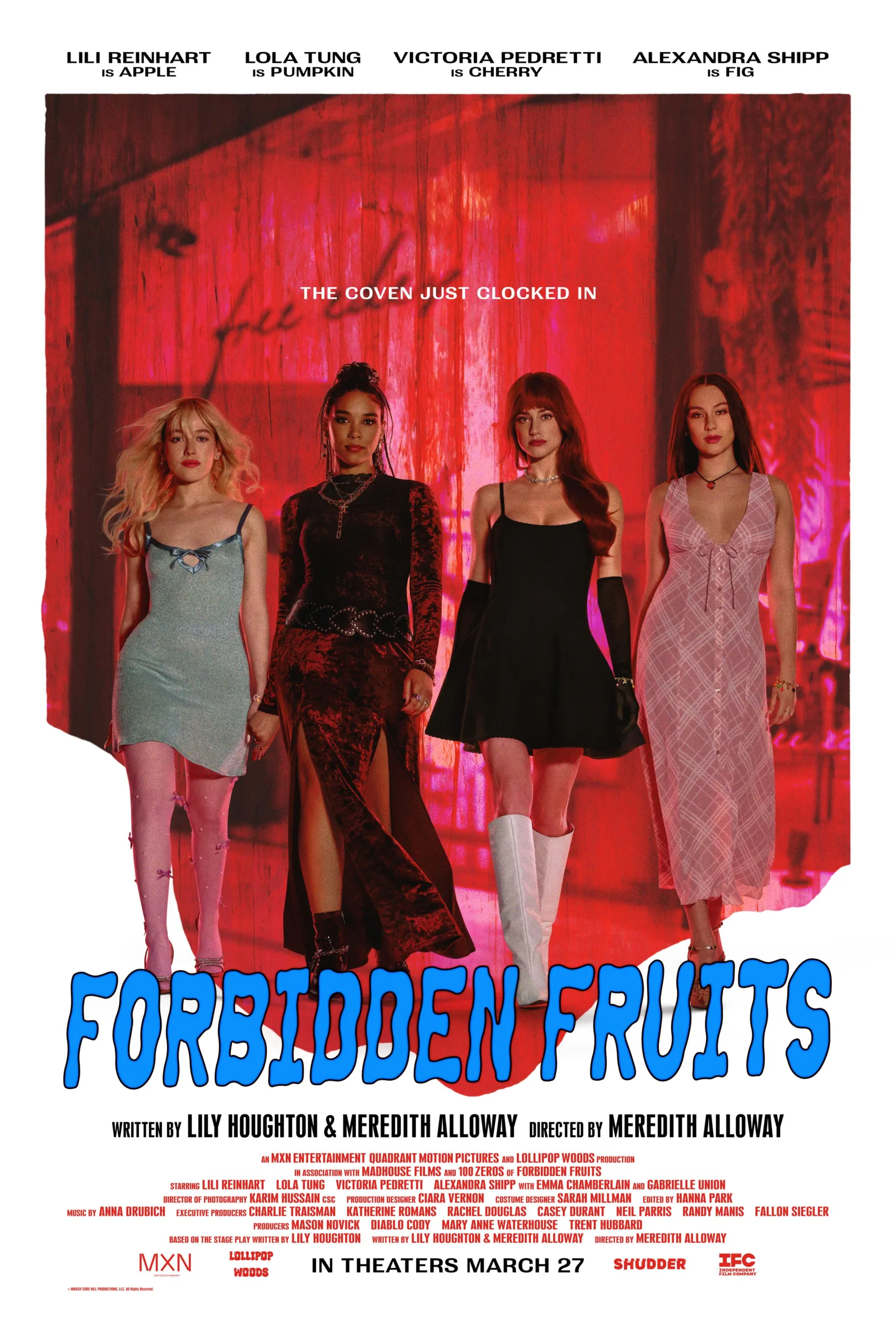
When your film takes place in a store called Free Eden, where its central characters are named only by fruit and they play witches, you’d be hard pressed to find any subtext here, even at a discounted rate. But this maximalist canvas allows for the film’s larger provocations around kinship to take center stage. Free Eden is situated in a Dallas mall, and the aforementioned Apple works there with Fig (Alexandra Shipp) and Cherry (Victoria Pedretti). They’ve sharpened their personalities (and their customers’ insecurities) to yield high profits for the company, frequently convincing patrons to buy any number of high-end pieces.
After a chance encounter between Fig and a new girl named Pumpkin (Lola Tung), the latter quickly becomes the fourth member of the group. The girls follow a strict routine, down to when they can have sex to what type of food they can eat, but Pumpkin begins to suspect there is something supernatural at play as she descends into the machinations of this coven. Her suspicions are confirmed when the Fruits reveal themselves to be a coven whose activities coalesce into gathering elements into a cauldron and cursing those afflicting them.
A whole other piece can be written about Costume Designer Sarah Millman’s effervescent wardrobe work here. She dresses the fruits in all sorts of outfits, equal parts sultry, prismatic, and commanding. The clothing often feels like a living organism, the hues and textures reacting in real time to the emotions of the bodies wearing them. It’s one of the many flourishes that make “Forbidden Fruits” punch above its weight in terms of the scale of the story; it may rarely leave the confines of the mall and its parking lot, but there’s a divine, cosmic heft to this story amplified through this feature.
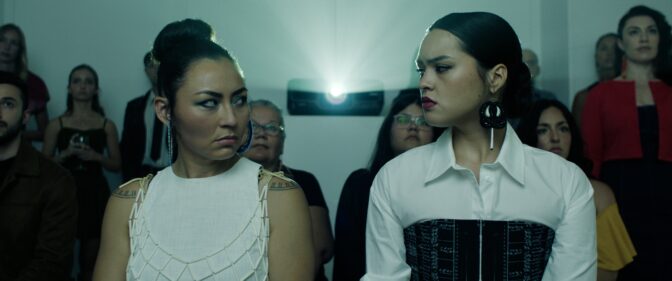
There’s a lot under the hood of “Forbidden Fruits” to justify its descent into the glitz and the gore. As Pumpkin ingratiates herself into this new world, she finds herself torn between the prospect of community and the urge to question the sisterhood’s imperfections. With deep relationships comes the potential for exploitation, and Pumpkin’s mix of hopefulness and inquiry into the interpersonal dynamics at play–the way Satan brought the seed of doubt to Eve (you get the idea)–is the disruption that catalyzes the film’s spiral into grisly delights. Tung plays Pumpkin with a conniving glee; Pumpkin knows she can’t directly challenge Apple’s authority, so she has to find subtle manifestations for her strength. “My job doesn’t define me. My hotness and my personality do,” she says at one point, and you can practically feel her volley that venom at the queenpin herself.
Reinhart has a similarly devilish joy when she leans into Apple’s draconian and sardonic bits (“I know yesterday was wack but it’s really not my fault because I Googled it and Mercury was in retrograde,” she says, deadpan) and while she’s the obvious villain in that she’s the one subjugating the others to the rules, she’s not an easy target. Within the walls of Free Eden, she’s crafted a world whose terms of engagement and safety are dictated by women with agency and power over who gets access to them. This is a space that had to be created in reaction to a misogynistic world out there that’s far too ready to turn girls into prey and exploit them. Yet at the same time, there’s an element where she’s transferred over the world’s manipulation and malice. As delightful as Reinhart is when she’s at maximum vixen, when Houghton and Alloway’s script lets her dip into lurking rage, it unlocks new levels of pathos. There’s a unique animosity when you realize that the paradise you’ve spent your life building gets torn asunder, and if Apple is to be banished, she won’t go out without a fight.
The whole cast is immaculate, each refusing to be distilled to their most basic qualities, and they often find nuance within their archetypes. Pedretti imbues Cherry with an effervescence that barely hides the trauma and hurt she feels, not just from her family life, but also from being punched down by Apple. She is the source of the film’s biggest laughs. Shipp is of the most kindred spirit with Pumpkin: She’s indoctrinated but not uncritical, and her alliance with Pumpkin gives the film some propulsive narrative tension, especially as Cherry and Apple grow closer together.
From “Dawn of the Dead” to “Paul Blart: Mall Cop,” malls in American cinema have acted as epicenters of artifice, excess, and community. “Forbidden Fruits” is another part of this canon: It’s both a creation narrative and a story of paradise lost, how the worlds we construct to save ourselves can be both well-intentioned and perpetuate the same harms we were hoping to escape from. It captures so well the insanity of the contradictions we–particularly women–have to live into daily. By the end of the film, nearly all the characters will have released a cathartic scream. It might just invite you to do the same.
This review was filed from the world premiere at the SXSW Film Festival. It opens on March 27, 2026.