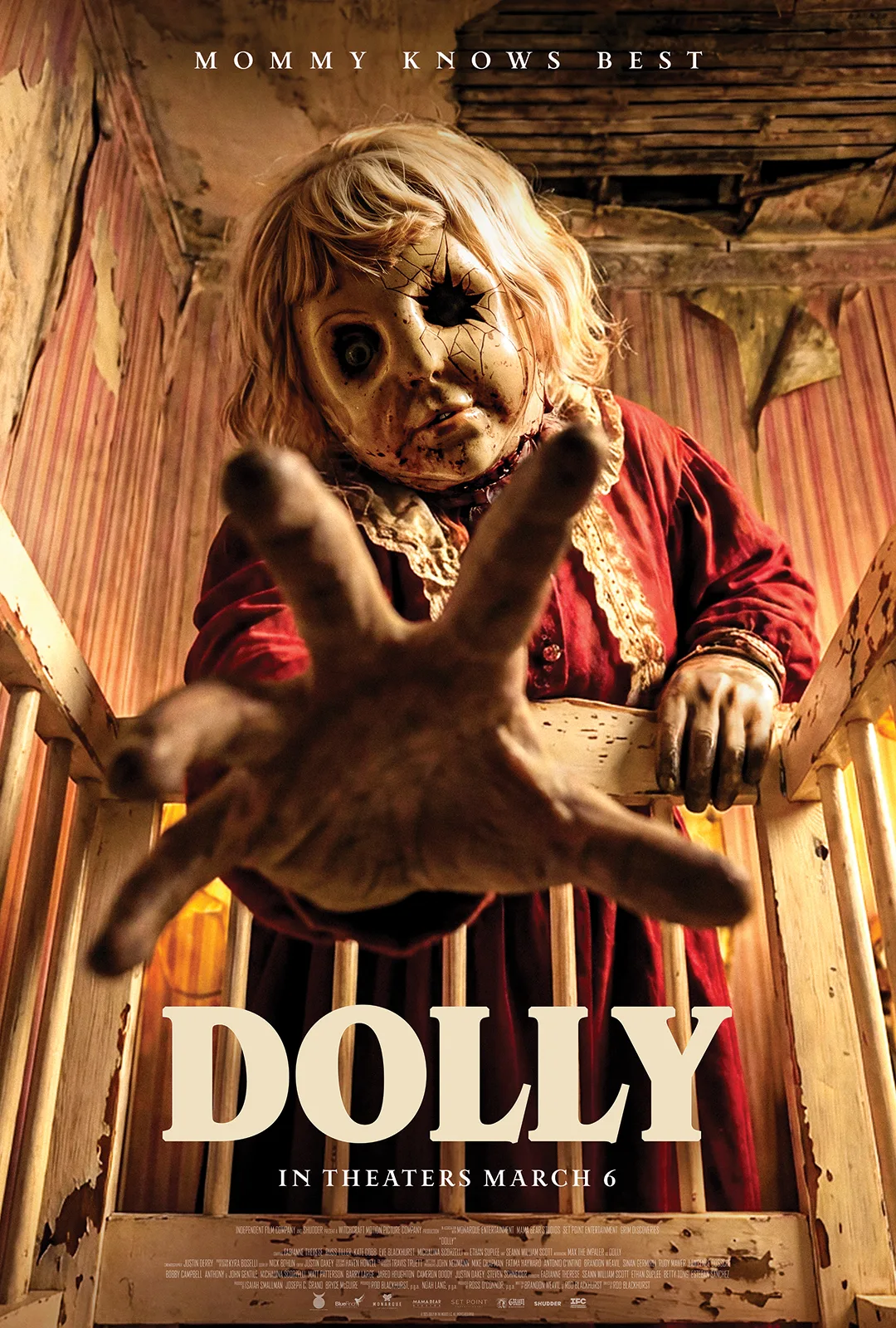
“Dolly” feels like a trap. As the slasher subgenre grows increasingly abstract and dependent on high-concept gimmicks, it’s easy to fall into the old-man-in-a-rocking-chair rhetoric of going back to basics. “Horror movies used to be mean and nasty—none of this slick meta nonsense,” the disillusioned fan might sniff. And, to be fair, Rod Blackhurst’s quick-and-dirty ‘70s tribute does have its mean and nasty moments. The trap is that those moments, while satisfying, are not enough to carry the film. But they do make the person pointing that out into a real buzzkill.
“Dolly” sets viewers up for an experience that it can’t quite deliver, mostly due to small acts of self-sabotage. The film is shot on 16mm for a tactile, grainy grindhouse look, for example, but then Blackhurst ruins the illusion with drone shots that would not have been possible in a vintage exploitation film. Then there’s the violence, which begins with a shocking and graphic act of mutilation, then breaks down into a series of diminishing returns.
The latter issue is especially disappointing, considering that Blackhurst’s primary inspiration (that’s the polite word for it) is “The Texas Chain Saw Massacre.” Where Hooper’s film overdelivers in terms of impact—“Texas Chain Saw” is less bloody than its reputation would suggest—Backhurst’s starts strong, as Seann William Scott gets his jaw split in two by a very sharp shovel wielded by an unnaturally strong killer. He really should be dead, but somehow survives, making extensive use of a flappy prosthetic that hangs from Scott’s face as he crawls through the woods by his fingernails.
It’s a gnarly effect, but whether for budgetary reasons or a lack of focus on the director’s part, everything that follows is a letdown. Even at 82 minutes, “Dolly” struggles to fill time, relying on its main character to make a series of increasingly foolish and unrealistic decisions to keep the plot going. Macy (Fabianne Therese) seems like a reasonably intelligent person in the first act, but by the end of the second, she’s stopping mid-flight to turn around and yell “fuckkkk youuuuuuuu” at the film’s Leatherface-esque slasher, presumably to give the lumbering old gal time to catch up.
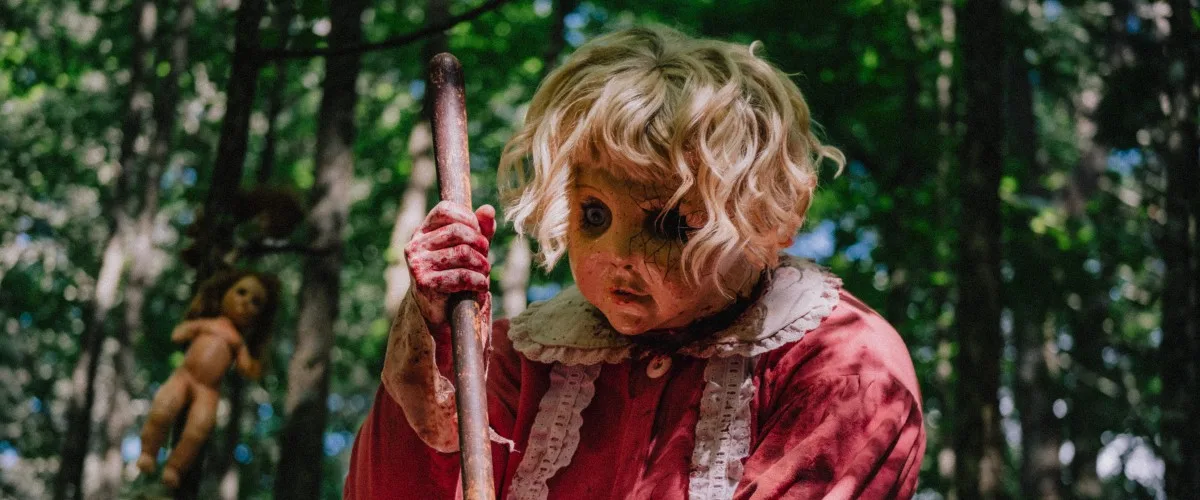
Macy’s actions dissipate the film’s tension, leading to a supposedly cathartic denouement that’s notable mostly for how blatantly it copies its inspiration. “Dolly” borrows extensively from the structure of “Texas Chain Saw,” beginning with the protagonists leaving civilization — in this case, walking into the woods, where Chase (Scott) plans to propose to Macy — before forcibly entering a claustrophobic nightmare world. (This one is decorated with creepy dolls instead of butcher-shop scraps, but the effect is the same.) A sign posted along their path reads “Hooper Mine,” in case you didn’t get the reference, although Macy jumping out of a second-story window and breaking down at the story’s end both make the point.
Blackhurst telegraphs his themes more clearly than Hooper ever did, setting up a contrast between Macy—independent, conventionally attractive, reluctant to settle down—and the titular villain, played by pro wrestler Max the Impaler. Where Macy isn’t sure if she even wants a family, Dolly longs for one, going so far as to steal the engagement ring Chase was going to give to Macy before he was split like a can opener. When it’s not fetishizing them, “Dolly” shows disgust for the trappings of femininity, and which is which depends largely on who’s deploying them. The unspoken part of all this is that Macy is slim and pretty and Dolly is fat and ugly, implying that this creature’s desire for marriage and motherhood is part of her monstrous nature.
And yes, Dolly is a homicidal (and presumably inbred) mutant raised by deviants in a crumbling Victorian home in the middle of nowhere. Yes, she wears a mask modeled after a porcelain doll, and the shot where Macy shatters it to expose Dolly’s filthy, twisted face is pretty cool. And yes, this is all just as, if not more, relevant than the character’s body size, which is probably not much deeper than an attempt to emulate the late Gunnar Hansen. But, like “it’s supposed to be bad,” “it’s not that deep” can be a defense designed to shut down criticism.
Although it’s not as smug, in this way “Dolly” recalls 2024’s “Strange Darling,” another film so focused on creating a stylish pastiche that it fails to notice that the director is spewing his subconscious attitudes about women all over the screen. It’s not just poor, grotesque Dolly, either: Although they’re framed as horror, the squirming disgust that comes from the film’s belt spanking and diaper-changing scenes largely comes from how sexualized they are. “Dolly” is quite repellant, which in this case can be read as a compliment; it is what Blackhurst was going for, after all. Scratch the surface, however, and it’s less flattering, one predictable element among many in this utterly predictable film.