
In case it is not entirely clear that this documentary is an unapologetic love letter to the woman who successfully sued Donald Trump twice, a statement appears before the final credits stating that the film is “inspired by the writing and fabulous life of E. Jean Carroll.” There is a great deal of interest in the story of a woman who played an important role in the 1970s explosion of “new journalism,” jettisoning the more decorous, aspirational “objective,” just-the-facts rules of reportage for a more provocative, personal, subjective form of storytelling. “You swirl the events around yourself and write about how you reacted.”
But the movie never questions some of Carroll’s choices or the significance of her contribution as a journalist and a lesser pre-lawsuit public figure. This is most jarring in the selection of songs on the soundtrack, which have a “you go, girl” vibe, better suited for a rom-com than a documentary about a woman suing the then-former President of the United States for sexual assault and defamation.
Possibly, filmmaker Ivy Meeropol has a special understanding of people who are villainized in the media and despised by a large portion of the population. Her grandparents were Julius and Ethel Rosenberg, executed for conspiracy to commit espionage at the height of the Red Scare era in 1953. This may explain the sympathy she has for Carroll and the admiration she has for her refusal to back down.
As the movie opens, we see Carroll arriving at the courthouse for the first of her lawsuits. The sidewalk is crowded with photographers, and her lawyer may be making a larger point by asking, “Hey, guys, can you make room for her, please?” She tells us why she sued Trump: “Because he called me a liar and I couldn’t let it stand.” In 2019, Carroll published the story of how, in the 1990s, Trump led her into a department store dressing room, shoved her so hard her head slammed against the wall, pulled down her tights, and raped her. Trump denied the story and, as “proof,” said he was not attracted to her.
After it happened, she told only her two closest friends, writer Lisa Birnbach and television news anchor Carol Martin, and she made them promise never to tell anyone. She never filed a complaint. We see archival clips from her television appearances. including one where she commented on allegations of sexual abuse by powerful Washington figures. Anita Hill testified about Justice Clarence Thomas’ inappropriate conduct, including very crude sexual comments, and Paula Jones sued President Bill Clinton for sexual harassment. Carroll called them “wimps.” Later, she says that the sexual abuse complaints about Harvey Weinstein were a “watershed moment” for her in recognizing the importance of holding abusers accountable.
The film touches on but does not explore Carroll’s conflicted feelings about the importance telling women how precious they are (which she says is the one thing she wants them to understand) and to stand up for themselves with her own decision to do nothing about being assaulted and thus allow a predator to continue to harm other women.
There are really two stories here, and the film would have more heft if it examined each one and its connection. The first is Carroll’s past, and the archival footage is thoughtfully selected and intriguing. We see her in her cheerleader uniform as a contestant on the game show “To Tell the Truth” during her reign as Miss Cheerleader USA, one of the film’s highlights. Carroll is influenced by “gonzo” journalist Hunter S. Thompson, who believed “the world was something to have fun with.” She was a woman writing for men’s magazines like Outside, Esquire, and Playboy, relishing the challenge to get her “eccentric personality on paper.” When Elle magazine offered her a job as an advice columnist, she found what she thought was her calling. Roger Ailes gave her a daily live television show, with an 800 number for people to phone in and ask her for advice.
Perhaps her greatest moment of self-awareness is when she says she remained a cheerleader by supporting the women who brought her their troubles. A cheerleader is there for entertainment and encouragement, but does not create the strategy or score the goals.
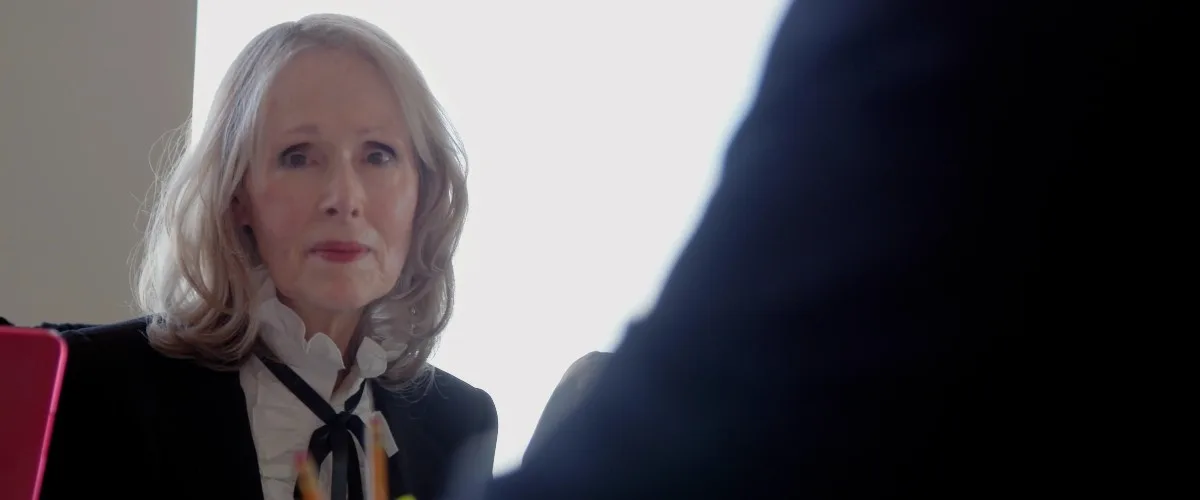
The other story is the lawsuits, the first one for sexual assault and defamation, where she was awarded $5 million, and the second, eight months later, for the defamatory comments Trump made after the first verdict, where the jury awarded her $83 million. She has pledged to use that money to support women, but for now, those payments are on hold pending appeals. There is extended footage from her depositions, mostly of interest to show the excruciating questions from the defendant’s lawyer that a plaintiff has to answer.
Most striking is the impact of the horrific messages she received after the first trial. The depositions are less than a year apart, but she looks ten years older. The conflict she feels between being a self-described member of the “chin up, move on, grin and bear it generation” and being a committed believer that no one should give anyone else the power to make you a victim is another element presented but not explored. Instead of assessing, it observes and assumes the audience is as enraptured with the subject’s insouciance as the filmmakers are.