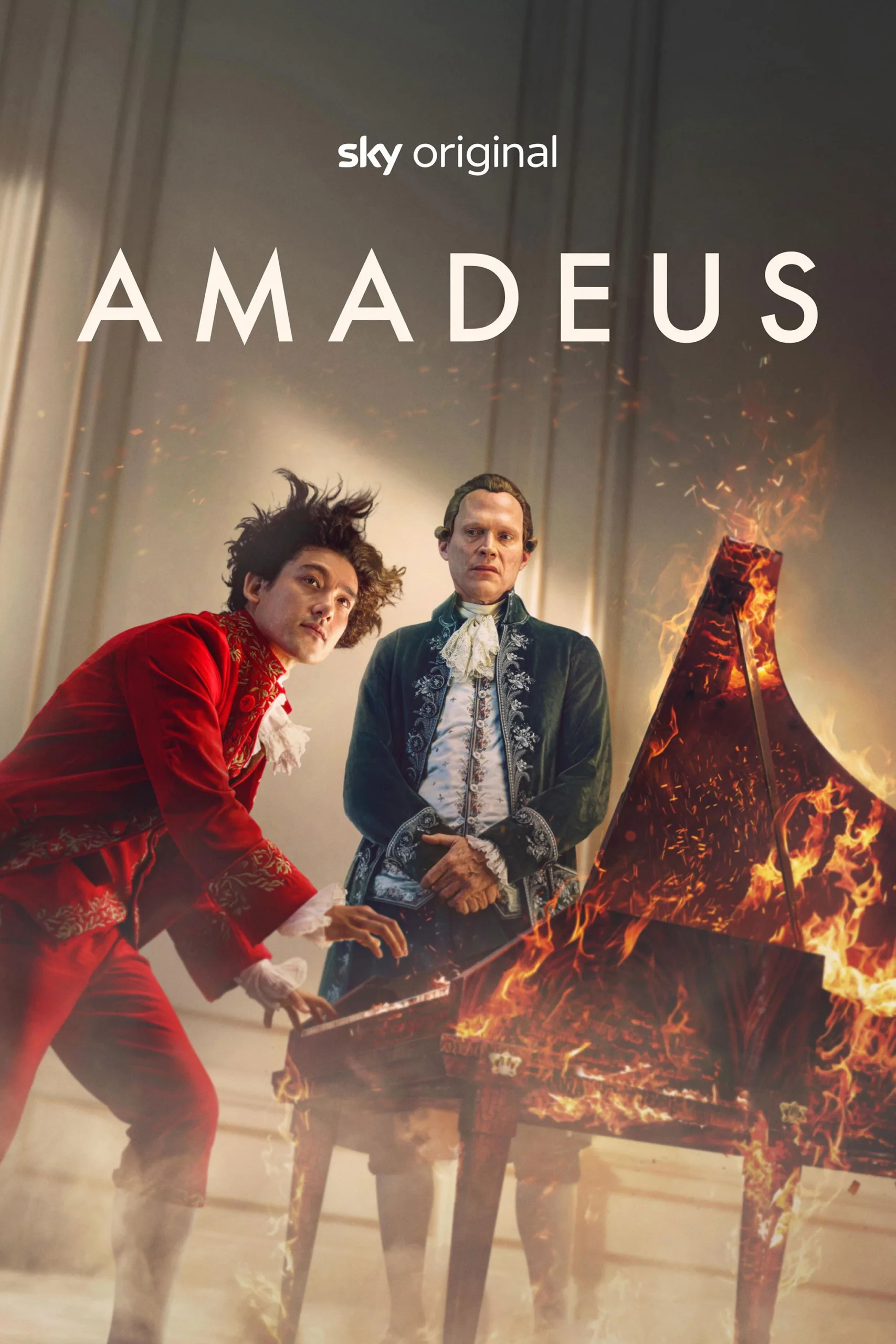


The first scene of Starz’s new adaptation of “Amadeus” begins exactly how the series ends: in a dark room with a confession whispered so quietly that it may not be meant for the ears of the inhabitants of the screen, but solely for the audience to hear. The beginning of the series sets in motion the resulting effects of the twisted relationship between two rival composers, each of whom, over the course of the show, succumbs to their vices in the privacy of their startlingly empty lives.
This preoccupation with darkness that the show prepares us for in its opening minutes, when a room is lit only by a smattering of candles, has nearly disappeared by the time the series’ protagonists show up. Yet, as the series unfolds, it once again comes into view, before nearly smothering out any light and joy that was once present in the lives of both Antonio Salieri (Paul Bettany) and Wolfgang Mozart (Will Sharpe).
Although it may sound dour, the immediate gloom and doom allow the series to stand out amongst its peers. Biopics continue to ravage theaters each year, and “based on a true story” seems to be its own genre rather than just a tagline. Instead of rehashing moments we all know, writer/creator Joe Barton (“Giri/Haji,” “Black Doves“) peels back the fanfare of the tale it’s based on, exposing the raw underbelly of its famous characters.
We see this rawness as soon as we meet Salieri, whose struggle to compose new work intensifies around his friend, Emperor Joseph (Rory Kinnear), who has a penchant for revisiting Salieri’s older, more respected works. Salieri is a man out of time, stuck in a festering limbo due to his own cowardice and desire to please the rich men around him.
The tightly wound facade he puts falls apart in the presence of Mozart, who bursts onto our screens from inside a moving carriage before vomiting onto the city streets. While he’s sharp-tongued and ill-mannered in a way that deters many of his wealthy contemporaries, a character describes the composer as being “guided by something greater than himself.” Like many, Salieri seems as repulsed by Mozart’s flair for the dramatic as he is fascinated by him, and when Mozart asks for a meeting with the Emperor, Salieri begrudgingly agrees. From there, the relationship between the two composers is a cat-and-mouse game, in which one character seeks to destroy the other, while the other seemingly lies in wait for their own demise.
Initially, “Amadeus” appears to be a straightforward story about two great musicians who lead each other to their demise. But by the second hour of its five-hour runtime, the series has already transformed into an indescribable and haunting saga unlike the one we were introduced to. Here is where the seediness begins to creep in, with Salieri’s wickedness bleeding out into the forefront, and Mozart’s psyche unraveling with each passing month he spends in Vienna.
Despite this, everything seems to come easy to Mozart; ideas come on the fly, things go his way when they shouldn’t, and he somehow ends up in the good graces of the Emperor despite writing an audacious opera about a harem. Meanwhile, Salieri prays to God to use him as a vessel for his work, unable to find inspiration in his own life, and desperate to use religion as a means to cover up just how miserable he is, and how comfortable he is forcing this misery onto his greatest rival.
With the shadows of the night cascading upon their faces, both Bettany and Sharpe wield these characters so tightly that they often disappear beneath their snarls and drunken stupors. Sharpe, in particular, delivers a performance that is impossible to look away from, harnessing a despondent yet feverish gaze in his eyes in every scene he’s in, as if inhabiting this larger-than-life character is an act that carries so much weight that his knees threaten to buckle beneath him. If the tale that unwinds here wasn’t entertaining enough, watching both of these actors circle each other over a decade imbued with toxicity would be a treat in itself.
What unfolds within Starz’ latest series isn’t necessarily a story about the hatred that festered between two warring contemporaries. Rather, it’s a tale about how the desperation of two men ignites a fire that, once it begins, threatens to burn down the foundations of each of their lives. Part ghost story and part retelling of Peter Shaffer’s 1979 play, the series is a perfect example of how modern adaptations should be done.
Instead of rehashing sequences or rumored events audiences already know, “Amadeus” allows these characters to fester under a fresh lens until they become a newer, often inexplicable beast. It’s a beast that doesn’t threaten the sanctity of the work from which it’s adapted, but one that cannibalizes itself instead, leaving in its wake a bolder, rawer creation.
All episodes were screened for review.