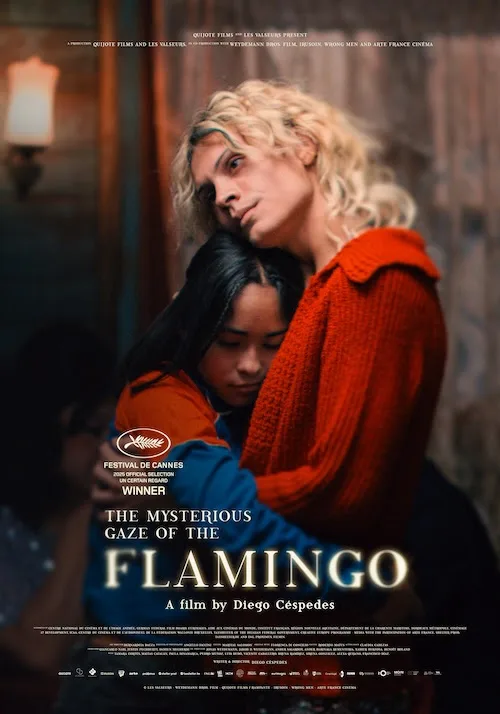
As the saying goes, love is blind. But what Chilean filmmaker Diego Céspedes presupposes with his debut feature, “The Mysterious Gaze of the Flamingo,” is that love transmits itself through the gaze—not just looking, but seeing the ones we desire, even as that desire threatens to end us. Perception is our greatest source of connection, but it’s also the thing that can get us killed; if you’re queer or trans, that’s doubly true, given that those you desire could turn around and hurt you for loving them.
This simple idea blossoms into a broader folk fable in “Flamingo,” set in a remote mining town in North Chile in the early 1980s. Here, the ramshackle group of miners, toiling away in the desert sands, have but one source of entertainment: The cabaret home of Mama Boa (Paula Dinamarca), one of a group of so-called “transvestites” (the term at the time; none explicitly identify as trans, though they use female pronouns) who dance, lip sync, and perform for this group of lonely men. But that relationship exists on a very thin line between desire and violence, as these chasers sublimate their queer attraction through the insistence that these women carry a deadly “plague,” one transmitted through a longing, direct gaze between lovers. (The AIDS parallels are hardly subtle, particularly as the film spells it out near its end, a move that feels disappointingly literal given the magical realism on display here.)
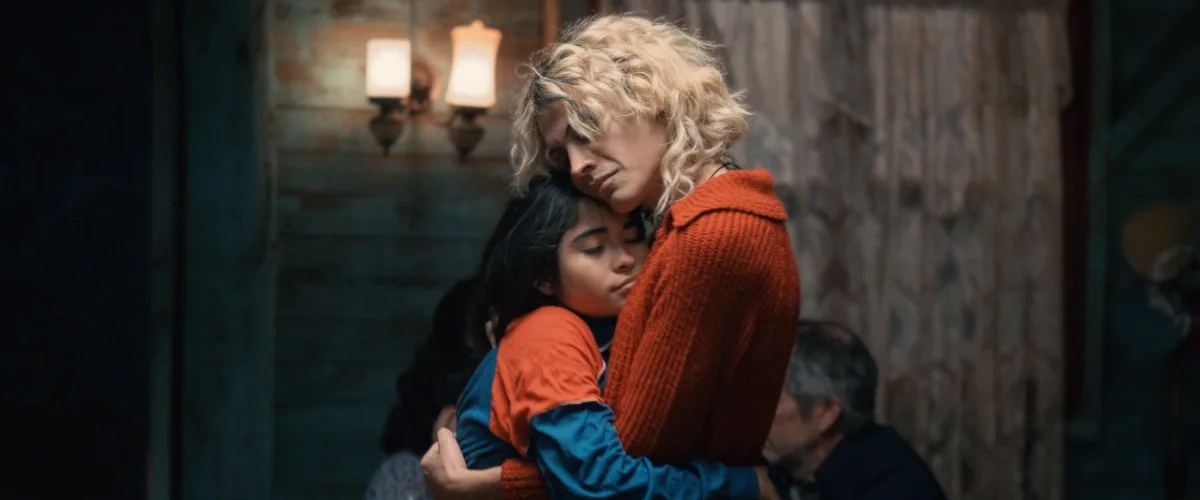
At the story’s heart is Lidia (Tamara Cortés), an eleven-year-old girl on the cusp of adolescence, raised by these queer women in a fierce, loving, but consistently imperiled household. Her adoptive mother, and the star of Mama Boa’s show, is Flamingo (Matías Catalán, delicate and captivating), who must fend off both her progressing illness and the advances of the miners and her former lover, Yovani (Pedro Muñoz), who arrives one day with a gun, begging her to take the illness out of him. What happens next sets Lidia on a path of self-discovery as she struggles to discern truth from myth about the plague. It’s the kind of showdown fitting for the Western inflections Céspedes employs in this tale of love in the wilderness: Angello Faccini’s lush, closed-in 4:3 cinematography evokes the vast vistas of John Ford and the intimate social dynamics of Howard Hawks.
But nestled deep within this tale of social malaise is an intense, abiding love that can be found in queer community, even as it attempts to negotiate an uneasy truce with the straight world. One of its greatest strengths is the way it holds on to the casual rituals and effervescence of a found queer family thriving; Lidia, being around them, learns resilience and experiences care in ways that are both charming and heartbreaking to witness. Boa, Flamingo, and the others hover around her like supportive hens. “Flamingos,” in its tight-knit social dynamics, captures the fetishization and exoticization of queer people and the violence it enacts on queer and trans bodies; scenes of lovemaking shift elegantly into murder attempts, and back to tenderness. The desert expanses only make our characters feel more isolated, huddling in cramped homes for safety and solace.
Granted, such folk elements can wreak havoc on the cohesiveness of a picture like this; its meandering, dreamlike structure can sometimes feel like it’s stretching a simple premise to feature length. It can get more than a little repetitive, as Céspedes’s ideas struggle to find new angles for exploration as Lidia continues to grow. Then again, this haziness also allows us to swim in the folkloric spirit of the film’s inhabitants, witnessing a slice of the everyday push-and-pull between desire and violence these characters experience. There’s riveting imagery here, particularly when Faccini and Céspedes allow glimpses of the surreal to invade the domestic realism of the proceedings—fantastical flashbacks to forbidden queer love turn the simple act of intimacy into a dangerously freeing ritual.
“The Mysterious Gaze of the Flamingo” feels like a promising start for the Chilean director, especially since it won Un Certain Regard at this year’s Cannes. (It’s also, pointedly, part of a crop of “Unreleased Gems” Letterboxd is trotting out for its inaugural bid at the video rental business.) But at its heart, it’s an assured tale of queer resistance, blended with the supernatural rhythms of the folktale, and it feels suitably transgressive for its gender-nonconforming characters. It’s sweet, and affirming, and hopefully opens a few people’s eyes (and hearts).