

Features
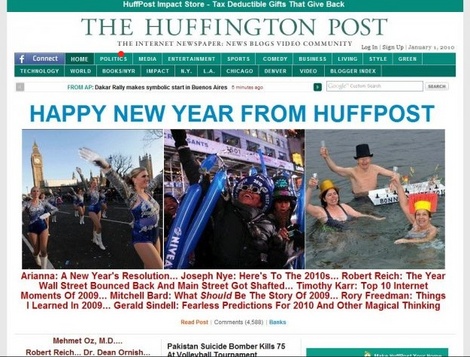


Say, fellows! Try these tips on dating!
var a2a_config = a2a_config || {};
a2a_config.linkname = “Roger Ebert’s Journal”;
a2a_config.linkurl = “http://blogs.suntimes.com/ebert/”;
a2a_config.num_services = 8;
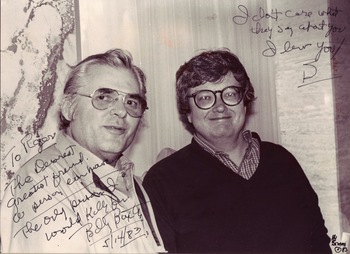
Who is Billy “Silver Dollar” Baxter?
One of the chapters in my memoir is devoted to Billy Baxter, a friend of a lifetime. Some readers think the story is too good to be true. Not so. Billy is a great original. A performance artist. His son Jack, a filmmaker, made this video which honors the legend. Billy is still thriving not far from Broadway (“his umbilical,” I called the street) and when he recently got a pacemaker every doctor and nurse in the hospital got a silver dollar.
The financial crisis explained (nsfw)
Some 200 of my TwitterPages are linked at the right.
var a2a_config = a2a_config || {};
a2a_config.linkname = “Roger Ebert’s Journal”;
a2a_config.linkurl = “http://blogs.suntimes.com/ebert/”;
a2a_config.num_services = 8;
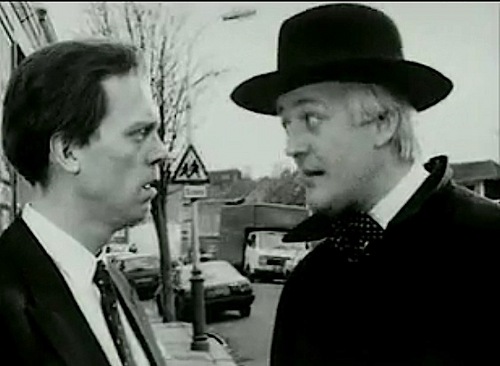
Hugh Laurie as Rupert Murdoch, Stephen Fry as Clarence the Angel
var a2a_config = a2a_config || {};
a2a_config.linkname = “Roger Ebert’s Journal”;
a2a_config.linkurl = “http://blogs.suntimes.com/ebert/”;
a2a_config.num_services = 8;
I could watch a Fellini film on the radio
Nino Rota by Fellini
It was the middle of the night in Artena, Italy, a small hill village outside of Rome. Franco Zeffirelli was preparing to shoot the balcony scene of his “Romeo and Juliet.” In the gardens below an old stone wall of the Palazzo Borghese, carpenters were hammering on a platform that would the camera to film Romeo’s climb to Juliet’s balcony. Prop men scurried up and down Romeo’s path, planting strategic flowers and picturesque shrubs.
A small, bald man came threading through the trees. It was Nino Rota, Zeffirelli’s composer. “I thought I’d find you here,” he said. “I want you to listen to this.” He began humming a tune.
I had been talking with Zeffirelli, and now I followed them, forgotten, as Rota hummed and the two men walked and swayed in time with the music. There was a full moon. I said to myself I would never forget that night, and you see I haven’t.
I believe Nina Rota was the greatest composer in the history of the movies. Who else wrote scores in the 1950s and 1960s that are in print and selling well today? I have seven of them on iTunes. It is impossible to remember a film by Fellini without recalling the score.
Recently, in a review of “Nine,” the musical inspired by “Fellini’s “8 1/2,” I noted one of its problems: It was less memorably musical than the original film. Then this sentence came from my fingers: I could watch a Fellini film on the radio.
Play these clips with your eyes closed:
amarcord
la dolce vita
casanova

Preview some commercials for Superbowl 2013
Give this page a little time to load.
• Mercedes-Benz Superdome in New Orleans, Louisiana, on February 3, 2013 at 6:30 EST.
• Price tag: $3.5 million for 30 seconds; $5 million for placement before kickoff.
• A detailed article by Gayle Falkenthal in the Washington Times.


The Ebert Club Christmas 2011: public edition
This is a free edited sample of the Christmas Newsletter.
For Roger’s invitation to the Club, go here.
From the Grand Poobah and Mrs. Poobah:
Seasons Greetings Everyone!
Idiot with an iPhone
First there was the silent classic Man With a Movie Camera. Then Jamie Stuart made Idiot with a Tripod, a video about the great New York blizzard that went viral. Then Kevin B. Lee and Steven Boone created the video essay about the “City Symphony” Films. It was only a matter of time until someone made “Idiot With an iPhone.” The approach remains the same: Carefully composed shots build up to a mosaic of moments from life, accompanied by music.
Idiot with an iPhone from pawl made this, inc on Vimeo.
var a2a_config = a2a_config || {};
a2a_config.linkname = “Roger Ebert’s Journal”;
a2a_config.linkurl = “http://blogs.suntimes.com/ebert/”;
a2a_config.num_services = 8;

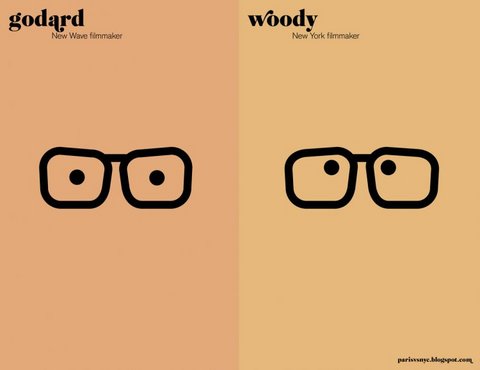
Woody Allen meets Jean-Luc Godard
An excerpt from my forthcoming memoir, Life Itself:
Woody Allen thought of Bergman as a genius. He told me the American cinema had produced only one genius, Orson Welles. “Godard is supposed to be a genius,” he told me dubiously one day. I told him I had witnessed the table napkin at Cannes upon which the producer Menachem Golan wrote out a contract with Godard, misspelling Godard’s name while promising him a script by Norman Mailer, and a cast including Orson Welles as Lear and Woody Allen as the Fool.
“Norman Mailer wrote the screenplay?” Allen asked. “Well, there was no screenplay at all the day Godard shot me. I worked for half a day. I completely put myself into his hands. He shot over in the Brill Building, working very sparsely, just Godard and a cameraman, and he asked me to do foolish things, which I did because it was Godard. It was one of the most foolish experiences I’ve ever had. I’d be amazed if I was anything but consummately insipid.
“He was very elusive about the subject of the film. First he said it was going to be about a Lear jet that crashes on an island. Then he said he wanted to interview everyone who had done King Lear, from Kurosawa to the Royal Shakespeare. Then he said I could say whatever I wanted to say. He plays the French intellectual very well, with the 5 o’clock shadow and a certain vagueness. Meanwhile, when I got there for the shoot, he was wearing pajamas–tops and bottoms–and a bathrobe and slippers, and smoking a big cigar. I had the uncanny feeling that I was being directed by Rufus T. Firefly.
Here is the complete film:
Watch King Lear (1987, Jean-Luc Godard) in Culture | View More Free Videos Online at Veoh.com
var a2a_config = a2a_config || {};
a2a_config.linkname = “Roger Ebert’s Journal”;
a2a_config.linkurl = “http://blogs.suntimes.com/ebert/”;
a2a_config.num_services = 8;

Jason Reitman in conversation
Jason Reitman is not only a gifted director, but a forthright and thoughtful one. After three features (“Thank You for Smoking,” “Juno” and “Up in the Air”), he has achieved, at the age of 34, firm standing on the A List.
He visited Chicago on Jan. 29 to appear on the Oprah program, and stopped off at my house on his way to the airport. Having only just discovered the video capability of a new camera, I took these videos. They are hand-held, shaky and need editing. But what Reitman says is perceptive and worth sharing.
Also in the room: My wife Chaz, off camera to the left. Reitman’s wife, the actress Michelle Lee, to his right. Chicago publicist Janet Hillebrand on the sofa in front of the windows. The voice on my MacBook is sometimes heard.
The sculpture is “Warrior Woman,” which Chaz and found in a London gallery that holds an exhibition called “Not in the Spring Exhibition,” for works not accepted in the annual show of new works by the Royal Academy of Arts. In other words, Refuseniks. Jason and Michelle are standing in front of an abstract by the British expressionist Gillian Ayres. RE
•
•
•
•
•
•
•
•
•
•
•
•
•
•
•
if (WIDGETBOX) WIDGETBOX.renderWidget(‘502fed1c-392e-46ca-9f0e-ade724d131dc’);
Get the rogerebert.com :: Movie reviews, widget and many other great free widgets at Widgetbox! Not seeing a widget? (More info)
•
36 Hitchcock death scenes all at once
“Ultraculture” certainly devoted a lot of time and love to this. The challenge is to identify each film. I did pretty well. More than 25, anyway. It’s a demonstration of how vivid Hitchcock’s images are.
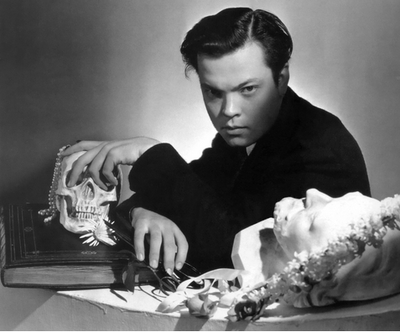
Orson Welles young, old, drunk, sober, and plenty pissed off about frozen peas
Booked into the Auditorium Theater in Chicago in the 1930s, Orson Welles was confronted by a snowstorm of historic proportions. Most of his audience couldn’t make it to the theater.
“Good evening, ladies and gentlemen,” he said. “My name is Orson Welles. I am an actor. I am a writer. I am a producer. I am a director. I am a magician. I appear onstage and on the radio. Why are there so many of me and so few of you?”
How to get a guy to notice you during sex (nsfw)
How To Get A Guy To Notice You While You’re Having Sex With Him
var a2a_config = a2a_config || {};
a2a_config.linkname = “Roger Ebert’s Journal”;
a2a_config.linkurl = “http://blogs.suntimes.com/ebert/”;
a2a_config.num_services = 8;
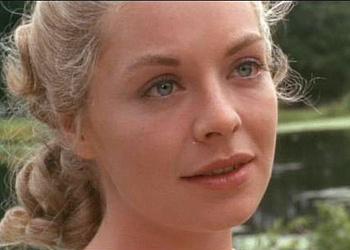
Susannah York, 1939-2011
By Roger Ebert
Susannah York, the British actress who could plunge deep into drama and then skip playfully in comedies, died Saturday of bone marrow cancer. She was 72.
Raised in Scotland, a graduate of the Royal Academy of Dramatic Arts, she was 20 when she made her first important film, the classic “Tunes of Glory” with Alec Guinness.
She was to become an icon of 1960s British films in such titles as “Kaleidoscope,” “A Man for All Seasons,” “The Killing of Sister George,” “Oh! What a Lovely War” and “The Battle of Britain.” She memorably played a patient in John Huston’s “Freud” (1962), starring Montgomery Clift. But it was as a newlywed struggling to win a marathon dance prize in the American film “They Shoot Horses, Don’t They” (1969) that she won an Academy Award nomination.
In 1972 she won the best actress award at the Cannes Film Festival as a schizophrenic housewife in Robert Altman’s “Images.” Altman fulminated for the rest of his life that York and the film never received the respect they deserved.
York starred in films as recently as 2009, and did a great deal of London stage work and television. One success was Piers Haggard’s “A Summer Story” (1988), adapted from the John Galsworthy story. Petite and lively all her life, her hair often in a pixie cut, she was a popular guest on British chat and game shows.
Married in 1960 to the actor Michael Wells, she had two children, Sasha and the actor Orlando Woods, before their divorce in 1973. She and her children had close-by homes near Clapham Common in South London, and Orlando told the Guardian: “She loved nothing more than cooking a good Sunday roast and sitting around a fire of a winter’s evening. In some senses, she was quite a home girl. Both Sasha and I feel incredibly lucky to have her as a mother.”
In private life she was a political activist, active in the Campaign for Nuclear Disarmament. She is survived by her children and two grandchildren.
Tom Jones (1964) Directed by Tony Richardson.
Saul Alinsky pours for the Tea Party
I had heard a great deal about Saul Alinsky’s book Rules for Radicals, but had never read them. The Right has demonized Alinsky, linking him to Obama. Curious to know more, I went to Wikipedia and found the Rules themselves.
As I read them, it occurred to me that these Rules are strategic, not ideological. Alinsky was of the Left, but the Rules have no party.
As I look around America in 2010, it occurs to me that the group currently using these Rules most effectively is the Tea Party.
From Wikipedia:
* Rule 1: Power is not only what you have, but what an opponent thinks you have. If your organization is small, hide your numbers in the dark and raise a din that will make everyone think you have many more people than you do.
* Rule 2: Never go outside the experience of your people. The result is confusion, fear, and retreat.
* Rule 3: Whenever possible, go outside the experience of an opponent. Here you want to cause confusion, fear, and retreat.
* Rule 4: Make opponents live up to their own book of rules. “You can kill them with this, for they can no more obey their own rules than the Christian church can live up to Christianity.”
* Rule 5: Ridicule is man’s most potent weapon. It’s hard to counterattack ridicule, and it infuriates the opposition, which then reacts to your advantage.
* Rule 6: A good tactic is one your people enjoy. “If your people aren’t having a ball doing it, there is something very wrong with the tactic.”
* Rule 7: A tactic that drags on for too long becomes a drag. Commitment may become ritualistic as people turn to other issues.
* Rule 8: Keep the pressure on. Use different tactics and actions and use all events of the period for your purpose. “The major premise for tactics is the development of operations that will maintain a constant pressure upon the opposition. It is this that will cause the opposition to react to your advantage.”
* Rule 9: The threat is more terrifying than the thing itself.
* Rule 10: The price of a successful attack is a constructive alternative. Avoid being trapped by an opponent or an interviewer who says, “Okay, what would you do?”
* Rule 11: Pick the target, freeze it, personalize it, polarize it. Don’t try to attack abstract corporations or bureaucracies. Identify a responsible individual. Ignore attempts to shift or spread the blame.
var a2a_config = a2a_config || {};
a2a_config.linkname = “Roger Ebert’s Journal”;
a2a_config.linkurl = “http://blogs.suntimes.com/ebert/”;
a2a_config.num_services = 8;
