

Features

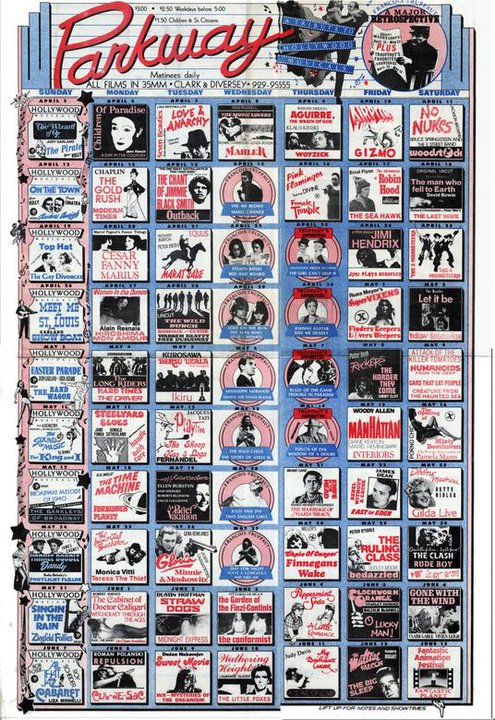
A double feature every day!
Cahiers du Cinema books the ideal repertory theater:
La cinémathèque idéal selon Les Cahiers du cinéma .
Internet Scout: Larry J. Kolb, ex-CIA. My TwitterPages are linked at the right.
var a2a_config = a2a_config || {};
a2a_config.linkname = “Roger Ebert’s Journal”;
a2a_config.linkurl = “http://blogs.suntimes.com/ebert/”;
a2a_config.num_services = 8;

My talk at TED 2011
Rather than use the voice on my computer to speak for TED’s entire allotment of 17 minutes, I asked my wife Chaz and two friends, educator John Hunter and Dr. Dean Ornish, to help read my remarks.
var a2a_config = a2a_config || {};
a2a_config.linkname = “Roger Ebert’s Journal”;
a2a_config.linkurl = “http://blogs.suntimes.com/ebert/”;
a2a_config.num_services = 8;
Jonathan is three and loves great music
I posted the Beethoven video not long ago and it inspired enthusiastic comments, many of them coming down to: Who is this kid?
Under another video online I found a comment, possibly by his mother, saying Jonathan started trying to conduct before he could walk, and is now receiving violin lessons from a teacher he really likes.
There are more videos online, but embedding has been disabled.
Of Jonathan conducting the 4th movement of Beethoven’s 5th, I found this comment on a blog named Murphies:
This is the same symphony that Forster wrote about in “Howard’s End” in what some of you already know is my favorite piece of writing about music anywhere. I think Forster and Jonathan would understand one another perfectly. Here’s what Forster had to say about the segment Jonathan is conducting:
“The goblins really had been there. They might return–and they did. It was as if the splendour of life might boil over and waste to steam and froth. In its dissolution one heard the terrible, ominous note, and a goblin, with increased malignity, walked quietly over the universe from end to end. Panic and emptiness! Panic and emptiness! Even the flaming ramparts of the world might fall. Beethoven chose to make all right in the end. He built the ramparts up. He blew with his mouth for the second time, and again the goblins were scattered. He brought back the gusts of splendour, the heroism, the youth, the magnificence of life and of death, and, amid vast roarings of a superhuman joy, he led his Fifth Symphony to its conclusion. But the goblins were there. They could return. He had said so bravely, and that is why one can trust Beethoven when he says other things.”
var a2a_config = a2a_config || {};
a2a_config.linkname = “Roger Ebert’s Journal”;
a2a_config.linkurl = “http://blogs.suntimes.com/ebert/”;
a2a_config.num_services = 8;
if (WIDGETBOX) WIDGETBOX.renderWidget(‘1b397149-af9a-4c53-b8cf-a8894526dbcf’);
Get the Roger Ebert’s Journal widget and many other great free widgets at Widgetbox! Not seeing a widget? (More info)
Is Quentin Taranytino just plain not any good bad at talking to black people?
Is it white chauvinism for me to suggest that whites are more sensitive than blacks on this issue? Here’s my interview with Pam Grier after the LA press screening of “Jackie Brown.”
And here’s my 4-star review of “Jackie Brown.
— powered by Cracked.com
New Year’s with Steve: In tribute to a great heart
*
*It’s hard to believe Steve Goodman has been gone for 25 years. Even though we knew he had leukemia, and sang for 16 years with it, he fought it with courage and good cheer. You counted yourself blessed to find a chair when he presided at the Earl of Old Town every New Year’s Eve.
Steve was the composer of great songs funny and sad, and a guitarist of amazing skill. He didn’t claim to have a great voice, but he had the right voice for Steve Goodman and his loving audiences. He was above all a friendly soul with a big grin, and he would sing anything on New Year’s Eve if it made him laugh.”I miss my old man tonight,” he sang in one of his great songs. I miss Steve Goodman tonight.
•
•
*
•
*
*Steve’s most famous song, played to our astronauts on the Moon, was “The City of New Orleans.” He was in fine form here, with his dear friend Jethro Burns. A later performance is offered lower down on this page.
*
*
*
*
*
**
* Pete Seeger, Harry Chapin and Steve
*Steve sings “The Twentieth Century is Almost Over”
*
*
*
*
**
*Steve and Jethro Burns
*Steve performs “Tico Tico” with Jethro. When Homer and Jethro performed before the Fourth of July fireworks at Memorial Stadium in Urbana – Champaign in the 1950s, I ran up 15 flights of stairs to get their autograph.
*
*
*
*
*
**
*Steve performs “A Dying Cubs Fan’s Last Request” from a rooftop overlooking Wrigley Field.
*
*
*
*
*
**
*Janis Ian and Steve
*Steve does his tongue-twister “Talk Backwards”
*
*
*
*
*
*
*Steve and John Prine sing Steve’s song “Souvenirs”
*
*
*
*
*
*
*John Prine sings Steve’s “My Old Man”
*
*
*
*
*
*
*
*Steve and Jethro singing Michael Peter Smith’s “Dutchman.” Steve and many others in the Chicago Folk Revival (John Prine, Bonnie Koloc, Larry Rand, Fred Holstein) all had a special love for this song, which Steve popularized.
•
*
*
*
•
*
*Steve and Jimmy Buffet
*Steve and Bobby Bare live, singing “The City of New Orleans.” Looking at this video, my feeling is that Steve was fairly ill at this time. There’s a little energy lacking in his voice. But the joy is there.
*
•
*
*
*
*
*
•The City pulling out of Chicago more than 60 years ago
*
*For a bio, discography and ordering info for all of Steve’s many albums, this is the place to go. And by the way, the guy on the left in the photo is Earl Pionke, owner of the legendary folk mecca The Earl of Old Town. Once when he was throwing out a drunk, the guy demanded to know his last name, “Of Old Town,” he said.

I believe the Mushroom Man can save the world
“Mushroom Man,” by Leslie Iwerks, tells us: “This is the story of how mushrooms can save the world! Renowned mycologist and mushroom pioneer Paul Stamets harnesses the power of infamous fungi to fight the planet’s leading problems, from developing cures for cancer to destroying toxic radioactive waste.”
There’s a back story here. Bill Stamets, Paul’s brother, has been a Chicago friend of mine for years. We always sit in the back row of the Lake Street Screening Room. He is a film critic for many outlets, often helping with Sun-Times festival coverage. He’s a filmmaker, photographer, and very busy as a film teacher. He’s always telling me about his brother Paul, the Mushroom Man. I’ve always imagined some post-hippie organic guru with plastic on the windows of his garage, selling mushrooms from a pickup at farmer’s markets. Bill would say that wasn’t quite the story with Paul. Chaz always sits closer to Bill, and listens better. She touted this film to me. Now that I’ve seen it, I realize: I’ve been sitting with the brother of a hope for the planet. RE
Mushroom Man | Leslie Iwerks from Focus Forward Films on Vimeo.
Freddie Mercury: The Untold Story
This film, which played at Ebertfest, is by Rudi Dolezal from Vienna, one of Europe’s leading directors of music videos. He met Freddie Mercury in that way and gained his agreement to make the film. Freddy’s mother also agreed to participate. It is the first film involving Mercury’s childhood in India and his identity as a Parsi, of Persian roots. To view this, you will need Veoh Web Player
Watch Freddie Mercury – The Untold Story in Entertainment | View More Free Videos Online at Veoh.com
Rudi, Chaz and me at his home in Vienna
Some 200 of my TwitterPages are linked at the right.
var a2a_config = a2a_config || {};
a2a_config.linkname = “Roger Ebert’s Journal”;
a2a_config.linkurl = “http://blogs.suntimes.com/ebert/”;
a2a_config.num_services = 8;

Your handy Tribune guide to masturbators in the news
Software algorithms routinely link items that are related to one another. Sometimes you’d really rather not know. This is from the June 11 Chicago Tribune web site. Note dark circles under eyes.
var a2a_config = a2a_config || {};
a2a_config.linkname = “Roger Ebert’s Journal”;
a2a_config.linkurl = “http://blogs.suntimes.com/ebert/”;
a2a_config.num_services = 8;
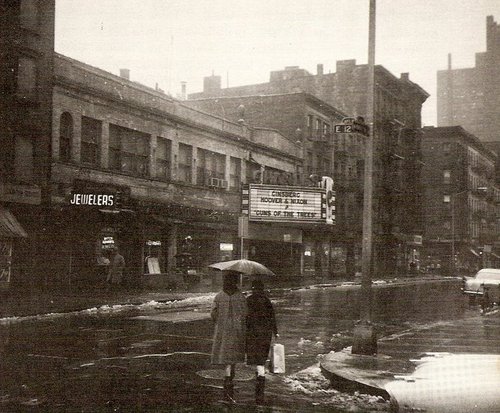
Street scene: Movie theater, snow, rain, promise
This photo was sent to me by a reader, Chris Aiello. At first I processed it as an atmospheric street scene with a movie theater. Then I read the marquee. That placed it in the early 1960s, and I remembered that Jonas Mekas’ “Guns of the Trees” (1961) was a film I reviewed in the early days of the ill-fated Town Underground theater in Chicago (now the Park West).
Aiello told me, “That was the St. Charles movie theater NYC. Circa 1962.” And reader Irving Benig added, “East 12th in the Village .”
The “Ginsberg Hoover and Nixon” refers to Allen Ginsberg, who read his poetry on the sound track.
My first thought was that the scene in the photograph looked cold and lonely. Then I read the marquee and thought, no, that’s simply how it would have looked on a winter’s day. Inside it would have been warm, and the beam from the projector would have made a cone in the cigarette smoke.
When I left the theater it would have been dark and I would have looked around for a place to get a bowl of chili. I could read while eating it. I had the paperback of Norman Mailer’s Advertisements for Myself in the pocket of my corduroy sports coat, under my thin khaki raincoat.
The Internet Movie Database lists only one review of the film, this one.
I went looking for a clip or a trailer of “Guns of the Trees,” and there wasn’t one. Adding the search term “Jonas Mekas,” I found the short film below. You never know what you might find.
var a2a_config = a2a_config || {};
a2a_config.linkname = “Roger Ebert’s Journal”;
a2a_config.linkurl = “http://blogs.suntimes.com/ebert/”;
a2a_config.num_services = 8;
“Making Giant Hands,” by Dog and Panther
I’m not sure if you remember me, but I’m the guy in the wheelchair from the happy, slow-motion youtube video. (I don’t usually describe myself that way, but it seemed to be the easiest way to describe myself). If you’re interested, I just finished another short. I’m super proud of it. Here it is. If you don’t have time or just don’t feel like watching it, no worries. I’m really looking forward to your new show, next year. And, at the risk of not being politically correct, merry Christmas,
John Katona
var a2a_config = a2a_config || {};
a2a_config.linkname = “Roger Ebert’s Journal”;
a2a_config.linkurl = “http://blogs.suntimes.com/ebert/”;
a2a_config.num_services = 8;
You can sample every track in that album by clicking this link.
Amazon.com Widgets
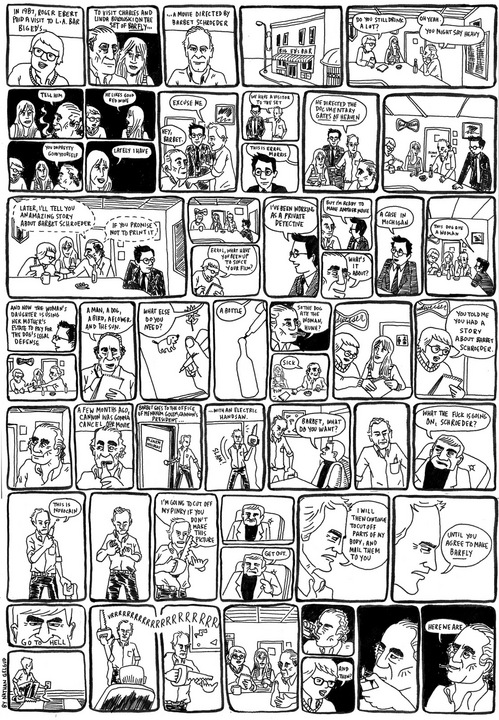
So anyway, Charles Bukowski, Errol Morris and Roger Ebert walk into this bar…
Click to enlarge this comic strip by Nathan Gelgud. Here is a link to Roger Ebert visits the set of “Barfly.”
A photo of us that day in the bar at Remembering Bukowski.
Thanks to Wael Khairy, my Far-Flung Correspondent in Egypt, for forwarding this.
Amazon.com Widgets
var a2a_config = a2a_config || {};
a2a_config.linkname = “Roger Ebert’s Journal”;
a2a_config.linkurl = “http://blogs.suntimes.com/ebert/”;
a2a_config.num_services = 8;
A Holiday Present for Readers
Recently I reprinted a letter sent to my friend Christy Lemire, film critic of the Associated Press. In it, a great-grandmother described how she took four generations of her family, including herself, to see “The Nutcracker in 3D.” They all responded, quite naturally, as if they had found coal in their stockings. It was a shocking film to promote in the guise of family entertainment. What does the Holocaust have to do with The Nutcracker Suite?Marie Haws, the good-hearted Hon. Sec’y. of the Ebert Club, was so moved by the letter that she proposed we make the following special page and fill it with these wonderful Minuscule clips and share them with readers, in the hope they raise spirits and spread smiles this Christmas season — for those disappointed kids, and everyone. Season’s screenings!
Minuscule is a French series of 5 minute shorts created and directed by Hélène Giraud and Thomas Szabo. Described as “a cross between Tex Avery and Microcosmos,” each features one or more insect characters in a self-contained and often humorous storyline.
var a2a_config = a2a_config || {};
a2a_config.linkname = “Roger Ebert’s Journal”;
a2a_config.linkurl = “http://blogs.suntimes.com/ebert/”;
a2a_config.num_services = 8;
Here for Zone One (North America) is the Miniscule DVD.


♫ Nestor Torres and the spirit in the music
I have seen Nestor Torres play three times at the jazz concert convened every year by Dave and Don Grusin at the Conference on World Affairs at the University of Colorado. Like all the famed professional musicians at the CWA, he plays without a fee. Then he plays on into the night out of sheer joy. He plays jazz, Latin, classical. He has performed as a soloist with many symphony orchestras. He has many albums and is in demand all over the world, but has very few professionally-produced videos. These have mostly been photographed from the audience. There is nobody else like him.
Nestor Torres and young Ricardo Chiesa at the Heineken Jazz Fest 2005
“My name is Nestor Torres”
The University of Warwick’s One World Week concert
Torres live in concert
Caribbean Life’s JuneFest 2006 Unplugged with Nestor Torres
Nestor Torres’ biography and his web site.
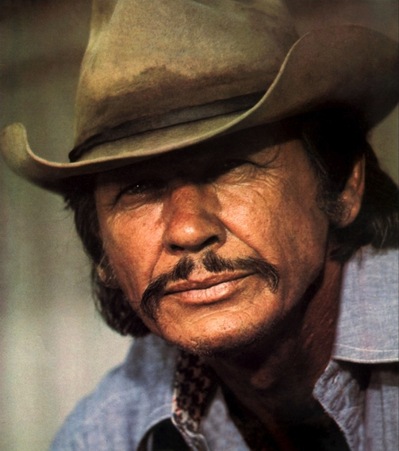
Bronson: Coming of age in Scoop Town
By Roger Ebert
I met Charles Bronson in New York City, where he was working once again with Michael Winner Winner, who also directed him in “Chato’s Land,” “The Stone Killer,” and “The Mechanic.” The new movie was “Death Wish,” about a middle-aged New York architect who is repelled by violence until his own daughter is raped and his wife murdered. Then the architect becomes an instrument of vengeance. He goes out into the streets posing as an easy mark, and when muggers attack, he kills them.
“Death Wish” was being shot in New York in late, bitterly cold February night, and for openers I observed that the character seemed to have the same philosophy that’s been present in all of Bronson’s work with Winner: He is a killer (licensed or not) with great sense of self, pride in his work, and few words.
Bronson had nothing to say about that “I never talk about the philosophy of a picture,” he said. “Winner is an intelligent man, and I like him. But I don’t ever talk to him about the philosophy of a picture. It has never come up. And I wouldn’t talk about it to you. I don’t expound. I don’t like to over talk a thing.”
We are in the dining room of a Riverside Drive apartment that is supposed to be the architect’s home in the movie. Bronson is drinking one of the two or three dozen cups of coffee he will have during the day and, having rejected philosophy, seems content to remain quiet.
Could it be, I say, that it’s harder to play a role if you talk it out beforehand?
“I’m not talking in terms of playing a role,” Bronson said. “I’m talking in terms of conversation. It has nothing to do with a role at all. It’s just that I don’t like to talk very much.”
He lit a cigarette, kept it in his mouth, exhaled through his nose, and squinted his eyes against the smoke. Another silence fell. All conversation with Bronson has a tendency to stop. His natural state of conversation is silence.
Why?
“Because I’m entertained more by my own thoughts than by the thoughts of others. I don’t mind answering questions. But in an exchange of conversation, I wind up being a pair of ears.”
On the set, I learned, he doesn’t pal around. He stays apart. Occasionally he will talk with Winner, or with a friend like his makeup man, Phil Rhodes. Rarely to anyone else. Arthur Ornitz, the cinematographer, says. “He’s remote. He’s a professional, he’s here all the time, well prepared. But he sits over in a corner and never talks to anybody. Usually I’ll kid around with a guy, have a few drinks. I think there’s a little timidity there. He’s a coal miner.”
Later in the day, Bronson is sitting alone again. I don’t know whether to approach him; he seems absorbed by his own thoughts, but after a time he yields. “you can talk to me now. I wouldn’t be sitting here if I didn’t want to talk. I’d be somewhere else.”
I was wondering about that.
“I had a very bad experience on the plane in from California yesterday. There was a man on the plane, sitting across from me, and they were showing an old Greer Garson movie. He said, Hey, why aren’t you in that? The picture was made before I even became an actor. I said, Why aren’t you? I think I made him understand how stupid his question was.
“When I’m in public, I even try to hide. I keep as quiet as possible so that I’m not noticed. Not that I hide behind doorways or anything ridiculous like that, but I hide by not making waves. I also try to make myself seem as unapproachable as possible.”
More silence. Phil Rhodes, the make-up man, is leafing through a copy of Cosmopolitan. Suddenly he whoops and holds up a centerfold of Jim Brown.
“Will you look at this,” he says.
“Would you ever do anything like that, Charlie?”
“Are you kidding?” Bronson said. “What a bunch of crap. Look at that. Old Jim. People are so hung up on sex.”
And, inexplicably, that sets Bronson talking “I’ve been trying to make it with girls for as long as I can remember,” he says. “I remember my first time. I was five and a half years old, and she was six. This was in 1928 or 1929. It happened at about the worst time in my life. We had been thrown out of our house . . .”
The house was in Ehrenfeld, known as Scooptown, and it was a company house owned by the Pennsylvania Coal and Coke Company. When the miners went out on strike, they were evicted from their homes, and the Buchinsky family went to live in the basement of a house occupied by another miner and his eight children. “This would have been the summer before I started school,” Bronson says. “I remember my father had shaved us all bald to avoid lice. Times were poor. I wore hand-me-downs. And because the kids just older than me in the family were girls, sometimes I had to wear my sisters’ hand-me-downs. I remember going to school in a dress. And my socks, when I got home sometimes I’d have to take them off and give them to my brother to wear into the mines.
“But, anyway, this was a Fourth of July picnic, and there was this girl, six years old. I gave her some strawberry pop. I gave her the pop because I didn’t want it; I had taken up chewing tobacco and I liked that better. I didn’t start smoking until I was nine. But I gave her the pop, and then we . . . hell, I never lost my virginity. I never had any virginity.”
He remembers Ehrenfeld well, and has written a screenplay with his wife Jill Ireland about life in the mining towns. He worked in the mines from 1939 to 1943, and getting drafted, he says, was the luckiest thing that ever happened to him: “I was well fed, I was well dressed for the first time in my life, and I was able to improve my English. In Ehrenfeld, we were all jammed together. All the fathers were foreign-born. Welsh, Irish, Polish, Sicilian. I was Lithuanian and Russian. We were so jammed together we picked up each other’s accents. And we spoke some broken English. When I got into the service, people used to think I was from a foreign country.”
Five boys in his family were drafted into the Army. An older brother, the one who took him into the mines for the first time, was part of the European invasion. “He was a Ranger, and he won a medal,” Bronson said. “He was under fire constantly. And he said he’d rather do that than go into the mines again.”
Bronson would not talk about his hometown screenplay, called $1.98, except to say it was fundamentally a love story with a mining town as the environment, but the next afternoon he met with two VISTA workers to discuss possible locations in Appalachia for the film. The towns he had scouted, he told them, looked too good. There were streets, there were lawns where things grew . . .
“I remember the old company towns. There was no neon, except for the company store. Nothing was green. The water was full of sulphur. There was nothing to put a hose to. There were unpaved streets covered with rock and slag. You had the rock dumps always exploding. They were always on fire, down inside, and if it rained for a long enough time, the water would seep down to the fires and turn to steam and the dump would explode.”
The VISTA volunteers asked if Bronson’s movie would deal with black lung disease.
“No, it’s a love story. But it will be . . . beneficial to the miners, I hope. Right now it isn’t a finished script. There are too many empty, dull places. And it’s naive. But it will be accurate about mining. You had a feeling about mining. It was piecework; you didn’t get paid by the hour, you got paid by the ton, and you felt you were the hardest-working people in the world.
“When I worked, the rate was a dollar a ton. You spent one whole day preparing so you could spend the next day getting it out. The miners felt bound together; they knew how much they could get out, how much they could do. And they worked. With the new machines, it’s easier. Not more pleasant, but easier. But in those days, that was pure work. It wasn’t a man on a dock with a forklift or any of that bullshit. It was pure work.”
After the war Bronson went back home, but not to the mines. The veterans were given three months, he recalled, to decide if they wanted their old jobs back. Bronson did not. He picked onions in upstate New York, and then got his card in the bakers union. He worked on an all-night shift at a bakery in Philadelphia and took art classes in the evenings. He decided he knew more about drawing than the instructor did. He dropped the classes and quit his job (he still holds cards in both the miners and bakers unions), and went to New York City with the notion that he might try acting. Why acting?
“It seemed like an easy way to make money. A friend took me to a play, and I thought I might as well try it myself. I had nothing to lose. I hung around New York and did a little stock-company stuff I wasn’t really sure at that time if l even wanted to be an actor. I got no encouragement. I was living in my own mind, generating my own adrenaline. Nobody took any notice of me. I was in plays I don’t even remember. Nobody remembers. I was in something by Moliere – I don’t even know what it was called.
“I have no interest in the stage anymore. From an audience point of view, it’s old-fashioned. The position I’ve been in for the last eight years, I have to think that way. I can’t think of theater acting for one segment of the population in just one city. That’s an inefficient way of reaching people.”
After New York, he tried the Coast. Spent some time at the Pasadena Playhouse. Got his first movie role in You’re in the Navy Now because he could belch on cue, a skill picked up during Ehrenfeld days. He worked for years as the heavy, the Indian, the Russian spy. He had two TV series, “Man with a Camera” and “Meet McGraw.” And he was getting nowhere fast, he decided, so he went to work in Europe, where they didn’t typecast so much and he had some chance of playing a lead or getting the girl.
His first great European success was in “Farewell, Friends,” opposite Alain Delon. That made him a lead, and then movies like “The Dirty Dozen” and “Rider on the Rain” made him a star. Although he worked for years in Europe, he refused to live there; he always maintained his home in America. He met Jill Ireland on a set in Germany in 1968, three years after her separation from David McCallum and a year after her divorce. And now, he says, “I don’t have any friends, and I don’t want any friends. My children are my friends.” And in Europe, Asia and the Middle East, he is said to be the top box-office draw. “One of the ironies,” he observed, “is that I made my breakthrough in movies shot in Europe that the Japanese thought were American movies and that the Americans thought were foreign.”
That night in New York, the “Death Wish” company gathered to shoot a scene outside a grocery store on upper Broadway. Bronson said that, since he was here anyway, he would do some shopping. He began with a box of cookies. An old man, a New York crazy, was berating a box of Hershey bars because it wouldn’t open. “What the hell’s going on here? “he shouted at the box. Bronson opened it for him. The man hardly noticed.
While the location was being prepared, Michael Winner drank coffee across the street and talked about his enigmatic star.
“It’s unnecessary for him to go into any big thing about what he does or how he does it,” Winner said, “because he has this quality that the motion-picture camera seems to respond to. He has a great strength on the screen, even when he’s standing still or in a completely passive role. There is a depth, a mystery – there is always the sense that something will happen.
I mentioned a scene in “The Stone Killer” in which Bronson has a gunman trapped behind a door. The gunman fires through the door, and Bronson, with astonishingly casual agility, leaps to the top of a table to get out of the line of fire.
“Yes,” said Winner. “His body projects the impression that it’s coiled up inside. That he’s ready for action and capable of it. You know, Bronson is, as a human being, like that. That’s not to say he goes about killing people. I’m sure that he doesn’t”
A pause. “That’s not to say he hasn’t, in his day. Now he seems to have gotten a reputation for blowing up and hitting people on pictures. In my experience, he’s not like that. He’s a very controlled and reasonable person.” Pause. “But there is a great fury lurking below.”
The next afternoon, Bronson taped an interview for exhibitors with some people from the publicity department at Paramount. Bronson described the character he plays in “Death Wish:” “He’s an average guy, an average New Yorker. In wartime, he would be a conscientious objector. His whole approach to life is gentle, and he has raised his daughter that way. Now he has second thoughts, and he becomes a killer.”
Did you prepare for this character in any special way?
“No, because to play him I draw upon my own feelings. I do believe I could perform this way myself.”
var a2a_config = a2a_config || {};
a2a_config.linkname = “Roger Ebert’s Journal”;
a2a_config.linkurl = “http://blogs.suntimes.com/ebert/”;
a2a_config.num_services = 8;
Amazon.com Widgets

We are so very, very, very small
The graphic was created by the National Aeronautics and Space Administration to represent 1,235 planets we know to exist, and the suns they orbit. Each planet is a black dot. Our sun is below the top row at the right. It’s estimated that millions of such planets exist in our galaxy alone.
