Kirk Douglas: I’ve killed so many Romans, so many Vikings, so many Indians…
By Roger Ebert
©Esquire magazine 1970
This was a restless man. He rocked on the balls of his feet. He looked, turned, looked back to where he’d turned from. Demons were gaining. He peered out the window. Opened the door. Closed the door. Peered out the window. Evoked a pastoral image.
“There was a lovely little picket fence,” Kirk Douglas said. “And a mailbox with my name on it, and a soft little carpet of green grass out there in the middle of the desert. It got to be a joke. But I’ve spent so much of my life on locations that after awhile . . . well, we had that goddamn trailer fixed up like a garden spot. The crew members used to compete to see who could think of something new to add.”
And that was on . . .
“That was on this one. ‘There Was a Crooked Man.’ The last of my current trilogy and my fiftieth picture. Jesus!”
Douglas took a seat on the very edge of a sofa. He leaned forward, his elbows braced on his knees. Then he slammed his hands together, looked down at the carpet and shook his head.
“Fifty pictures.” His voice caressed the words. “That’s what it all amounts to, you know. Staying power I was a star before I even heard of Julie Andrews.”
He smiled the Kirk Douglas smile, half nostalgic, half rueful, half ferocious.
“I remember meeting Tito once. The English ambassador had been waiting six months to present his credentials. Tito sent his private plane to pick me up, and we talked for three hours. Turned out he’d seen just about every one of my movies. He sees one or two movies a night. He said they take his mind off his problems.
“And that’s where it’s at. That’s what movies do. Take ‘Lonely Are the Brave.’ There was a movie that communicated on all levels. Maybe it was anti-Establishment, or maybe it was about a kooky cowboy. A movie like that is so much better than some foreign horseshit about an actor chewing for twenty minutes.
“But you never know. I made a movie two years ago, ‘A Lovely Way to Die.’ They pushed me into it. (ital) Kirk, they said, you oughta make a cop picture. (unital) It was a bomb. Well, why was ‘Bullitt’ a success? Nobody understood ‘Bullitt.’ It had two good elements in it: the chase, and the killing in the bedroom. Otherwise, it was as hard to understand as ‘Last Year at Marienbad.’ I didn’t know what that was about (ital) either. (unital) The foreign directors are always fumbling about in obscurity, and the critics are always writing about the juxtaposition of black and white and the existential dilemma and all that shit, to disguise the fact that they don’t understand the first damn thing about it either . . .”
Douglas wore frayed denims, no shirt, boots. Hair long and combed back like Ratso in ‘Midnight Cowboy.’ He’d just come from the set. Now he went into the bedroom of his bungalow on the Warner Brothers lot and came back wearing a blue terry-cloth robe.
“But now, yes, I’ve made a trilogy I’m proud of. My forty-eighth, forty-ninth and fiftieth pictures. ‘The Brotherhood,’ ‘The Arrangement,’ and ‘There Was a Crooked Man.’ It gives me a certain measure of pride to look back at these three pictures and realize I’ve come this far and remained intact.”
He backed into a corner of the room, and stood looking up at the ceiling.
“‘The Brotherhood.’ I got a lot of indirect messages from the boys on that one. They wanted to meet me.”
The Mafia?
Silence.
He was gently tapping his head against the wall.
You weren’t … uneasy?
A sharp laugh. He advanced from the corner, sat in a chair. “I know Italians and I like them. A lot of my father’s best friends were Italians. I responded to that in making the picture. I put a lot of warmth into that character. Those immigrants were tough, more intensive than people are these days. I’d love to discuss the picture with the boys. I’m not interested in movies, anyway; I’m interested in people. I love talking to interesting people, people like O. J. Simpson, Andretti … I love champions. A champion has something (ital) special (unital) about him.”
Douglas was filled with nervous energy, raw vitality. He couldn’t remain still. It was in a sense actually wearying to be caged in a room with so much restlessness. Douglas walked halfway across the room and then whirled, fixing me on the quivering tip of a rhetorical point.
“I preceded a lot of this youthful revolution,” he said. “And Thoreau did too, back in 1825. Compared to Thoreau, Saint Francis of Assisi was peanuts. And don’t get me wrong. There’s nothing the matter with building castles in the air. It wasn’t so much Thoreau as his philosophy. It’s like, you ever hear that song? It’s gotta be me, just gotta be me . . .”
Douglas sat again on the couch, as the last notes lingered. He was quieter now, subdued, called back to the present.
“Too often,” he said slowly, “I have not been what I wanted to be I’ve succumbed to pressures. Yes, I have. The things I’ve done that I liked, I’ve always done against advice. The bad films everybody was high on. The good films, they advised me against. But by God! From now on, it’s gotta be me!
“‘Champion,’ for example. I had a chance to be in a picture with Gregory Peck and Ava Gardner over at Metro. I said, no, I want to make this picture ‘Champion.’ The agents thought I was nuts. On the other hand, I let myself be pushed into ‘A Lovely Way to Die,’ and what a load of shit that was. And ‘War Wagon.’ Well, ‘War Wagon’ wasn’t bad. It was entertainment. I rather enjoyed it. But that woman, Pauline Kael–did you see that piece she wrote about it, about ‘War Wagon?’ If Pauline Kael were sitting here right now,” he said, indicating an empty chair, “I’d tell her, you’re a bright dame, but you’re full of shit.”
He stood up, continuing to address Miss Kael.
“Don’t crucify me because of what your idea of a movie star is,” he said, pointing a finger at the chair. “I didn’t start out to be a movie star. I started out to be an actor. You people out in the East have no idea what goes on out here.” He punctuated his speech with short thrusts of the finger. “No awareness or knowledge whatsoever. You lose track of the human being behind the image of the movie star.”
Leaving Pauline Kael speechless, Douglas turned back to me.
“You know,” he said, “sometimes an interviewer will look at me and say – you’re bright! They’re actually surprised I might be bright. Well, I say, what if I wanted to be a writer? I just might be better at it than you are! Ever think of that? There are a lot of journalists who are just plain dumb.
“And I understand what’s going on here, for example. The subtleties of the situation. An interviewer is not simply reporting what somebody said. It’s a point of view toward that person. It incorporates the point of view of the interviewer.”
He jerked his thumb over his shoulder toward the chair where Pauline Kael was not sitting.
“I don’t need a critic to tell me I’m an actor,” he said “I make my own way. Nobody’s my boss. Nobody’s ever been my boss. Your only security is in your talent I didn’t get into this business as a pretty boy. I’ve made good pictures, bad pictures, I’ve been a maverick, I’ve never been under contract, except for one year at Warner’s after ‘Champion’ – l’ve made my own way!
“You know what it makes me think of sometimes? My picture ‘Young Man with a Horn.’ Bix Beiderbecke in his lonely personal quest to hit that unattainable note. I like to play that role. The rebel. The guy fighting against society. The champion!”
Douglas lay down flat on the floor and braced his feet on top of the coffee table. He rested his head on his hands, and looked up to the ceiling. He talked in a faraway, thoughtful, pensive, reflective, philosophical voice.
“In all dramatic stories,” he said, “death is the inevitable end. There aren’t many songs you have to sing They’re all variations on a theme. I’m attracted and fascinated by how difficult it is to be an individual. The thing of being a so-called movie star works against you. Sure, you can always make exciting pictures, adventure pictures, but when you try something different they dump on you because you’re a star. And yet that theme of the individual, fighting against society … it’s always obsessed me. ‘Lonely Are the Brave’ … ‘Spartacus’ … ‘Champion’ … it doesn’t matter if you’re a nice guy or you’re a bastard. What matters is — you won’t bend!”
He swung his legs off the coffee table and rolled over onto his stomach, resting his chin on his hands, sighting along the hallway toward the kitchen, where lunch was being prepared.
“Somebody who won’t bend. That’s what ‘The Brotherhood’ was about. But a star’s image is determined by what the public wants They want me to be tough. A loved enemy. Neither the public nor the critics want you to do something they don’t want you to do.”
He sat up now, cross-Iegged on the floor.
“That’s why the perfect movie star is John Wayne. I was in a lousy picture with him once, ‘In Harm’s Way.’ I used to think about John Wayne that he brings so much authority to a role he can pronounce literally any line in a script and get away with it. But I figured ‘In Harm’s Way’ had a line even John Wayne couldn’t get away with. It was) I need a fast ship because I mean to be in harm’s way. I thought, oh, shit, I’ve gotta hear him say this line. But you know what? He said it, and he got away with it. Now that’s John Wayne . . .”
Lunch was served: vegetable soup with herbs, relish plate, rolls and butter, cold cuts if you wanted some but nobody did.
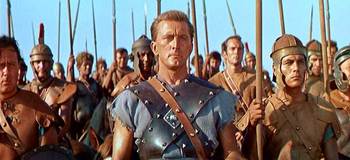
“And there’s nothing wrong with a John Wayne movie,” he said. “I hate arty-farty pictures. What you always hope to make is a good, honest picture with balls. We did that with ‘Spartacus.’ That was the best big spectacle ever made. ‘Ben-Hur’ made almost three times as much money and didn’t even compare. In our spectacle, the characters dominated the setting. It was a picture about men, not production values. Well, it made money. But my best pictures have seldom been my most successful. ‘Lust for Life’ wasn’t a big money-maker. ‘Paths of Glory’ has now finally broken even. ‘Lonely Are the Brave’ … boy, the non-artists really balled that one up. Instead of putting it in a little theatre and waiting for the reviews, they shoveled it into saturation bookings before anybody heard about it.
“That’s what I mean, it’s gotta be me! You got to fight!” He clenched his fist and shook it, and clenched his teeth, too. “In ‘The Brotherhood,’ that great scene in the bedroom with Irene Papas, where I’m drunk and we both have all our clothes on and, Jesus, that scene was erotic! It could have easily fallen on its ass, and Martin Ritt wanted to cut it out of the script, but, no, you got to fight for those things.
“But then you make the money on the others. I was offered a million and a half to star in ‘The Fall of the Roman Empire.’ And you know something? Now that I look back, I was a fool not to take it.”
Douglas wasn’t hungry. Too wound up. He dabbed at his soup with a roll and finally stood up and paced back and forth, chewing celery sticks.
“I have a 16-millimeter print of every movie l ever made,” he said. “It was a fight to get them! But I can look at those prints, fifty prints after this one, and I know there’s good stuff there, great things in those pictures, and they can’t take that away from me.
“Like in this forty-ninth picture, ‘The Arrangement.’ A-ha!” He smacked his fist into his palm. “Working with Kazan was a real experience. An actor’s director. He relates to the actors. He’ll do anything short of committing a homosexual act to get the best out of his actors.”
Smack! “But you’ve got to fight for what you believe in. I remember in ‘War Wagon,’ I fought with them for the nude scene. Remember, where I was walking away from the camera bare-ass? I said that’s the only honest way to shoot it. I’m in the sack, see, and John Wayne’s knocking at the door, and we’ve already established that I wear a gun at all times. So we play the whole scene at the door, me with my gun on, and when I walk back to bed you see the gun is the only thing I’m wearing! Great! You put pants on the guy, the scene isn’t honest anymore.
“I’m not surprised, though, they wanted to destroy the scene. Dealing with Universal is always … well, they were the aces who got me where I lived on ‘Lonely Are the Brave.’ I wanted to call it ‘The Last Cowboy.’ It had a simplicity to it. But the aces put it through a computer and came up with a nothing title. And things like that and ‘A Lovely Way to Die’ … I hated that one … I said, from now on I’m only doing what I want to do. And now, after fifty pictures and the last three damn good ones, it’s time to take inventory.”
Douglas collapsed on the couch, legs outstretched, heels digging into the carpet, arms crucified on the sofa’s back. He sighed.
“I’m getting to be a tired warrior,” he said “I’ve killed so many Romans, and so many Vikings, and so many Indians.”
He sighed again.
“The killing must stop.”
A pause. A silence. It became a long silence.
“What I need,” he said again, “is a pause to take inventory.”
He twisted to lie flat on the sofa, head braced against one arm, feet propped up on the other “You know what I did the other day?” he said. “I did a crazy thing. I took a walk out there on the back lot of Warner’s. Back there behind Stage 19. And it was like it was haunted . . .”
Very slowly, he lifted his feet and swung them around to rest them on the carpet again. And then he rested his elbows on his knees and his chin on his hands and it was like he was looking back in time, remembering other days, other rooms . . .
“There were staircases,” he said. “Dozens of staircases. You’ve never seen so many staircases. And you could imagine ghosts on them. Cagney. Flynn.” He chuckled nostalgically. “Bogey.” His voice took on a wondering quality “And you couldn’t help thinking, one day these staircases were seething with activity. And as you walked among them, that line of poetry came to your mind. You know, the one about what town or peaceful hamlet or something or other. Well, I can’t remember how it goes . . . ‘Ode to a Grecian Urn,’ that’s the one. And you can’t help thinking, Jesus! The ghosts that walk here at night. Because movies are filled with the stuff of everyone’s dreams, and you know what a studio is? A dream factory. Staircases . . . barrooms . . . barbershops . . .”
Another silence. Douglas stood up, put his hands in his pockets, looked out the window. His voice came back over his shoulder.
“And then it occurred to me, hell, I’m a star, too. And the final test is staying power. After forty-seven pictures, I was still in there, working in interesting movies. I was glad I had those 16-millimeter prints. It’s a rough business. You lose that freshness. It’s a struggle to stay alive in every picture . . . and, hell, I don’t know.
“I turned down ‘Stalag 17,’ Holden won an Oscar. I turned down ‘Cat Ballou.’ Marvin won the Oscar. But, hell, you never know. Decision making . . . I’ll tell you one thing. Five pictures in a row like ‘Paths of Glory,’ and I’d have been out of business. And then when you try something ambitious, like when I went back to Broadway in Kesey’s ‘One Flew Over the Cuckoo’s Nest.’ Van Heflin warned me. He said, They hate actors who’ve made it. They’ll kick you in the ass if they can. But, hell, I was just like any other regular fellow making a couple of million a year.” He laughed at that “I knew Kesey early on, and then I met him again later. I did the play because I believed in it. But Kesey . . . Christ, I don’t give a shit what anybody does. But to destroy a talent is wholly unjustified. God, Kesey looked bad when I saw him again.
“There is something sad and dramatic about the disintegration of a talent. At the start, Brando was the best. And now . . . well, it was a damn shame he had to miss with Kazan. Kazan, of course, wanted Brando to play the lead in ‘The Arrangement.’ The two of them, together again. But after Kazan talked with Brando, he felt Brando wasn’t quite with it . . . didn’t have the old enthusiasm . . . but, hell I don’t want to get into that. And yet, you know something?”
Douglas turned away from the window now and sat on the floor. His knees were pulled up and he bridged them with his arms.
“Being a star doesn’t really change you. If you become a star, you don’t change-everybody else does. Personally, I keep forgetting I’m a star. And then people look at me and I’m reminded. But you just have to remember one thing: the best eventually go to the top. I think I’m in the best category, and I’ll stay at the top or I’ll do something else. I’m not for the bush leagues. I remember as a kid of twenty, on Broadway, I had a chance to take a good role with a road company, or stay in New York playing a walk-on and an offstage echo. I stayed. I wanted that association with champions.”
Douglas looked up almost fiercely.
“Champions!”
•
The next morning, the door to his Beverly Hills home was opened by a maid who hadn’t been informed that anyone had an appointment with Mr. Douglas. The housekeeper also looked suspicious. They thought perhaps a mistake had been made. A misunderstanding. Perhaps if . . .
“Hi, I know who you are,” Peter Douglas said. “He’s okay,” Peter told the servants. “Come on in here and have a seat. I knew you were coming. I like to keep in touch around here . . .”
Peter was perhaps twelve, sandy-haired, personable, looked like his father. He wore tennis shoes and a T-shirt.
“Dad’ll be down after awhile,” he said. “You want some pretzels? No? I’d offer you something else, but at the moment,” he sighed dramatically, “it’s pretzels and that’s it.”
Peter shrugged his shoulders stoically. “Know the one I’d like to make a movie out of? ‘Fail-Safe.’ I’m Peter, by the way. I’m just a slave here.”
Peter headed toward the pool. The room he left was a sort of den and library, half open to the living room and the bar. There were several animal skins on the floor, and a two-year run of Time magazine laid flat on a shelf with the spines overlapped. And there were a lot of books on the shelves, and a display of primitive carvings and statues, and . . .
“How about a cup of coffee?” Kirk Douglas said. He had entered silently on bare feet “It’ll be here in a minute.” He grinned in anticipation. “That first cup … ah!”
He touched one of the skins with a bare toe. “How do you like that leopard skin?” he said. “Isn’t it a beauty?” He sat down and his voice became serious. “What a terrible thing it is to kill. I impulsively went on one safari. I thought, Jesus, I can’t shoot an animal. But once we left Nairobi, I discovered the real me. A killer. I shot about thirty animals. I was shocked and embarrassed. I was confused. I asked myself, Do I really want to kill? The philosophers say, know thyself. But what really counts is how honest and how brave you are. You ask of a man, where is he strong? Where is he weak? The bully with the low voice may be secretly frightened . . .”
The coffee came, and with it a plate of chocolate-chip cookies. Douglas picked up his saucer in his hand, sipped, considered his cup. “The home of the brave,” he said finally. “What a violent nation we are! A violent people. That’s why there’s so much violence in the movies. The Greeks had a word for it. It’s catharsis. Audiences love gangsters. Virtue is not photogenic. Christ, even Disney bakes people into cookies.”
He paused to nibble a chocolate-chip, and then held it up. “Great? The best! They have to be. They were made by my cook. But the West … there was a certain simplicity and directness there.”
He leaped to his feet, balanced the coffee cup in his left hand, adopted a shoot-out stance (legs wide, right hand poised) and snarled. “Smile when you say that!” Then he shook his head in resignation. “It’s childlike,” he said “No one can be an artist without a childlike quality. If I were really sophisticated, how could I, a grown-up man, carry a gun in a movie?”
He put down his cup and picked up one of the primitive statues in the room. “Take this,” he said. “Childlike in its innocence. Look here. On this side, you can see it’s a woman. And then you turn it around and, well, on this side, it’s pretty obviously a man. It has an innocent bisexuality. It comes from a society where all things mix naturally together.
“Reminds me.” He sat down again, still considering the statue in his hands. “Kubrick once had this great idea. We’d make the world’s greatest pornographic film. Spend millions on it. And then maybe only show it in one country, like Switzerland, and fly people in to see it. Kubrick. A great director. I thank him for so much that is good in ‘Paths of Glory’ and ‘Spartacus.’ You know, at one time with ‘Paths of Glory,’ even Kubrick wanted to cop out. He wanted to rewrite the script, make it a sort of B picture, a commercial thing. But I’m glad we stood by our guns. There’s a picture that will always be good, years from now. I don’t have to wait fifty years to know that; I know it now. Certain pictures have a universality of theme. ‘Champion’ did. Audiences are all the same. They love the guy who’s up there on top. And yet, you know, in real life . . .” He sighed and finished his coffee.
“Somebody asked me not long ago if I was going to write an autobiography. Well, I have one good enough reason. I’d write it for my four sons. But nobody else would be interested. My life’s too corny and typical to make a good autobiography. I wouldn’t even do it as a movie. My life’s a B script. My life. The violins playing . . . the kid who didn’t have enough to eat . . . the parents who were Russian immigrants . . .
“I taught my mother to write her name. It’s like my parents came out of the middle ages, and in one generation I jumped to here.” He indicated the room with a sweep of his hand “My parents did the one essential thing. They didn’t miss the boat. I grew up in Amsterdam, New York. My parents never did understand my success. I’d say, Ma! I just signed a million-dollar contract! But son, she’d say, you look so thin . . .”
He leaned forward intensely. “And yet my mother was a great woman,” he said. “She had little formal knowledge, but she knew much about life. They used to come to her with sores, with boils. She’d take out an old, moldy loaf of bread and apply it to the sore, as a poultice. And this was years before penicillin.”
He gave a wry twist to his mouth. “My life,” he said. “A B picture. And yet my life is an American life. Because the real American life, the typical one, is a B picture. Like mine – the kid who worked up from abject poverty to become the champion. But you got to fight! Our forefathers set the bar so high we keep trying to go under it, instead of over . . .”
He stood up again now, and looked out the window to where two of his sons were swimming in the backyard pool.
“Look at those kids, he said. “Olympic material.”
He smiled, watching as Peter did a racing dive off the edge of the pool. Then he spoke again, slowly. “At this period of my life,” he said, “I look at this trilogy, these last three pictures, and I must admit I feel I’m functioning well. You have to set your own standards. I was nominated for ‘Champion.’ Broderick Crawford won that year I was nominated for ‘Lust for Life,’ but Yul Brynner won. You set your own standards. You have to. And then these arty-farty foreign movies come along, and . . .”
He whirled and strode away from the window, his fist slamming into his palm. The softness was gone from his voice; he was angry.
“You know why they criticize me?” he said “I’m criticized because I can jump over two horses! And they sneer. Hollywood, they say. Hollywood. Well I for one am plenty proud of Hollywood They go over there to Europe and they forget their roots and they lose the nourishment of Hollywood. I say if you want to grow a plant, put it where there’s some good horseshit to grow in!”
He walked rapidly toward the bookcase, and indicated a set of matched volumes “See those?” he said. “It’s a rare edition: 150 Years of Boxing. It’s all in there, and it’s all the same. Acting is like prizefighting. The downtown gyms are smelly, but that’s where the champions are.”
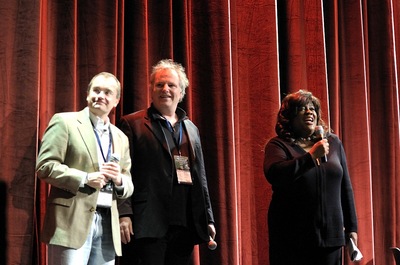
Sydney Pollack introduces “Champion.”
var a2a_config = a2a_config || {};
a2a_config.linkname = “Roger Ebert’s Journal”;
a2a_config.linkurl = “http://blogs.suntimes.com/ebert/”;
a2a_config.num_services = 8;