


Features

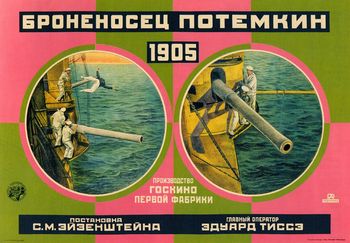
The “Potemkin” restoration
“Battleship Potemkim,” one of the basic masterpieces, has never before approached this clarity. When Kino says “frame by frame” that’s literally what they mean. This is detailed close work.
My Great Movies review.
var a2a_config = a2a_config || {};
a2a_config.linkname = “Roger Ebert’s Journal”;
a2a_config.linkurl = “http://blogs.suntimes.com/ebert/”;
a2a_config.num_services = 8;
View the trailers. If “none available,” click through to the Amazon VOD page.
Amazon.com Widgets


Rene Clair’s “And Then There Were None”
The Ebert Club is pleased to share the following film by the great French auteur Rene Clair and to invite you to join the Club and see what other mysteries lurk in the tree house!
And Then There Were None (1945) Directed by Rene Clair. Written by Dudley Nichols and based on the novel by Agatha Christie. Starring Barry Fitzgerald, Walter Huston, Louis Hayward, Roland Young, Mischa Auer, June Duprez and Judith Anderson. Winner! 1946 Locarno International Film Festival: Best Film.Synopsis: Ten strangers are summoned to a small island off the coast of Devon, by a mysterious note. Once there they discover that their unknown host, a certain “Mr. Owen”, has not yet arrived. They’re told he’ll be there by dinner and so they retire to their rooms to prepare for the evening. Come dinner, their host has still not arrived and suddenly a voice on a gramophone record proceeds to accuse all of them of past murders they were never prosecuted for. The guests strongly deny any wrong doing and a decision is made to leave the island immediately! A servant however, tells them that there’s no way to get the boat from the mainland. There’s also no phone on the island and the boat only comes twice a week. It won’t be back until Monday morning and it’s only Friday night….
Go here to join the Club and see what else we have!

Ezra Pound also wrote a poem about the Lake Isle of Innisfree. And shared a cottage with Yeats.
Spoken Word writes on his wonderful Spoken Verse.com: . Ezra Pound shared a cottage with W B Yeats during a period of three years. It seems that he didn’t share Yeats’ ambition to end up living alone on an island in the middle of a lake.
The title refers to Yeats’ poem “The Lake Isle of Innisfree. McHugh and I drove out there from Sligo, but your man who lived in the cottage on this shore didn’t feel like rowing us out.
“Volailles” actually means “chickens,” if we ]take it literally, but here it means whores. “Poules” is similar and it also means both chickens and whores. There was a delightful film called Irma la Douce with Shirley MacLaine and Jack Lemmon set in the seedy part of Paris populated mainly with the Poules, their Mecs and the Flics – meaning the Prostitutes, their Pimps and the Cops. And, if you haven’t seen Irma La Douce here it is – just watch the opening few minutes and you’ll be hooked–er, yes, “hooked” is appropriate:.
The first tobacconist is in ‘Little Britain’ : Government Street, Victoria, British Columbia, Canada.
The second tobacco shop is in Old Town. San Diego, California, USA.

O GOD, O Venus, O Mercury, patron of thieves,
Give me in due time, I beseech you, a little tobacco-shop,
With the little bright boxes piled up neatly upon the shelves
And the loose fragrant cavendish and the shag,
And the bright Virginia loose under the bright glass cases,
And a pair of scales not too greasy,
And the volailles dropping in for a word or two in passing,
For a flip word, and to tidy their hair a bit.
O God, O Venus, O Mercury, patron of thieves,
Lend me a little tobacco-shop,
or install me in any profession
Save this damn’d profession of writing,
where one needs one’s brains all the time.

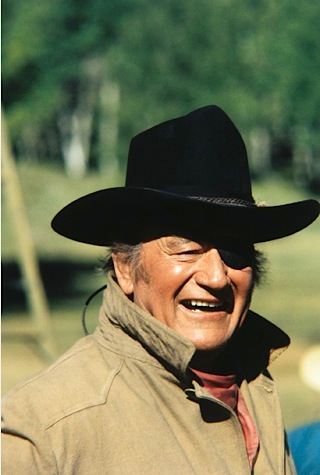
The Duke on Rooster: “My first good part in 20 years”
By Roger EbertDecember 8th, 1968
Hollywood, California — Over in a comer of the big sound stage, John Wayne was playing chess. He was leaning against a packing crate and studying the board in complete oblivion to the commotion Henry Hathaway was raising 10 yards away.
Hathaway got into the movie business as a juvenile in 1908 and has been directing action and Western pictures since 1918. His directing style remains unchanged; he gets excited about three times a day and starts shouting at people. But he has white hair and looks gentle, as opposed to Otto Preminger, who has no hair and looks dangerous, and so Hathaway is known as a terror but regarded with affection.
Just now he was haranguing a group of extras who were supposed to be a courtroom crowd. “You’re all waiting for the other fellow to sit down,” he was saying. “Now it’s clear as day that some of you have got to sit down before the rest of you do. So when the judge comes in, don’t everybody stand around with his hands in his pockets.” His tone was that of an eminently reasonable ship’s captain addressing a cargo of madmen in the hold. “Now let’s try it.”
“Here we go,” Wayne said. He plays the part of Rooster Cogburn in “True Grit,” a Western comedy, adventure, satire or what-have-you based on the best-seller by Charles Portis. The press releases describe Rooster as a mean, ornery, one-eyed, no-good, low-down rapscallion, and Wayne obviously enjoys the part. He took another look at the chess board, decided not to move until the scene had been shot, got up and moseyed over to the set.
It turned out that the light men hadn’t arranged the lights to their satisfaction, so Hathaway decreed a 10-minute break and Wayne walked back off the set, pushing his eye-patch up on his forehead.
“This is, oh, maybe the fifth or sixth picture I’ve made with. Hathaway,” Wayne recalled. “Every director has his own way of handling actors. John Ford, now, had a rapier wit and if he wanted to zing somebody he’d hit ’em quick and pull back. Henry, on the other hand, uses a club.”
What was the last picture by Wayne and Hathaway?
“Let’s see. That would be ‘Sons of Katie Elder.’ I don’t care for it much, myself. I had just got over that cancer operation and I thought I could hear myself breathing all the time. Everybody said it was my imagination. Well, old Henry was very thoughtful of me, of course, since I was recuperating and all. He took me up to 8,500 feet to shoot the damned thing and the fourth day of shooting he had me jumping into ice water. Very considerate.”
Wayne chuckled. “All the same, give Hathaway a good story, and that’s what ‘True Grit’ is, and he’s great. He’s not so good on his own stories; I found that out. He can’t quite get objective about them. But I love this story. I tried to buy the rights and then I found out Hal Wallis was bidding on it. Between us we pushed the price clear to the sky, and then Wallis got it and cast me anyway.”
The story involves a spunky little frontier girl (played by Kim Darby) who sets off to avenge her father’s murder and hires Rooster as her paid gunman. Glen Campbell, the hot young country singer and TV host, makes his screen debut in the film as a Texas Ranger.
“The picture’s got to make a bundle,” Wayne said. “And for a change I have a good part. I’d say this is my first good part in 20 years.”
There were protests from Wayne’s listeners. “Well,” he said, “what the hell has there been? I’m always the straight guy who heaves the pack up on his back shouts, ‘Follow me!’ Everybody else in picture gets to have funny little scenes, clever lines, but I’m the hero so I stand there.
“Howard Hawks worked out a whole system based on that. He’d just stand me up as a target and run everybody at me. ‘EI Dorado,’ that was just a remake of an earlier picture by Hawks, ‘Rio Bravo.’ And in both pictures you had Robert Mitchum or Dean Martin as the drunken sheriff, and you had the old deputy and the young kid, and where did that leave me?
“And in that picture, Who Killed What’s-His-Name? Yeah, the John Ford picture: ‘The Man Who Shot Liberty Valance.’ They had Lee Marvin as the colorful heavy, and that young Irish fellow playing the intellectual, and Andy Devine playing the best friend, and Jimmy Stewart to get a laugh kicking the horse crap out of his way, and what was left? Try to wind your way through that one…”
Wayne said he was talking in professional terms. “What I mean is, I haven’t been short of good roles in terms of starring roles, but I’ve gotten damn few roles you could get your teeth into and develop a character. Until Rooster in ‘True Grit,’ I haven’t had a role like that since ‘The Searchers’ (1956). And before that, maybe ‘Sgt. Stryker’ or ‘She Wore a Yellow Ribbon,’ another great Ford picture.
“But look at ‘The Quiet Man.’ Everybody was a character but me. For three fourths of the movie, I had to keep alive just walking through it. Those are the tough ones to do. At least in ‘Rio Bravo,’ I had a couple of gags in addition to furnishing the father image.”
He unwrapped some peanut brittle and took a bite. “And old Rooster is going to be a lovely role. When this picture’s over I got to go to work and get some of this weight off.” He grinned. “But it’s pretty nice playing a fat old man.”
Hathaway walked over, slapped Wayne on the shoulder, and said, “All right then, Duke, let’s get to work. Always assuming, of course, that I can get those damn fools to sit down when the judge comes in.”
“Heah come de judge,” said Wayne.
Some 200 of my TwitterPages are linked at the right.
var a2a_config = a2a_config || {};
a2a_config.linkname = “Roger Ebert’s Journal”;
a2a_config.linkurl = “http://blogs.suntimes.com/ebert/”;
a2a_config.num_services = 8;
Freddie Mercury vs. the Platters & Wayne’s World
Freddie Mercury was born today, Sept. 5, in 1946 in India.
☑ All of my TwitterPages are linked under the category Pages in the right margin.
var a2a_config = a2a_config || {};
a2a_config.linkname = “Roger Ebert’s Journal”;
a2a_config.linkurl = “http://blogs.suntimes.com/ebert/”;
a2a_config.num_services = 8;
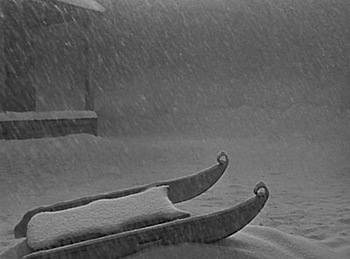
“Rosebud” was a rather tawdry device
Can you spot props from the movie? Before scrutinizing this frame from the film, you should watch the scene. Embedding has been disabled, but go here to view the ending of “Citizen Kane.
Here are my Great Movies review of the film, and my Viewer’s Companion to Citizen Kane.
The 2-disc Special Edition includes my commentary track.
var a2a_config = a2a_config || {};
a2a_config.linkname = “Roger Ebert’s Journal”;
a2a_config.linkurl = “http://blogs.suntimes.com/ebert/”;
a2a_config.num_services = 8;
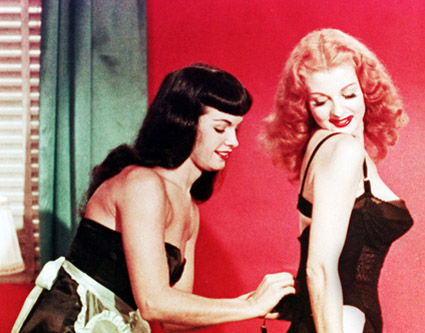
Teaserama!
Each week inside The Ebert Club, we aim to amuse and delight our readers, not just inform them; as anyone can do that. Instead, we aim higher and reach for the best – and if we fail, we compromise and reach for the best of the worst, or at the very least the last thing you’d ever expect to find. Behold a “naughty” b-rated trailer covered in 1950’s cheese! Go here to join the Club and explore a truly eclectic assortment of finds. Your subscription helps support the Newsletter, the Far-Flung Correspondents and the On-Demanders.
Go here to join the Ebert Club. Your subscription helps support the Ebert Club Newsletter, the Far-Flung Correspondents and The Demanders.
The 2013 winners of the Chicago Association of Film Critics
Click here for a page of the 2013 CAFC full speeches from the Award Ceremony.
And click here for the Honor Roll of Chicago Film Critics’ complete list of winners of the 2013 Awards.
“You being in love,” by e. e. cummings
you being in love
will tell who softly asks in love,
am i separated from your body smile brain hands merely
to become the jumping puppets of a dream? oh i mean:
entirely having in my careful how
careful arms created this at length
inexcusable, this inexplicable pleasure-you go from several
persons: believe me that strangers arrive
when i have kissed you into a memory
slowly, oh seriously
-that since and if you disappear
solemnly
myselves
ask “life, the question how do i drink dream smile
and how do i prefer this face to another and
why do i weep eat sleep-what does the whole intend”
they wonder. oh and they cry “to be, being, that i am alive
this absurd fraction in its lowest terms
with everything cancelled
but shadows
-what does it all come down to? love? Love
if you like and i like,for the reason that i
hate people and lean out of this window is love,love
and the reason that i laugh and breathe is oh love and the reason
that i do not fall into this street is love.”

“Sita Sings the Blues”
We showed this inspired film at Ebertfest 2009. It ran into copyright trouble involving the old records it used. Nina Paley then sidestepped copyright laws by making the film a gift under Wikipedia’s Creative Commons. It has found so many admirers that it’s now #42 on IMDb’s list of the 50 Best Musicals of All Time, right there between “The Many Adventures of Winnie the Pooh” (1977) and “The Jungle Book” (1967).
My blog entry, Having Wonderful Time, Wish You Could Hear.
My review of the film, sharing some wordage from the earlier blog.

Melissa Haizlip: Winner of this year’s $25,000 Chaz and Roger Ebert Fellowship at the Indie Spirits Awards
Melissa Haizlip was born in Boston and raised in the Virgin Islands, Connecticut and New York. After attending Yale, she moved to New York where she first collaborated with her uncle Ellis Haizlip when he produced the groundbreaking PBS special “Three by Three” for Great Performances: Dance In America (PBS).
After studying at Yale, and a 25-year career as a professional Broadway stage performer and TV / film actor, Melissa moved to Los Angeles to work in Development at the American Film Institute. She soon began casting for independent features, including “40,” a multi-storyline, international thriller set in Turkey and Africa. After winning the Golden Orange Award for best new talent at the Antalya International Film Festival in Turkey 2009, “40” premiered at the Toronto International Film Festival 2010, screened at Osaka 2010, and received special jury mention at Palm Springs 2011.
In 2009, Melissa founded Shoes In The Bed Productions, an independent film production company producing cinematic works of non-fiction with an emphasis on diverse new voices and filmmakers of color. The company’s first feature-length documentary, Mr. SOUL! was featured during IFP’s Independent Film Week 2010, Spotlight on Documentaries Forum, and is a participant in the 2011 Producers Guild of America Diversity Workshop. Mr. SOUL! screened at the Congressional Black Caucus Foundation’s 41st Annual Independent Film Series in 2011. This project is supported in part by the National Endowment for the Arts, which awarded a Spring 2012 Arts in Media grant to support producyion and post production costs of Mr. SOUL! Melissa is a Project: Involve Fellow in Film Independent’s Class of 2012-2013.
And here is a link to the the Website for Melissa’s film: .
And a link to my review of a previous winner.

Free sample of Ebert Club Newsletter
This is a free sample of the Newsletter members receive each week. It contains content gathered from recent past issues and reflects the growing diversity of what’s inside the club. To join and become a member, visit Roger’s Invitation From the Ebert Club.
Marie writes: Not too long ago, Monaco’s Oceanographic Museum held an exhibition combining contemporary art and science, in the shape of a huge installation by renowned Franco-Chinese artist Huang Yong Ping, in addition to a selection of films, interviews and a ballet of Aurelia jellyfish.The sculpture was inspired by the sea, and reflects upon maritime catastrophes caused by Man. Huang Yong Ping chose the name “Wu Zei”because it represents far more than just a giant octopus. By naming his
installation “Wu Zei,” Huang added ambiguity to the work. ‘Wu Zei’ is Chinese for cuttlefish, but the ideogram ‘Wu’ is also the color black – while ‘Zei’ conveys the idea of spoiling, corrupting or betraying. Huang Yong Ping was playing with the double meaning of marine ink and black tide, and also on corruption and renewal. By drawing attention to the dangers facing the Mediterranean, the exhibition aimed to amaze the public,
while raising their awareness and encouraging them to take action to protect the sea.
Rock Hudson’s secret
By Roger Ebert / July 20, 1986
If Rock Hudson had collapsed in Los Angeles instead of in a Paris hospital, he would have died with all of his secrets still intact.
Knowing he had only weeks or months to live, Hudson and his friends planned a scenario in which he would be taken to a condo in Palm Desert, where a hospice-like environment would be created. Male nurses, sworn to secrecy, would care for him, and when he died the cause of death would be given out as a heart attack or cirrhosis of the liver.
There would have been no mention of AIDS, no revelation that Hudson was gay, none of the personal details that are now the subject of two new books and countless magazine and TV articles.That’s the opinion of Sara Davidson, whose authorized biography, Rock Hudson: His Story (William Morrow & Co. Inc., $16.95), is based on interviews with Hudson during the last 27 days of his life, and revelations by his closest friends.
“A lot of people said it was so brave of Rock to admit that he had AIDS,” Davidson told me. “But actually he wanted it to be hushed up. He thought of AIDS as the plague. It made him feel unclean, and he felt it would destroy the image he had carefully built up over 35 years. If he had collapsed in L.A., he would have been taken to a place like Cedars-Sinai, a hospital used to hushing up the details of movie stars’ illnesses. The news would never have leaked out, just as it hasn’t in the case of several other AIDS deaths of famous people.
“But he collapsed in Paris, and the officials at the American Hospital were enraged. They didn’t accept AIDS cases in the hospital, and they said either he would have to announce it, or they would. When the statement was drafted, Rock”s publicist and his secretary read it to him, and all he said was, “Go ahead, it”s been hidden long enough.” He was shocked at the response to the announcement: The cover of Newsweek, the 28,000 letters of support from fans, the sudden interest in AIDS research and fund-raising. I think the response gave him a lot of comfort in his last days.”
In her book, Davidson creates a portrait of a man who was homosexual all of his life, yet successfully created a screen image as a romantic lead, and kept his private life secret. “He had a gentleman”s agreement with the press,” she said. “They didn”t ask the obvious questions. As a result, he developed a sort of love-hate thing with the press, based on a certain contempt. When the announcement about AIDS was approved, he said, “Throw it to the dogs.”
Although Davidson”s book reveals hundreds of details that Hudson preferred to keep secret over the years, it cannot, she said, answer the question of how Hudson was infected with AIDS.
“He had the disease for a long time before it was diagnosed,” she said during a recent Chicago visit. “Perhaps as long as three to five years. He may have been one of the earlier cases. When he learned that he had it, he said, “Why me? I don’t know anyone who has AIDS.” It was thought that perhaps Marc Christian, his last lover, was the source, but Christian tested negative. Rock wrote anonymous letters to his last three sex partners, telling them they might have been exposed, but he may have had AIDS long before meeting them. There just wasn’t any obvious source of AIDS around him.”
In your book, I said, you write about a trip Hudson made to San Francisco, where he and a friend went sight-seeing in some of the wilder gay leather bars. Is it possible that he engaged in sexual practices common in those bars, and got AIDS that way?
“I”m not at liberty to say,” she said, somewhat surprisingly.
Were there restrictions placed on what you could or couldn”t say in the book?
“Ninety-nine percent of my original manuscript is still in the book. The parts that were taken out deal primarily with Marc Christian, who is involved in legal action. Actually, I found out a lot more about Rock Hudson’s sex life than I wanted to put in the book. I know what he liked, and how, and with whom, but I didn’t think it was in good taste to go into all the graphic details.
“Even so, I’ve been attacked for going too far. Liz Smith and Marilyn Beck were on ‘Good Morning America’ and they said, “With friends like Sara Davidson, who needs enemies?” But the book is the result of my conversations with Rock and his closest friends, and I believe it tells the truth.”
Did Hudson engage in some of the more bizarre gay sexual practices?
“No. He wasn”t into S & M, for example. He was basically a very romantic man. He was like a woman; he’d run and tell his friends when he’d found someone new that he was in love with. He always believed there was one single right person for him, Mr. Right, and he was always looking for that person, and always finding him.”
And one day, a Mr. Right gave him AIDS.
“Not necessarily. One of the possibilities is that he got it through a blood transfusion in 1981, when he was in Cedars-Sinai for open-heart surgery. The hospital is right in the middle of West Hollywood, a largely gay community, and little was known in those days about the dangers of AIDS from blood transfusions. It”s as likely a theory as any.”
How much time did you really spend with Hudson? How much of the book is really his own story?
“I spent the last 27 days of his life visiting his home every day. He wanted to tell his story and he told all of his friends to cooperate with me. He had his good days and his bad days. Some days he”d be feeling well enough to come downstairs, ask for food, visit with friends. His mind would be perfectly lucid. In fact, his mind was always alert and clear. The people who say he was out of his mind at the end weren”t there to make that kind of judgment. But obviously I knew I wouldn’t have nearly as much time with him as I wanted, and so before I even agreed to write the book I spent time with Mark Miller, his secretary, trying to find out what was known, and who knew it, and if they would talk. I was satisfied.
“One surprising thing was that there were so few good articles written by other people about Rock. He was not a good interview. I hired a researcher to look through clippings, and our conclusion was that in 35 years he never gave a good interview to anyone, except once for an oral history project at Southern Methodist, where for some reason he opened up and talked for hours to a professor, maybe because he thought it was for posterity. In most interviews he was wooden and impersonal. And yet in person he was so lively and likable. It was said that the only way to really get him to open up was to spend hours drinking with him.”
Was he an alcoholic?
“In the last 10 or 15 years of his life, he drank a lot. It wasn’t easy, going from the No. 1 box office star in the world to No. 2, No. 6, and then dropping off the list altogether. The irony is that he just started to hit his stride as an actor in the 1960s, when handsome leading men like himself were on the way out. He looked at the new stars like Dustin Hoffman and called them the “Little Uglies.” He hated them because they didn’t have perfect faces. Rock Hudson never took a bad picture.”
“His career was absolutely of first importance for him. He placed it ahead of everything. When he read the script and saw the kiss, he agonized over it, but finally he decided to go ahead. I say in the book that he gargled with every known mouthwash. Actually, if you look at the kiss, he didn’t open his lips and it was sort of a chaste peck on the cheek.”
But even at that point in his illness, he was still taking his career that seriously?
“He had so much denial. After he was no longer a top box office star, he never developed other avenues — like producing, developing his own projects, things like that. He wanted to act right up until his dying breath. He appeared on those “Dynasty” episodes where he looked so thin and gaunt, and he would look at them, and say he looked like he did in his younger days. When he went to do that TV program (“Doris Day’s Best Friends”) with Doris Day, his life was literally hanging by a thread. He hadn’t had real nourishment in two months. She was so bouncy and full of pep, so vivacious, and there was Rock, the same age, and he was in such obvious pain you could hear the bones creak. And yet they still had their old chemistry, and it was really moving, the way he touched her cheek and snuggled with her.”
So many people seemed to know Rock Hudson was gay, and yet it was a secret. How about his mother? Did she know?
Davidson grinned. “There’s a great story about that. His mother was a devoted bridge player. One day down in Newport Beach, she was playing bridge, and one of her partners had something on her mind, and finally blurted out, ‘I heard that Rock was gay!” His mother answered, “I know. And the hardest thing is, I can’t remember his boyfriends’ names. Three no trump.’ ”
var a2a_config = a2a_config || {};
a2a_config.linkname = “Roger Ebert’s Journal”;
a2a_config.linkurl = “http://blogs.suntimes.com/ebert/”;
a2a_config.num_services = 8;

My master thinks this is art
These are photographs of dogs by Tim Flach, collected in a London exhibition at Osborne Samuel Ltd, . at 23a Bruton Street.
The web page explains:
Dogs is Tim Flach’s follow-up to the successful Equus, applying the same wildly creative vision he first gave to horses, to dogs. Here, Flach once again sets out to document fully the lives of animals whose history is powerfully linked to our own and to provide a unique perspective on one of our closest companions: this time, dogs. Using photographs of dogs both solitary and in groups, as well as in varied settings and locations, Flach uses his lens to present a inimitable and engaging portrait of the physical and spiritual lives of dogs around the globe. Dogs delves deep into the psyche of this enduring bond to create an exquisite study of man’s best friend, and promises to deliver one of the most appealing, popular and exciting photographic tributes to dogs ever published.
This is one of Flach’s contact sheets:
var a2a_config = a2a_config || {};
a2a_config.linkname = “Roger Ebert’s Journal”;
a2a_config.linkurl = “http://blogs.suntimes.com/ebert/”;
a2a_config.num_services = 8;
Bob Marley: One Love around the world
var a2a_config = a2a_config || {};
a2a_config.linkname = “Roger Ebert’s Journal”;
a2a_config.linkurl = “http://blogs.suntimes.com/ebert/”;
a2a_config.num_services = 8;

I unwisely asked Marie Haws why it took so long for Snail Mail to reach her
Marie is the Hon. Sec’y of The Ebert Club, and editor of our newsletter. As you can see, she communicates well in images.
Here is a free sample of The Ebert Club Newsletter. So hop on board, already.
Whenever you send me stuff in the mail, you always wonder why it takes so long.
I live in a foreign country. 🙂
Otherwise, behold my physical mail box. Size of a shoe box, it can hold letters, flyers, DVD’s, bubble envelopes, etc. Anything bigger than that, and you’ll get a note from Canada Post to pick it up at the Mall, etc.
When it’s UPS or FEDX, they paste a sticker notice thing near your box so you’ll see it.
The building I live in was built circa 1973 and the style resembles Canadian architect Arthur Erickson, channeling Frank Lloyd Wright on Crack. LOL
Wait till you see the “Mall”…. it’s a 19th century diorama. 🙂
How to print out a firearm in the comfort of your own home
Thanks for the link to Michael Mirasol
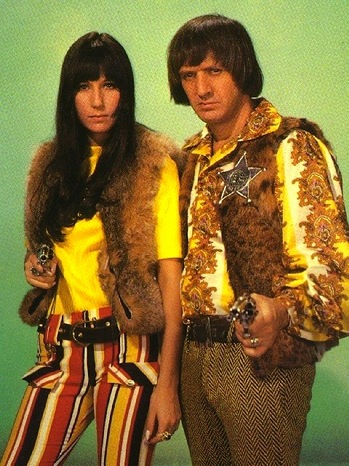
“It’s not like Dr. Jekyll and Mr. Hyde,” Cher said.
By Roger Ebert / May 7, 1967
To begin with, there was a little girl out in the hallway with long black hair and white bell-bottom trousers. She was sitting on a bench by the elevator, looking across the hallway into a mirror which showed her sitting on a bench by the elevator. So when you came up in the elevator and the doors opened, here was this image of a little girl with long black hair and bell-bottom trousers, looking into the elevator door at you.
At first your mind didn’t understand, and you thought maybe this was Cher herself, waiting by the elevator for you, and so you stepped off the elevator, smiling stupidly because you were caught off guard, and suddenly the little girl was behind you, and there you were smiling at her in the mirror, and she was scowling because she thought maybe you were trying to pick her up or something.
It was one of those totally unsettling, absolutely miserable situations. If you were James Cagney you would turn on her and snarl, “Dammit, you’re only 12,” and mash a grapefruit in her face.
But instead you knocked on the door of Room 640, and Sonny himself opened it, dressed in white bell-bottom trousers and a silk brocade shirt the color of rainbows. Then you heard this wail being sent up from behind you: “Sonnnneeeeeyyy!”
The scream propelled you into the room as Sonny hastily slammed the door. In the room there were two girls with long black hair and white bell-bottom trousers. They looked up at you and you wanted to explain that you weren’t the one who had been screaming just now, but it didn’t seem that they had heard anything.
“Hi, I’m Sonny,” said Sonny. Studying the two girls in the room he singled out one and said, “This is Cher.”
“Gratified,” Cher said. You saw that she wore a ring that said “Sonny.” You edged around to see Sonny’s hand, and, sure enough, he wore a ring that said “Cher.” All’s well.
The girl who wasn’t Cher said she would call Room Service.
“Well,” you said.
“Now that we’ve covered that,” Cher said.
“How about a drink?” said Sonny.
“I’ll just have a Coke,” said Cher. “No, Diet Pepsi.”
“It must be hazardous to be the idols of teeny-boppers everywhere,” you said. “Do you ever wish you could just, uh, walk down the street?”
“Oh, everybody knows us in Los Angeles,” Sonny said. “They’re used to seeing us. We don’t believe in being aloof and above everybody and all that. We try to be natural.”
Cher smiled. “The clothes may not look too natural, but out on the coast they don’t stand out too much. Here, I guess they look a little eight and a halfish.”
“Eight and a halfish,” we said.
“She means Juliet of the Spiritish,” Sonny said.
A silence fell.
“The only time you really have to worry about your fans is in a concert situation,” Sonny said. “Mass hysteria gets started, and adoration turns to hostility. The best thing to do in a situation like that is, don’t panic, but assert authority.”
“There was only one case where we got physically torn apart,” Cher said.
A waiter from Room Service came into the room and passed out menus. Sonny ordered a hamburger and a tossed salad.
“Dressing?” said the waiter.
“I’ll have the Roquefort,” Sonny said. “A wise decision,” the waiter said. “Soup or appetizer?”
“No thanks,” Sonny said.
“I’ll have English muffins,” Cher said. “No, make that just one English muffin.”
“One English muffin,” the waiter said “Soup or appetizer?”
“Whoddya think this is?” said Cher.
After luncheon was served, Sonny talked about the events of three and a half years, which have catapulted the couple to stardom.
“I had tried to be a singer on my own, but without success,” he said. “When I met Cher, I was a promotion man for a record company. I was fascinated. I thought she was beautiful. I knew at once she’d be great.”
“I was going to school at the time,” Cher said. “I was attending Montclair, an acting school. I didn’t really want to be an actress, but I had no interest in regular school and my parents thought this would occupy my time.”
Sonny said he hesitated before asking her to marry him.
“I knew she’d be a star. I didn’t want to be the husband in the background while she was famous,” he said. “I wrote her a poem, saying goodbye. But then we got married. I knew I had to be as powerful as she was if our marriage was to work. Without Cher, I was nothing as a singer. Together we were everything.”
Sonny said they now face their greatest hurdle.
“We have to change from singers to entertainers,” he said. “We have to develop an appeal for adults as well as the kids. People don’t buy a sound, they buy a personality. Look at Sinatra, Bogart, John Wayne.”
He said their current image, based on long hair and mod clothes, is simply an outward appearance.
“I don’t see why anybody can object to contemporary clothes if they’re neat and clean,” he said.
“It’s not like Dr. Jekyll and Mr. Hyde,” Cher said.
“You can dress this way, yet be ambitious, clean, and have good moral values,” Sonny said.
“That’s what we were trying to say in our movie,” Cher said. “If there’s a message in ‘Good Times,’ it’s don’t sell out.”
“We don’t make that unhealthy scene on the coast,” Sonny said. “A lot of kids are being mislead by Timothy Leary and Allen Ginsberg and Ken Kesey. The whole LSD crowd is nothing but a lot of bald-headed teeny-boppers. They’re really weirdos.”
“That sort of thing wouldn’t happen if parents knew where their children were at all times,” Cher said.
“That’s right,” said Sonny. “It’s up to the parents. The family has to unite again. There are altogether too many divorces.” He said his marriage with Cher symbolizes the possibility that people can be married.
“Not like a lot of these groups,” Cher said, “where there’s no telling what goes on.”
“Let’s face it,” Sonny said. “We’re pros. I’d wear a suit if I had to because I want the business.”
From the hallway carne a plaintive cry: “Soonnneeee!”
“I would go bald,” Sonny was saying. “I would cut off all my hair to play a role.”
var a2a_config = a2a_config || {};
a2a_config.linkname = “Roger Ebert’s Journal”;
a2a_config.linkurl = “http://blogs.suntimes.com/ebert/”;
a2a_config.num_services = 8;
