At the start of the year, I saw the rock band Geese perform on “Saturday Night Live.” The guitarist and vocalist Cameron Winter, whining nasally and wearing a sleeveless T-shirt that screamed “I Don’t Play Rocky,” was particularly unimpressive to me. And one of the songs was named “Au Pays Du Cocagyne,” which might be a conscious allusion to Breughel but maybe isn’t and is pretentious beyond words either way.
The whole Geese “thing”—the From-Brooklyn hype, Winter’s mondo-boho upbringing (his mother is the author of a book about her experiences in polyamory, woo hoo!), the way Winter ostensibly manages to front a group and have a solo career—left me kind of cold. In point of fact, Geese mainly brought to mind a beloved old 10cc song. Yes, “The Worst Band In The World.”
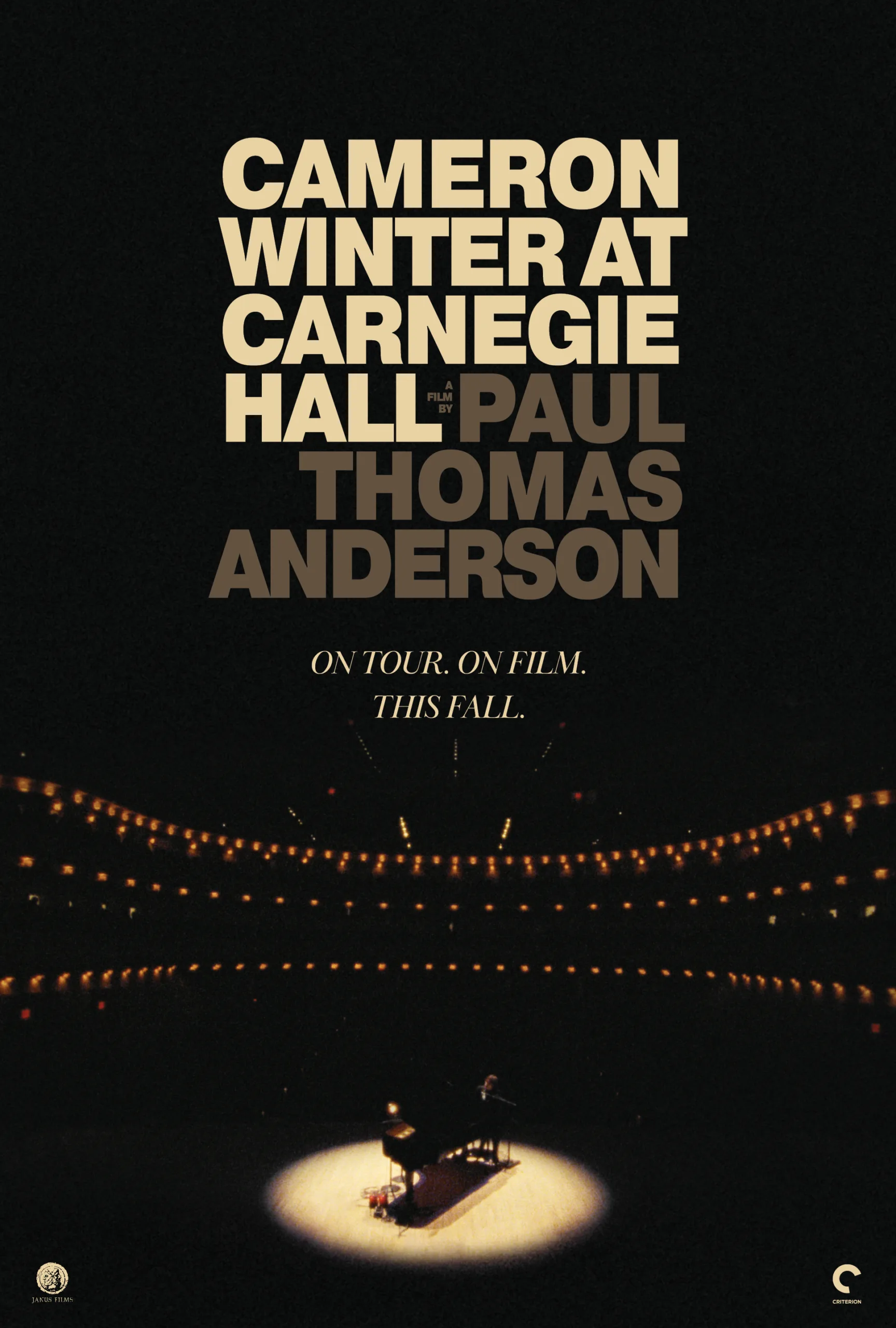
So it was moderately confounding to learn that Paul Thomas Anderson, a filmmaker I have long admired and with whom I’ve had lengthy and rewarding discussions concerning music (the last such chat was some time ago, admittedly, for “Inherent Vice” in 2014), had made a film of a Cameron Winter concert at New York’s Carnegie Hall.
One thing I’ve learned in my discussions with Anderson is that he has almost no use for New York City, so for him to hang out in New York City in the dead of winter prepping and shooting this December 2025 concert, he must really like the guy. And as we likely all know by now, Anderson, along with Christopher Nolan and Brady Corbet and a few other arguably persnickety directors, insists on shooting on real celluloid. For this picture he uses a combination of 16 and 35 millimeter. I reckon he had some say in the picture’s lighting as well; he’s credited as the picture’s cinematographer.
Winter’s songwriting tends to the emotionally intimate, you might say, but the feelings in which it deals are not what you’d call generous; his couplets teem with seemingly hermetic non-sequiturs, as in “send me the basslines of the future/my good sense doesn’t win me any wars,” which crops up in a song called, yes, “The Rolling Stones.” (He should write a song called “10cc” next, that’d be funny.) His tetchy stage manner complements this. His Steinway is positioned at a slight angle on the Carnegie Hall stage, so that on the stool his back is almost three-quarters turned away.
It will not surprise you to learn that he’s not big on stage patter. There’s not a whole lot you can do to visually snazz up this presentation. So Anderson mostly leans hard on the weird anti-charisma Winter projects. Every now and then he’ll throw in an extreme profile close-up of Winter, a light from the upper levels of the hall making a kind of rainbow pattern on his face as his nose hangs an inch above the keyboard. At one point, a camera from a backstage door rushes up behind him as he plays.
While the movie did not convert me to Winter’s music, it did compel me to afford it more respect. His pianism derives from both Elton John and Billy Joel, but he’s not nearly as impressive a player as either. As convoluted as the ironies of his lyrics can be, he delivers them with, in the words of the far superior artist Robert Wyatt, an “almost painful sincerity.” And his second-to-last song, a brutal farewell to an ex-lover called “Take It With You,” is an unabashedly staggering piece of work. More like those, please.