After a verrry long and fruitful week in Montreal, I’m now back in Chicago. Festivals can wear and tear on even the most sleep-deprived critic, especially at a fest like Fantasia, where the sheer volume of films on display can be downright overwhelming. Even so, I was grateful for my time there, catching up with old critic friends, meeting distant faces for the first time, and most importantly, partaking in some crucial Fantasia Fest traditions.
Every year, the audience collectively picks some pre-show ad to go gaga over. In years past, it was an old ramen commercial that the crowds performatively hoot and holler over. We’ve also sung along to the Teotaxi jingle. This year, our target of collective ritual was the commercial for Montreal’s Montréal-Trudeau International Airport; the ad comes on, the audience goes wild, and we get to work clapping along with the slick, corporate thump of the ad’s backing track. (RogerEbert.com contributor Katie Rife, shouting at full volume: “I love the airport!”) Then, of course, the universal chorus of meows that happens before any Fantasia screening, an annual tradition that sparked (allegedly) when a 2007 screening of “Simon’s Cat” went dark, leaving audiences to meow at the screen while the projector figured it out.
Good vibes all around, right? Well, today’s dispatch lets us swim in the ocean of decidedly bad vibes, with a tryptich of tales of people living or moving in filth, or otherwise realizing the world around them is coming apart at the seams and there’s nothing we can do about it.
I’ve been a fan of Canadian filmmaker Seth A. Smith since I saw his slimy, claustrophobic sci-fi thriller “Tin Can” at a previous Fantasia; his latest, “Permanent Damage,” feels like if Harmony Korine directed an episode of “Letterkenny,” and I mean that with all the love and confusion that entails. Emerging as if reborn from a garbage bag dropped in a badbug-infested landfill, escaped convict Tommy Gods (Calem MacDonald) makes a mad dash for safety, only to get caught trying to steal clothes from a dollar store. The only thing that saves him is the intervention of old Mrs. Whynot (Clare Coulter), who rolls up to him and assures the security guard that this is her son, Donnie. Of course, she’s not playacting; she’s deeply senile, but Tommy sees a chance for respite and goes with her to her run-down home.
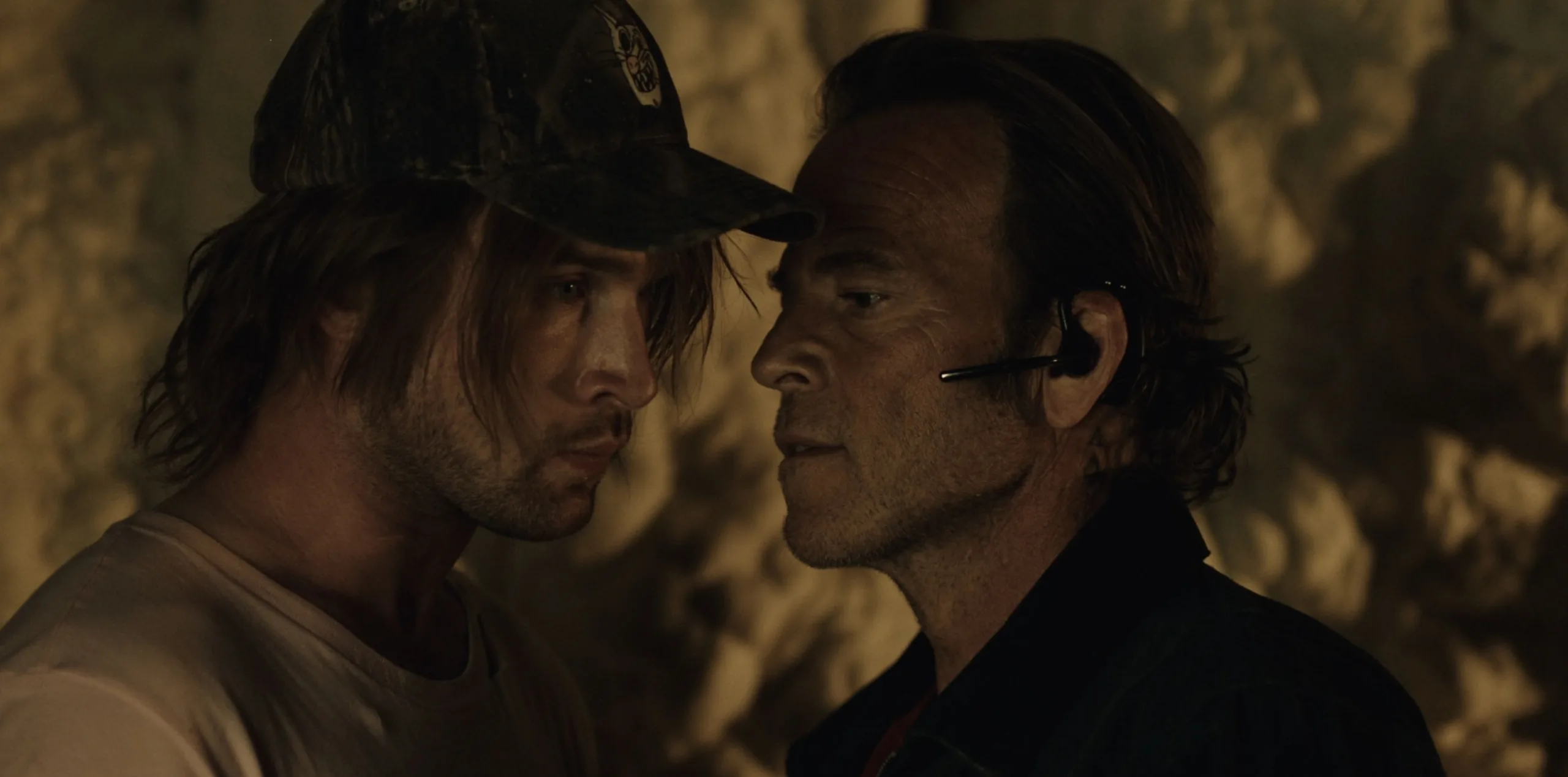
The rowhome becomes the setting for Smith’s queasy, surreal hangout crime picture, as Tommy adopts Donnie’s old life and starts spending time with the other crazy characters who sit and while away their lives among the flotsam that collects on their front lawn. He even starts falling in love with the beautiful young Joe (Olivia Scriven), a match made in heaven if not for the fact that her uncle, LL (Stephen Dorff), is their maniacal landlord, who’s all too eager to kick out Mrs. Whynot and tear the place down as tribute to the almighty gods of gentrification. All the while, Tommy and Joe look for a way to escape their life of poverty and save their flop house from LL’s white-hot sociopathy—a scheme that might involve a magic drug whose provenance is a highly lucrative secret, and a spoiler it’s best not shared here. (At the screening, they handed out ‘brown dot’s in little baggies and instructed us to take them at a particular point in the movie; once you find out what they actually are, you grow to regret it.)
Smith’s film is steeped in the modes of pop-punk slacker films from the 1990s, with crunchy EDM tracks sitting nicely alongside Julien Ferland’s ambient drone-heavy score. There’s a thick, ill fog in the film’s atmosphere, from the sight of wrecking balls slowly demolishing people’s homes to the hypnotic expansion of insulation foam being sprayed from a gun (an image Smith returns to several times with great effect; it’s everything from subtextual whitewashing of the realities of poverty to a comical weapon in the right hands). The cast inhabits their roles with delightful strangeness, including Dorff at his most pent-up and angry and one-scene wonder Stephen McHattie as an oddball drug kingpin who spends his time in a hot tub murmuring nonsense about crypto while a furry gives him an underwater blowjob.
It doesn’t all quite hold together, and “Permanent Damage”‘s quirks start to grow a bit stale as the film goes on. But I love the way Smith cares for these working-class characters, even as they shit, piss, and stick themselves to chairs; they’re doing everything they can to cling to what little the world leaves them, and finding what little happiness they can find. Decidedly welcome anti-landlord cinema.

Another returning golden boy from the fest is Mark H. Rapaport, whose previous film “Hippo” has frequently been compared to “Dogtooth” in its tale of stunted fucked-up childhoods; now, he’s back with “Godhead,” a religious thriller that feels like another Yorgos joint, “Bugonia,” with its tale of a pair of dangerous, oddball siblings (Sarah Coffey, “Hippo” star Kimball Farley) holding a middle-aged priest (Al Warren) with his own secrets hostage in his own church. The pair have a holy mission for Father: They know that one of them is the physical manifestation of the Holy Ghost, and require him to judge which one fits the Godhead. Then, by sunrise tomorrow, he must shoot them dead with the Smith & Wesson they helpfully bring along.
Rapoport lays down the building blocks of his tight, cohesive script so elegantly, sitting with Warren’s lonely, conflicted priest for a good long while before Firstborn and Secondborn are even introduced. William Babcock’s black-and-white cinematography, boxed in true Academy ratio, keeps us confined in the staid, austere walls of the lonely country church that is our stage. We see Father raising a young boy (Luke Speakman) dropped on his doorstep as a baby, clearly with love but with disquieting protectiveness, as he keeps the boy locked in a windowless room and blares apocalyptic sounds from loudspeakers to sell the notion that the world outside his walls is naught but hellfire.
Then the twins arrive, and “Godhead” turns into a locked-room psychological thriller that feels at once like a particularly potent episode of “The Twilight Zone” and evokes some of the best works of folk horror and religious torment. The cast is uniformly excellent; Green plays Father as a man sprinting toward faith to avoid the difficult choices, both past and present, he’s had to make. Coffey and Farley, for their part, are suitably macabre, the former all wily impulse and Farley as the twitchy, childlike counterpart. The script’s twists and turns remain surprising, even as some third-act developments teeter towards the absurd in ways that let down the sizzling tension of the first two acts. Even so, this is a film playing merrily with ideas of faith, certainty, guilt, and responsibility towards our fellow creatures. It’s also one of the best films I’ve seen at the fest.

Closing off our bad vibes trilogy is “Sour Minnows,” a film which also pairs nicely with fellow Fantasia entry “Dance Freak” in that they’re depictions of flagging men slowly watching in horror as their worlds implode around them in increasingly refractive ways. It begins, as all movies should, with the sight of several humans frantically licking the concrete of a Los Angeles street; the sight is witnesed by two slacker roommates, Ricky (David Brown) and Tepper (Chase Williamson), who can barely comprehend what they’ve just seen. Ricky, for his part, blocks it from his memory.
But the two slack-jawed zennials are forever changed by this sight, and as Harrison Atkin’s feel-bad comedy continues, the walls between time and memory and sanity start to collapse in ways that challenge even “Sour Minnows”‘ most willing viewers.
Speaking honestly, it would almost be folly to try to explain the linear plot beats of “Sour Minnows,” as Ricky, in particular, disappears down Lynchian rabbit holes of recursion and lost time and the collapse of all sense of reality, Atkins dragging us along for every blackout chapter and surreal encounter. This makes the actual film itself hard to parse, the only real throughline being watching Ricky’s slack-jawed descent into dissociation, with only friend and love interest Aura (Suzanna Son) offering tidbits of coherence in the form of a “Yellow Thing” that unravels your reality and gives you a “permanent state of déjà vu.”
Of course, the impulses behind Atkins’ madness are deeply relatable: Ricky’s day job is to help train an AI therapy chatbot, while he desperately tries to get a filmmaking career off the ground (he’s got plans for two shorts and a music video, none of which are explained in great detail). All the while, the news sputters nonsense at us and content comes and goes without us even remembering we’ve watched it (as evidenced by Ricky and Tapper trying to watch the signature film of a famous actor the news tell them has died; By the time Ricky’s plugging in the laptop to watch their torrented copy, Tapper is telling him they watched it already).
Watching “Sour Minnows” feels like experiencing a nervous breakdown; as someone who’s had them before, Atkins nails the sensation of your own understanding of yourself and the world being unmoored. Have you watched that movie already? How long have we been seeing each other? Did what I just experience really happen? What did I even do yesterday? For all its confusion, Atkins’ film does capture that feeling of being trapped in your own existential collapse. And for that, it’s a strangely comforting feeling. The world makes less sense every day, but at least we’re not alone.