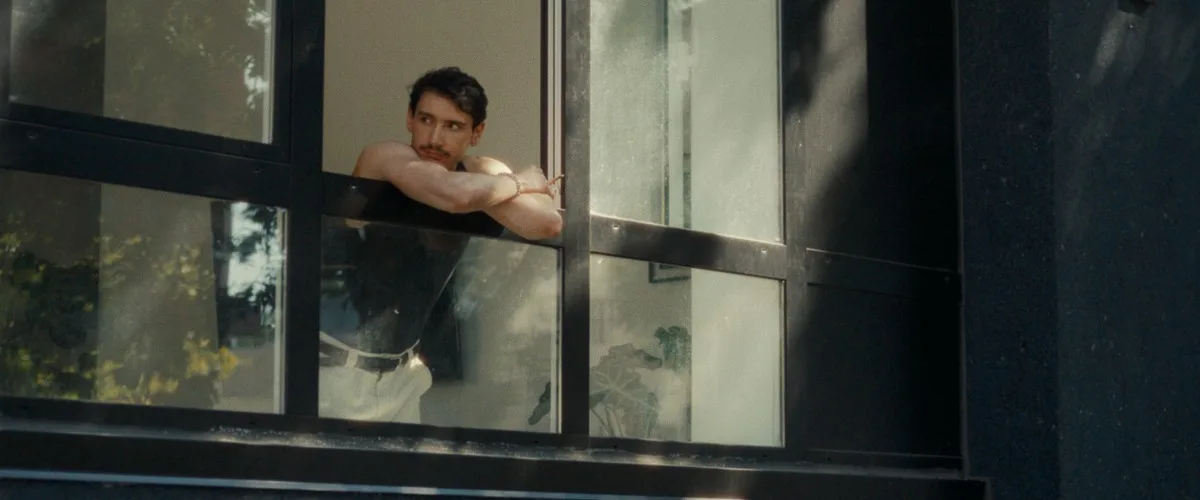
The city is as romantic as the country in the transformative queer drama “Drunken Noodles,” and a brief encounter can be just as meaningful and profound as a sustained relationship. We join Adnan (Latih Khalifeh), a college student, as he goes on an introspective and often pretty randy journey of self-discovery after he agrees to apartment-sit in Brooklyn for his uncle.
Adnan’s experiences are broken down into non-linear, freely associated vignettes, so it’s hard to tell whether he grows or progresses thanks to his encounters with the intriguing stranger Yariel (Joel Isaac) or his strained relationship with his boyfriend, Iggie (Matthew Risch). Still, one of the main pleasures of watching “Drunken Noodles” is seeing time and space expand repeatedly to accommodate Adnan’s wide-ranging stream of consciousness.
Among other things, “Drunken Noodles” is a rich and often thrilling trip into writer/director Lucio Castro’s personal understanding of how queer romance, sexual pleasure, and mind-expanding art can only flourish when we have enough room and receptivity to feel that everything inside us is either naturally or instinctively related.
We join Adnan and his itinerant train of thought in the middle of its journey, first alighting on his meetings with Yariel, a food-delivery guy with whom he shares an instant, credibly expressed connection. Then, after Adnan shows Yariel some of Long Island artist Sal Salandra’s graphic and playful embroidery art (lots of full frontal nudity!), he thinks back to how he first encountered Salandra’s work.
In real life, Salandra’s fabric art set Castro on his own path to making “Drunken Noodles,” a project initially conceived as a documentary about Salandra, who’s represented in the movie both through his canvas work and a fictionalized character played by Ezriel Kornel. Instead of painting a portrait of Salandra, Castro took a scripted/fictionalized approach to conjuring what he calls a “liminal space of desire” in the movie’s press notes.
Adnan’s story is remarkable not only because he finds sex and art to be mutually expansive means of connecting with others. Rather, what really stands out in “Drunken Noodles” is Castro’s knack for cultivating a shared gracefulness and air of possibility to unite scenes of pastoral beauty—leafy trees, unpaved roads, and a private brook, too—with enchanting urban settings where strangers can find and seduce each other anywhere, including city streets, art galleries, playgrounds, and apartments.
To be clear, it is thrilling to see Adan’s tender relationship with Yariel depicted with equal carnality and tenderness. It’s also wonderful to see that connection treated as more than just a deviation from, or a counterpoint to, his complicated relationship with Iggie. With one foot grounded in earthy pleasures and another testing more heady waters, Castro synthesizes Adnan’s experiences into a charming style that, as you watch, sometimes feels like entering a state of lucid dreaming.
The movie’s low-key but moody soundtrack is one of the few ways Castro makes Adnan’s private journey immediately accessible. Ambient sounds—especially crickets chirping, but also the low thrum of nearby car traffic—underscore the tranquil, abiding silence that follows Adnan from one episodic sequence to the next. Anything seems possible in this semi-dreamlike state since Adnan’s emotions are felt rather than explained through the malleable form of Castro’s movie.
“Drunken Noodles” is, in that sense, essentially about the soul-expanding crossroads that we hopefully find ourselves at whenever we allow a combination of worldly and intellectual pleasures to transport us, without judgment or distinction, to a heightened state.
Instead of transcending oppressive thoughts or the world’s crushing materiality, Adnan enjoys a sometimes mystifying and frequently disarming process of self-discovery that unites him with the various objects of his desire. It’s not always a sensible or relatable process for viewers to follow, but even the most whimsical stretches—particularly a tableaux vivant-style orgy and a late-night encounter with a kinky, flute-playing faun—have a vital and affecting clarity.
Rather than get hung up on either the primacy or sublimity of sex and art, Castro unpretentiously celebrates Adnan’s ability to find joy in exploring the burgeoning range of his desires. That process isn’t necessarily a means to any specific end or an inroad to personal catharsis, but rather an intimate and mysterious kind of self-expression.
In that sense, “Drunken Noodles” both is and isn’t a romantic drama since it’s more about how Adnan’s desires are fulfilled without necessarily serving a greater purpose or resolution. He finds a subtly profound pleasure in longing, as well as in fleeting moments of connection with people and places that only ostensibly seem defined by oppositional relationships. Here, Castro looks past those superficial differences and celebrates the everyday pleasures of making connections that can be felt without necessarily being fully understood.