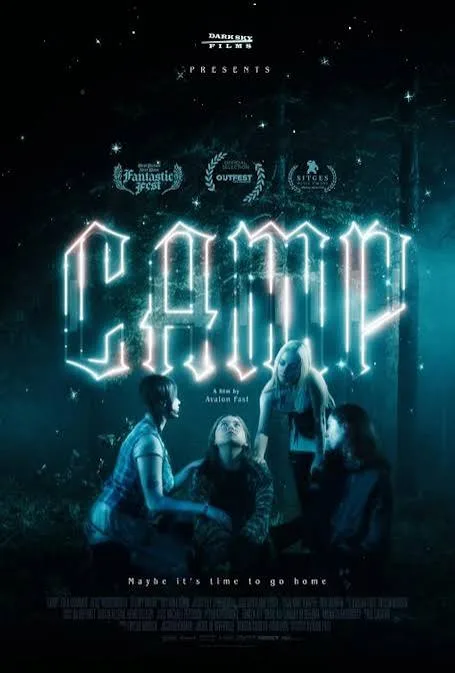

Movies about the grieving process tend to follow a specific arc. No matter how messy the characters might become, by the end of the movie, they’ll get up, make their beds, get sober, and bravely carry on. With their new witchcraft-themed “girl horror” film “CAMP,” Canadian writer/director Avalon Fast has created a counter-narrative about grief and guilt, one in which everything will still be okay even if you stay chaotic and keep getting high. Or it might not, because sometimes things just turn out for the worse. Either way, nothing you do or don’t do will make any difference, and there’s something freeing about that.
Fast’s film rejects Christian constructs of sin and repentance, and its moral agnosticism pairs well with the magical aspects of the plot, which go to darker places—these sorceresses have no problem inflicting harm—than in many other films of its kind. Most of the time, witches this wicked are the villains, but “CAMP” wraps its transgressions in such angelic warmth that, at times, it barely registers as a horror movie. This isn’t a film about overcoming darkness so much as embracing it, and seeing what, or who, might be waiting for you on the other side.
Although she’s barely out of high school, protagonist Emily (Zola Grimmer) has plenty of darkness to contend with: She’s responsible for the deaths of two people—inadvertently, but still—including that of her best friend, who overdoses in Emily’s car in a harrowing scene in the film’s prologue. Soon after, emotionally bruised and listless, Emily travels to northern British Columbia to work as a counselor at a summer camp for kids that Emily’s dad (Michael Tan) delicately refers to as “damaged.” He’s hoping that the change in atmosphere will help his daughter rebuild her sense of self; it does, but not in the way he expected.
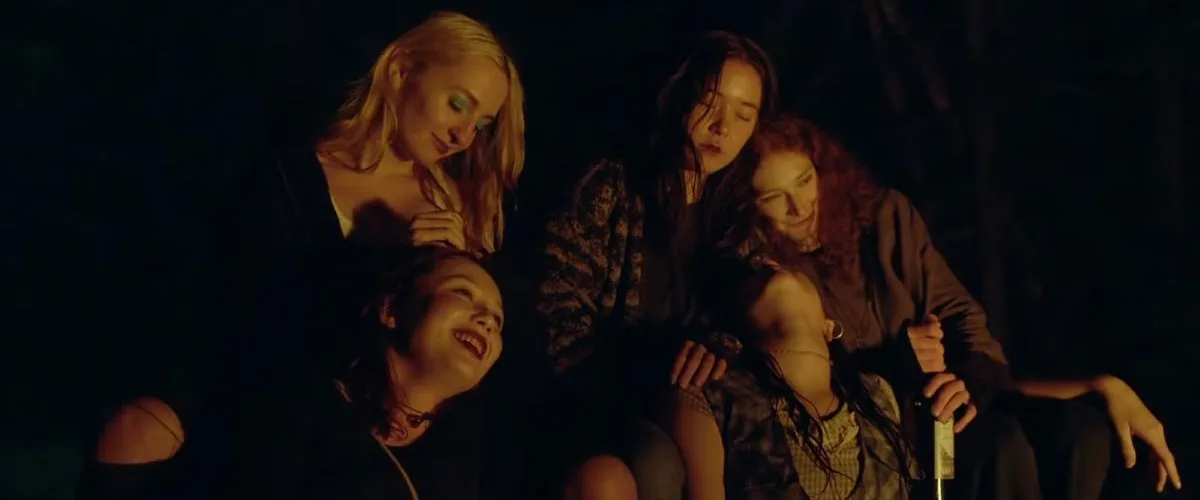
As it turns out, the hard-partying clique of lost girls who adopt Emily as soon as she arrives at the unnamed property (signs and buses simply read “CAMP”) is ingeniously using the cover of a Christian camp for troubled teens to practice witchcraft. At night, in between hedonistic bonfire parties, Clara (Alice Wordsworth), Rosie (Cherry Moore), Nev (Lea Rose Sebastianis), and Hope (Ella Reece) perform rituals that give them magical powers, which are granted in exchange for sacrifices. The bigger the sacrifice, the better the result.
The official summary for Fast’s film mentions “cursed cycles,” and there is an energy around “CAMP” that feels both benevolent and dangerous. This enchanted quality is accomplished largely through the cinematography—DP Eily Sprungman loves to smear a little Vaseline on her lens, creating a smudgy halo around much of the movie—as well as the blasts of fuzzy noise music in Max Robin’s score. But while her style is still developing, Fast is clearly a talented director, incorporating handcrafted multimedia touches and crafting intimate, consistently creative camerawork that effortlessly supports the movie’s charmed vibe.
“CAMP”’s dream sequences and ritual circles are especially delirious, putting the viewer into Emily’s hazy headspace in misty forest clearings under a blood-red moon as her sisters whisper for her to “fall from grace.” “Into what?” she asks. “All of this,” is the reply.
In those moments, the film’s stylized acting makes sense. It does take a while to get into “CAMP”’s dreamy groove, however, and the long, hypnotized silences in early dialogue scenes may be hard to overcome for viewers who aren’t already steeped in similarly avant-garde genre work from directors like Jennifer Reeder and Jane Schoenbrun. Even so, the chemistry between the cast members is so natural—many of them are friends in real life—that even skeptics will be gradually and seductively eased into the film’s wavelength.
Although “ethereal” is by far the best word to describe “CAMP,” the feral energy of Fast’s debut “Honeycomb” is present under the sparkly surface as well. So far, Fast’s primary area of interest as a filmmaker has been groups of girls and young women, and the magic and the violence of those relationships. “Camp” both severs and creates those bonds, and captures the exhilarating, terrifying feeling of losing yourself in a group of people. It urges you to take a leap of faith.
Does it all turn out all right in the end? That depends on how you look at it.