

“An image doesn’t have the responsibility to say something; they have to evoke something.” – Oliver Laxe, The Film Stage
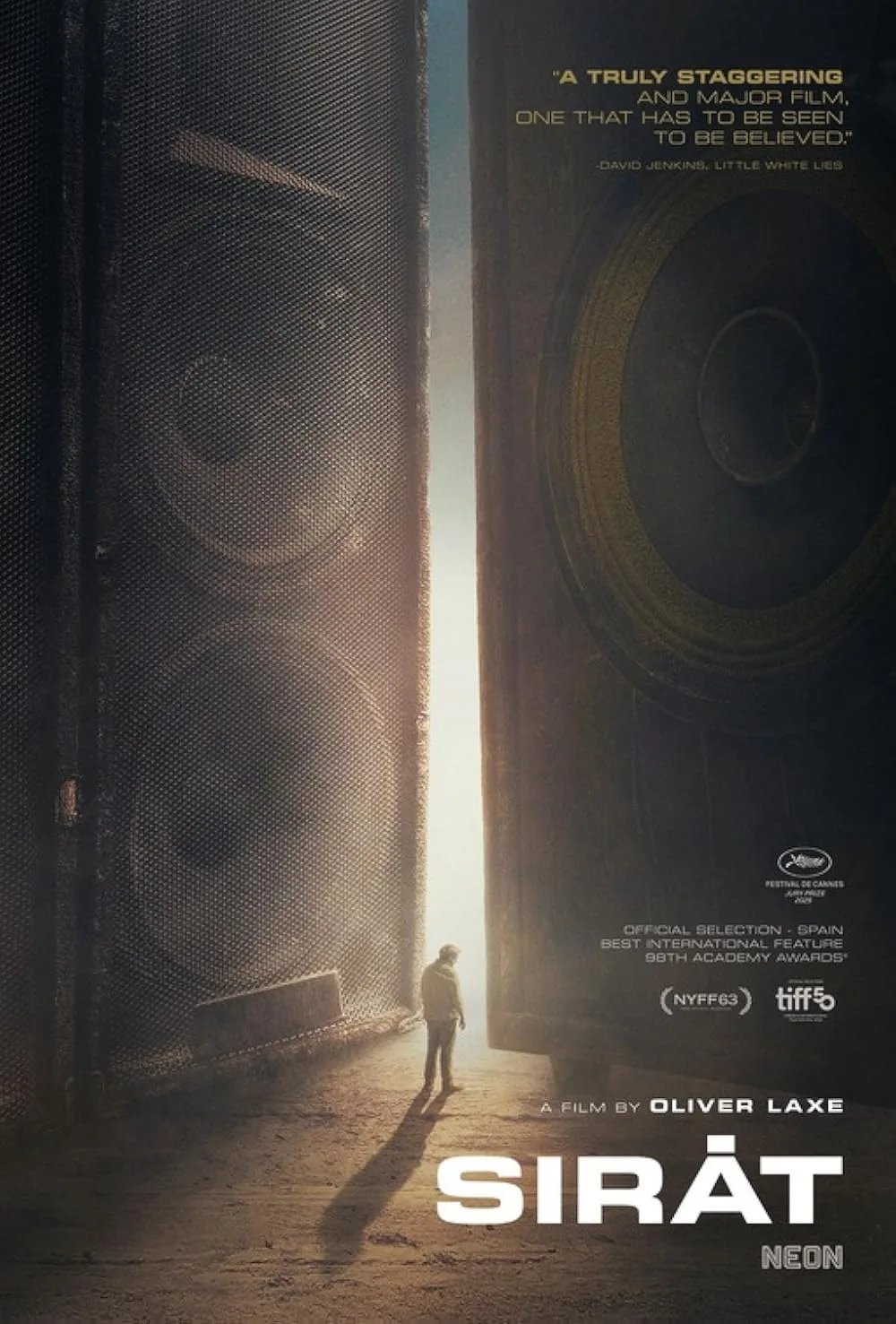
Oliver Laxe, the co-writer and director of the breathtaking “Sirât,” uses the visual and auditory assets of his form differently than even international audiences have become accustomed to experiencing. From the very beginning, his film is what the kids call a vibe, a movie that remains purposefully, and frustratingly for some, vague in its use of setting and depth of character, but one that has the power of a punch to the chest if you get on its wavelength. It’s a narratively simple film that has been interpreted differently by dozens of critics since its Cannes premiere last May, but it’s one that is impossible for this critic to shake, a reminder of what movies can do when they loosen the restraints of traditional narrative and remember that images are meant to evoke as much as they are to explain.
“Sirât,” which means “way” or “path” but also refers to a bridge that connects Hell and paradise, opens with an extended sequence of hands setting up speakers, the bass thumping across the rock formations in a Moroccan desert, and dancers bouncing and swaying to the music. There is almost no dialogue for the first 15 minutes of Laxe’s film, which lays the foundation for his evocative use of imagery and sound. Cinematographer Mauro Herce marries his imagery to the original music by Kangding Ray in a manner that’s entrancing, each working off the other to craft a cohesive vision of subcultures on the edge of a crumbling society, people who have found safety in their joint interests, only to find that shelter has collapsed.
It’s not just the ravers who are in trouble in “Sirât”, as news reports heard throughout hint at what’s basically the start of World War III back in urban civilization. Luis (Sergi López) and his son Esteban (Bruno Núñez Arjona) can’t concern themselves with that now; they’re too busy searching for Luis’s missing daughter, whom he hasn’t heard from in months. She was part of rave culture, which brought Luis into a world unfamiliar to him, where he handed out flyers at gatherings like the one that opens the film. When a group of armed soldiers arrives to evacuate the partygoers, a faction breaks off, and Luis follows them, hoping they will lead him to the next party and his child.
What starts like a mystery, then seems to shift to a story of subjugation by armed soldiers, and then becomes a desert road movie, with images of vans crossing a barren desert that almost echo “Mad Max: Fury Road” as a small convoy barter for fuel and rations. Herce and Laxe linger on shots of crumbling rocks along a cliff edge, and the dog Pipa accidentally ingests LSD in a manner that foreshadows greater trouble, but to say that “Sirât” takes unexpected turns would be an understatement. Fiction has conditioned us to expect unimaginable tragedy to be foreshadowed. Sometimes pain comes suddenly with an accident or an explosion. Sometimes your daughter disappears, and every decision you make to try to find her only takes you further from what matters. While Laxe and co-writer Santiago Fillol avoid grand statements of universal themes, it’s hard to not to consider “Sirât” as a product of its unpredictable era, one in which millions distract themselves from tragedy and danger with technology, entertainment, or maybe rave music. We’re all just dancing to the end of the world.
While pushing through a rainstorm up a nearly impassable mountain road, passengers trying just to get back to their people and their place, a character asks whether this is the end of the world. “It’s been the end of the world for a long time,” says another. There’s an existential dread that creeps into your bones while watching “Sirat,” a refusal to give audiences easy answers about, well, the end of the world. “It’s not for listening, it’s for dancing,” says Jade (Jade Oukid) of the ravers roughly a third into Laxe’s film, and it’s a hidden instruction on how to experience the film: don’t just listen, get on its vibe. There’s nothing more to be done about the end of the world.
There’s a scene late in the film, just before another wave of unexpected horrors, when Luis gets a chance to vibe again as speakers are set up in the middle of the desert, somehow feeling even more remote than any other part of the film. As the repetitive thump continues, emotion and rhythm overwhelm Luis. His thoughts and emotions in this scene are beyond words, beyond dialogue, beyond the over-exposition that is worse than ever in an era when films are made for people to watch with phones in their hands. The music is evoking something in him. He is no longer listening; he’s dancing.