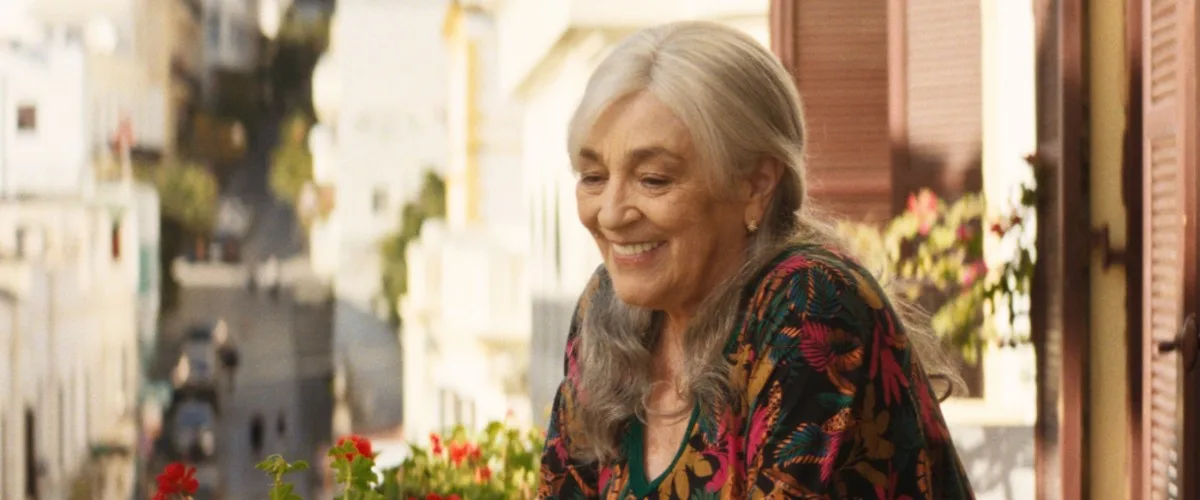
It can be hard to leave one’s home, but it’s even worse when it’s done against one’s will. That’s the predicament facing Maria Angeles (Carmen Maura), the gentle but determined protagonist of Maryam Touzani’s tender drama “Calle Málaga.” Maria is a life-long resident of Tangier, Morocco, where a Spanish community settled in the wake of Franco’s dictatorship. In her late 70s, she has her routine, a close confidante in a nun named Josefa (Maria Alfonsa Rosso), and friendly neighbors who know her well. When her daughter Clara (Marta Etura) arrives for a whirlwind visit from Spain, she tells her mother that she is selling the family’s long-held flat to buy a new home outside Madrid for her and her kids, inviting her mother to live with them. It is more of a demand than an offer, and Maria has no intention of moving to Spain. As her world crumbles around her, Maria finds a way to reclaim the possessions her daughter sold off and even discovers love at an unexpected time in her life.
Touzani, who wrote “Calle Málaga” with Nabil Ayouch, brings a sensitive touch to Maria’s feeling of displacement, taking care to show what Maria will lose in her move to Madrid—the friends, the sense of community, and belonging. At various points through Clara’s tumultuous visit home, she seems willfully ignorant of the many ties Maria holds to this place, looking past the many faces who greet her and her mother, or forgetting that her father’s grave is a place Maria still likes to visit. It’s possible she’s so selfishly motivated in her own distress (she’s trying to bounce back from a divorce) that she can only see her own pain and not that of her mother. But any way you look at it, Maria’s crisis is a difficult one, an issue neither mother nor daughter will see eye-to-eye on.
Despite the tough circumstances in which we meet Maria, it’s lovely to follow Touzani’s elder protagonist as she enjoys adventures of her own, especially as Clara (and likely other members of society) consider her to be too senior to live on her own, run a football watch party, and fall in love again. Maura’s performance is at once understated yet expressive. She’s never overly melodramatic despite the life-changing challenges her character faces. Instead, she lets her body do all the talking. After Clara broke the news that she planned to sell the home, Maura makes Maria a solemn statue, head held high and visibly resolute.
She only rarely shows her horns when the impositions become too overbearing. At the senior home, Clara tries to move her to, Maria dismisses the two hairdressers who insist on cutting her long hair short for easier upkeep with a snappy put-down. Yet, when Maria strikes up a connection with Absalom (Ahmed Boulane), the antiques dealer who sold her things, Maura shows a softer side of her character, one that’s giddy with the possibility of romance and practically melts on his arm when he successfully negotiates the return of her record player. New love can find a person at any age.
That excitement does not make leaving one’s home any easier. Despite the warmth that runs throughout much of “Calle Málaga,” there’s also an anxious undercurrent that Maria’s newfound life in the city is on borrowed time. As someone who has moved almost more times than she can count, the importance of a sense of community and home has only grown deeper with time. I will never know what it’s like to spend a lifetime in one place, but I know a little of the heartache so beautifully rendered in Touzani’s film. To lose the places we find comfort in, the faces that smile when they see us, or the destinations that hold so many memories that return to us every time we walk by them is a loss of its own. Yet, Touzani’s “Calle Málaga” is a reminder to savor the days we have in the places and communities we hold dear. We’ll all have to move on sometime.