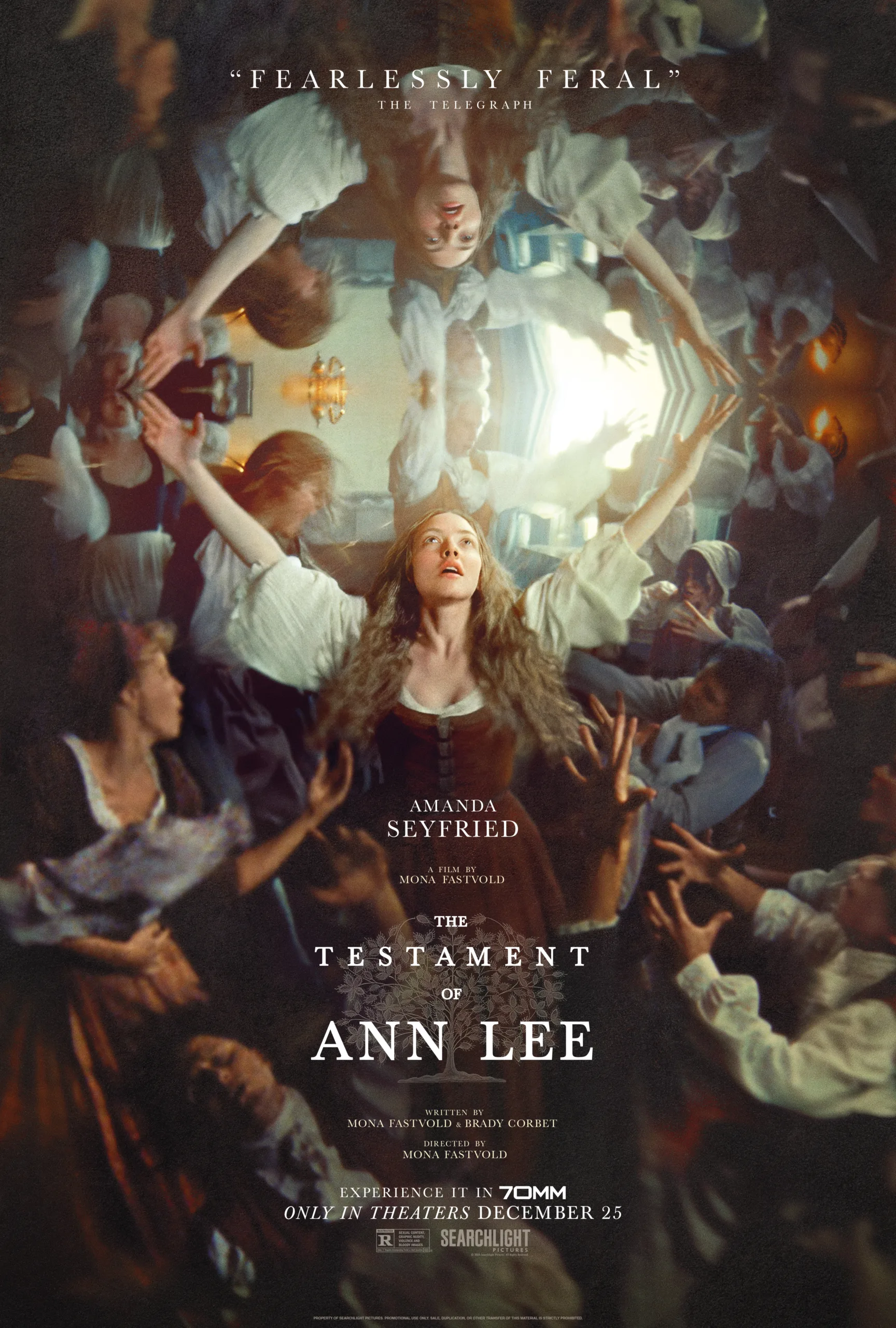

Husband-wife duo Mona Fastvold and Brady Corbet proved they make an excellent team with last year’s American epic, “The Brutalist,” which they co-wrote with Corbet behind the camera. This year sees them penning yet another wide-spanning tale of ambition set against a colonial backdrop, this time with Fastvold at the helm and Amanda Seyfried as the star. “The Testament of Ann Lee” is a large-scale production, mighty in detail, and Fastvold proves herself up to the challenge of her own aspirations, tackling the weighty biography with the same sort of labor-intensive dedication characteristic of its subject.
“The Testament of Ann Lee” takes us through the foundation of the Shakers practically from start to finish. It’s around four decades condensed to just over two hours, and while the development of the Shakers from England to the New World is certainly at the fore, so is the crafting of Ann Lee’s persona. She’s steadfast and a little gritty. Presumably gifted with religious visions, she is believed to be the second coming of Christ, whom the Shakers believe takes both the form of a man and a woman. Her core values are preceded by a life marked by physical labor and an early-born aversion to intimacy due to witnessing her parents in the act. It’s this dichotomy of the functions of the body–the relationship between work and pleasure, labor and payoff–that Fastvold molds into the center of her film.
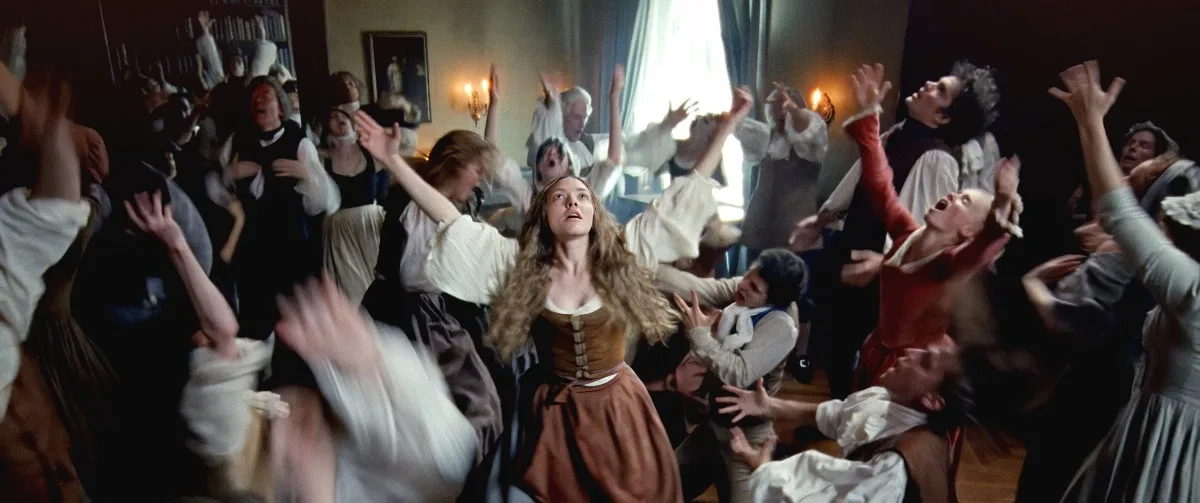
Perhaps most notably, the spellbinding Shaker movement, thanks to the film’s choreographer, Celia Rowlson-Hall, takes excellent advantage of the film’s musical genre. Hands beating on chests; arms outstretched to the skies; torsos heaving, feet stomping–soundtracked by grunts and wails, it’s all an embodiment of extreme catharsis. Its earthen quality foils the group’s heavenly influences, and this contrast is riveting.
The songs are just okay, though Seyfried’s singing is undeniable. Her performance anchors the film. She is raw and open, torn wide apart and glowing. Inhabiting Ann’s stoicism and commitment to the laws of her beliefs, there’s also a palpable tenderness and vulnerability swimming in Seyfried’s eyes. The accent work across the board is a bit shoddy, but in fairness, one kind of stops caring once the film reaches the next of many crescendos.
The film’s chapters are narrated by Sister Mary (Thomasin Mackenzie). While it’s clear that the narration serves as a tool for delivering so many decades’ worth of information and context, it also lends itself to moments of reveling in the film’s painterly qualities. Fastvold’s direction, coupled with William Rexer’s expert chiaroscuro, is reminiscent of the frames on museum walls. “A place for everything, and everything in its place,” is a dogma of Ann and Fastvold’s framing, as the film’s blocking gives way to numerous beautiful tableaus–shots to remember.
And this remembrance is both in the intention and the failures of “The Testament of Ann Lee.” Fastvold’s film feels like a tribute, an act of instilling memory. And yet, I’d be dishonest to say that the film, on the whole, was very memorable. It is most certainly an expert display of craft: the script is generally nimble, the visuals are stunning, and the choreography is moving. But it is bloated in history and starving for persona. Ann Lee was pious and dedicated, but in this film’s depiction, not much else. Therefore, the extended chapters of the film’s framework become repetitive, as do its themes. There isn’t a single performance in the bunch that can touch Seyfried’s, leaving the film aching for chemistry.
“The Testament of Ann Lee” will no doubt draw comparisons to “The Brutalist,” and in many ways, almost seems to shoot for companion piece status. But what the latter possesses is a complexity and harmony that, across the board, this film fails to find. “The Testament of Ann Lee” has its shining moments, but ultimately, its ambition outstrips Fastvold’s execution.