Man of Steel
The title "Man of Steel" tells you what you're in for when you buy a ticket to this immense summer blockbuster: a radical break from…
Claustrophobia isn't often considered a cinematic asset beyond tales of suspense and horror. But "Fill the Void," an award-winning Israeli drama about a naive 18-year-old…
"The Ballad of Narayama" is a Japanese film of great beauty and elegant artifice, telling a story of startling cruelty. What a space it opens…
Patrice Leconte's "Monsieur Hire" is a tragedy about loneliness and erotomania, told about two solitary people who have nothing else in common. It involves a…
Here are some ways to celebrate Roger's birthday (a birthday shared by Sir Paul McCartney).
A remembrance by Roger Ebert's book editor Donna Martin: "I had never even seen "Siskel & Ebert" on television when I knew I wanted to…
Suicide glamour and magazine-shaming; how American textbooks dumb down Vietnam; remembering the late investigative journalist Michael Hastings; why sex on the first date is not…
Here are some ways to celebrate Roger's birthday (a birthday shared by Sir Paul McCartney).
Kevin B. Lee reports on the film series at MoMA that he co-curated.
Katherine Tulich talks to Julie Delpy, Ethan Hawke and Richard Linklater about returning once again to the characters from "Before Sunrise" and "Before Sunset" for…
This summer's Millennium Park screenings kick off with a dedication to Roger Ebert.
Craig D. Lindsey is on the warpath against jerk cinema, in which arrogant heroes trample all over everybody and the film celebrates them as righteously…
Named after the David Cronenberg film, this is the blog of RogerEbert.com founding editor Jim Emerson, where he has chronicled his enthusiasms and indulged his whims since 2005. Favorite subjects include evidence-based movie criticism, cinematic form and style, comedy, logical reasoning, language, journalism, technology, epistemology and fun. No topic is off-limits, but critical thinking is required.

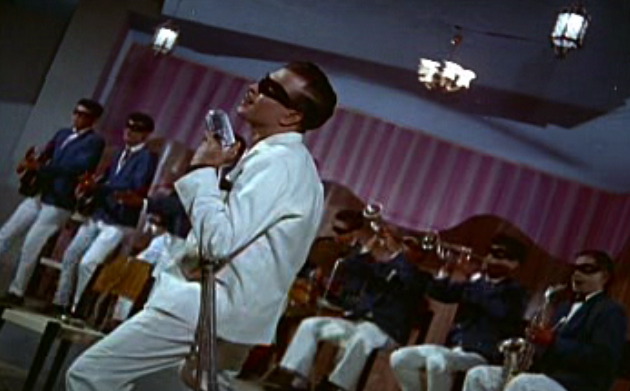
"Jaan Pehechaan Ho"
Terry Zwigoff ("Crumb," "Bad Santa," "Art School Confidential") said that as soon as he saw this musical number, "Jaan Pehechaan Ho," from the 1965 Bollywood production "Gumnaam," he knew he had to have it for the opening of his film "Ghost World." You can see why. It's mesmerizing -- one of the wildest, craziest musical numbers I've ever seen. The (Lynchian) energy is so frenetic the thing practically pops off the screen. And the way it's directed and choreographed for film is fantastic. The camera is always in the right place, and the shots of the necessary duration. You never feel like the director and editor are just cutting between different angles at random (as in the last few centuries of music videos, or Oliver Stone movies), chopping up and defusing the kinetic energy of the dancers and the dance. Every shot (mostly full shots, with a few mediums and only a few well-chosen close-ups for punctuation) seems to have been planned with the camera in mind, so that the whole dance only exists as assembled on film. That's the way a movie musical number is supposed to be. And there's something going on in just about every part of the frame -- and in the foreground, middle ground and background, too! (I think the opening of the first "Austin Powers" movie was the last time somebody did it right like this.)
The whole number is available on the "Ghost World" DVD, and on the web -- here as an .mpg download and here on YouTube.
Groovy frame grabs and more after the jump.


Mondo Digital provides some background on the original film (also available on DVD), a two-and-a-half-hour spectacular described as "India's first horror-thriller" -- although it sounds kind of like an alternate-universe "Lost" ("Gumnaam," in fact, means "Lost One"):
A planeload of random passengers is forced into an emergency landing on a very large island with only one spooky house offering refuge from the torrential rain. Representing a cross section of society, the bewildered guests include a doctor (Madan Puri), a perpetually happy dancer (Nanda), studly would-be heartthrob Anand ('60s singer and director Manoj Kumar), and most memorably, a drunken showgirl named Miss Kitty (Bollywood favorite Helen). Inside the house they see a shrouded body which turns out to be the prankster butler/cook (Mehmood, with an odd Hitler moustache), who indicates he has been expecting them all to arrive and shows them into the dining room. There they find a book indicating that each person has committed murder at some point in their lives but escaped conviction, so their mysterious host has now decided to dole out punishment....


Next Article: Re: Saddam's penis Previous Article: The musician: John Darnielle on criticism
As we mourn Abrams’ macho Star Trek obliteration, it’s a good time to revisit that most Star Trek-ian of accomplishme...
I cried yesterday at a retreat while listening to Michael Buble's rendition of "Smile." The tears came from out of no...
Lateral tracking shots can get to the heart of a film more quickly and succinctly than any other technique. What are ...
Please help me welcome the new Editor-in-chief for Rogerebert.com, Matt Zoller Seitz. What Roger and I found refresh...