
 Great Movies


When I saw, and immediately wrote about, Nicolas Winding Refn's "Drive," I knew almost nothing about it except the title and that Ryan Gosling was in it. I remembered that it had received acclaim at Cannes back in May (I did not recall that Refn had won the best director prize) and, as it turns out, I hadn't seen any of Refn's previous films -- although "Bronson" and "Valhalla Rising" had been recommended to me by friends. Since then, I've been reading up on "Drive" and have discovered so many fascinating little tidbits (many of which confirm my first impressions) that I decided to put together this little primer.
I recommend that you refrain from reading this until you've seen the movie, though.
Cited influences include: Grimm's Fairy Tales, John Hughes ("Sixteen Candles," "Pretty in Pink"), Sergio Leone, Alejandro Jodorowsky...
On the title font:
Refn: Me and Mat Newman, who edits all my movies, we stole that in the editing table from "Risky Business."
-- from an interview with Scott Tobias at The A.V. Club
On the character of the Driver:
Gosling: I think he's somebody who's seen too many movies. He's confusing his life for a film, and he's made himself the hero of his own action film. He's just kind of lost in the mythology of Hollywood. [...]
I think that he's psychotic, but he's not a psychopath. He's a myth as well, you know? We tried to treat the film like a fairy tale, like Los Angeles is this fairy-tale land based on fantasies, and he's the knight in his mind and Irene [Carey Mulligan] is the damsel in distress. Bernie Rose [Albert Brooks] is the evil wizard, and Ron Perlman's [Nino] the dragon he needs to slay.
-- from an interview with Chris Kompanek at The A.V. Club
Refn: In the book there's a back story but I eliminated all that because I wanted him to be mythological. He's a man of dreams and imagination. He is the classic hero who appears when we are in need of him. He's an enigma. I did a movie called "Valhalla Rising" where the lead character did not have a past either.
There is something about this man that is always a mystery. You cannot identify with him because you can never be him. You can identify with him falling in love with his neighbor Irene and wanting to protect her, and yet he remains a mystery. So the actions are larger than life because they must have higher meaning.
-- from an interview with Regina Weinreich, Gossip Central
On paring down the script to the essentials:
Refn: I'm a minimalist. I eliminated all backstory for the driver and most of the dialogue. Ryan and I were into the idea of the part being almost silent. We decided the driver was a man who would only speak if he was asked a question and would only answer if he had something to say. I eliminated his backstory because I wanted him to be more mysterious, an enigma that would unfold throughout the movie. There could never be a specific reason that could be analyzed about why he was the way he was because then he would lose his mythological qualities. I think the shooting script that I handed in was 81 pages. In shooting I would continue to pare down the script. I shoot in non-chronological order, so probably by the end what I had shot was maybe 60 pages. So it was down to the bone.
When we were editing the film, there was almost zero coverage. Not just a master, but, say, a master and two close ups. That had to do with many things, one of which was having very little money and time, so you have to be very specific, but also it was a way of doing the Hitchcock trick of protecting the movie from being tampered with later on.
-- from an interview with Brandon Harris, Filmmaker Magazine Blog
Refn: We would meet every morning, whoever was in the scene, and we would say, "You wanna say this? You wanna say that? You wanna say this? You wanna say that?" And a lot of the time, I would always go for "less is more." I had just done "Valhalla Rising," which has no dialogue, basically. I love the language of silence. Like the character in "Vanishing Point" who is essentially also very existentialist in his silence. The great heroes are always more silent, from that to the Man With No Name to The Samurai and Shane. There's a mythology. The man who's always more silent is always the one who's unpredictable. Ryan was very much seeing The Driver as a man who wouldn't have a conversation unless he meant to have one, so you eliminated all small talk automatically. That, of course, was a great way to take everything out that had to do with that, which is unnecessary anyway, just filler that you don't need. People talk nowadays like it's the end of the world. We don't do radio plays or plays. We do movies, which is about what you see. Or what you don't see.
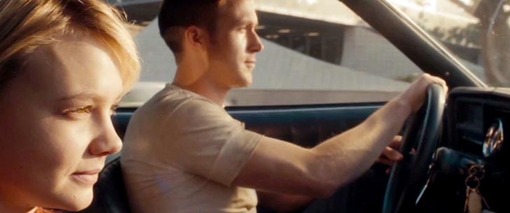
On Driver's repressed emotions and hugs for Gosling:
Refn: Ryan's dialogue was so reduced, which can be difficult for an actor. When you take away their dialogue, you handicap the actor and take away their movement...So they have to use parts of their body to communicate, which is harder than it looks. But a way to do that is to keep everything inside, so gestures and moves tells the story. But very quickly, people compensate, and move faster, and bigger, and more facial gestures, where they try to emulate something. But because we're making a movie, the camera sees, it's enlarged basically. So with Ryan, because he's such a unique actor, all you had to do is go over and hug him and hold onto him until he would let [go] into the hug. And I would say, "Keep it all inside, and go with God."
interview with Peter Labuza, LabuzaMovies.com
On emotional fetishism:
Refn: When [Gosling and I] met, there was a great connection between us that led to me seeing a movie in my head, about a guy who drives around in a car listening to pop music as a release. We experienced a similar emotion in a car and we wanted to make a movie about that emotion.
Then I went back and read James Sallis' book. I liked the stuntman story, and the script Universal was developing was pretty good also. Not everything was to my taste so I just picked and dissected everything and put the elements back into my fetish. I'm a fetish filmmaker.
On the colors and the compositions:
Refn: Well, I'm color blind so I can only see contrast colors, so everything in the film has to have that contrast. Most of the film is shot with wide-angle lenses, like Valhalla Rising, and Bronson for that matter. Each movie I want to see the background more than anything else, you know, the framing of an image. I want you to see what's behind the actor, what's going on behind the character action.
-- From an interview with Glenn Heath Jr. at Slant Magazine
On the reaction to the violence:
Refn: Anything graphic at that level will provoke laughter because it is absurd and bizarre and far out. So that will be a natural reaction. We did a screening at New York Times club and it was seniors and there was no laughter. So I think it depends on who you are. But any reaction to it is an interesting reaction. I guess I'm attracted to violence because it's my fetish. There's something very cinematic about it and primal, so I try to make it emotionally engaging. Violence works like sex--it's all about the build up to the climax. The better the foreplay, the better the payoff is going to be. And violence has the same DNA. It has to be very graphic because it digs into hyper reality, and that goes back to the Grimm's Fairy Tales with the retribution factor.
On consulting Gaspar Noe about the head crushing from "Irreversible":
Refn: Gasper's my friend. I called him up and went to meet him in Paris, where he kind of showed me how he did it. Then I went back and tried to emulate it. I think his is better. [...]
It's very technical. You shoot the scene with a dummy and then you move in and you shoot plate shots with a real human and then you put it together in a computer and make it work. In the end you add the sound effects, which really gives you the [audience] reaction.
-- -- from an interview tithe Craig Barboza, My DVD Insider
On the importance of the elevator scene:
Refn: There was a scene that was there that didn't really work. He had to protect Irene against the hitman. They were going to fight in the garage, and then he was going to kill the guy. But it was very important that he kill the guy very exclusively so the Irene character can see how he changed, how he had transformed himself. I couldn't make it work and ended up putting it in the elevator, having him kiss her before he smashes the guy's head in, to condense the movie into one scene. In all movies, you have to have one scene that is the heart, where all the blood flows from. It's the point of no return.
-- from an interview with Steve Dollar, GreenCine Daily


