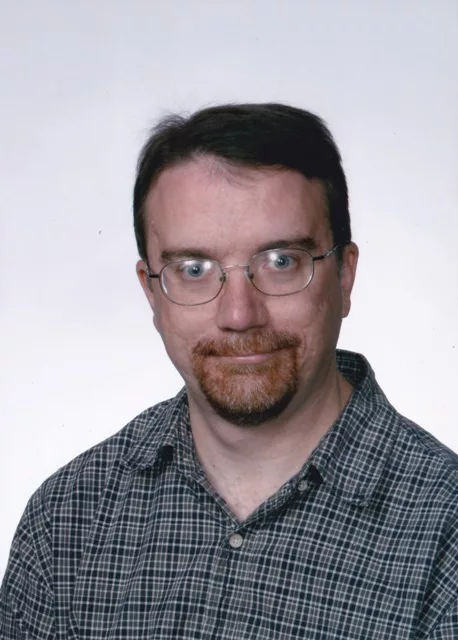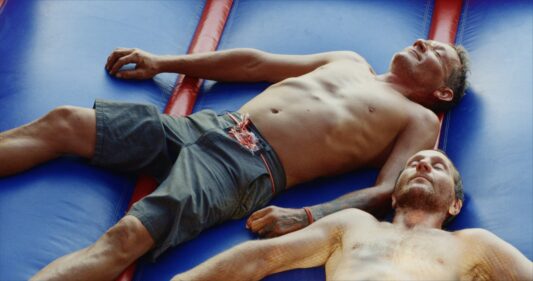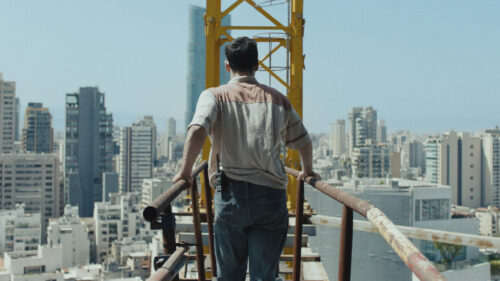

Michael Pantozzi’s “Off The Face of the Earth” opens with a reclusive photographer, Tim (Pantozzi), who struggles to find the courage to delete his social media account. Once he does that, will he truly be alone and perhaps freer? Or is he trying to take a stand against being a product that exists only to feed bots and algorithms? Whatever the case, it’s a monumental choice, and his mother (Kimmy Robertson from “Twin Peaks”) cannot fathom how he will exist in the world with no friends, especially when she relies on social media to keep in touch with hers, seeing as how her physical limitations keep her confined to the house.
Then something weird happens. Tim takes the dog for a walk on the beach and, while trying to take a photograph for work, he sees a woman about to jump to her death. The weird thing is, he can only see her through his phone camera and not in real life. He eventually learns that she might be a missing person who has been gone a long time, but this does not answer why he can only see her on his phone. Did she somehow “delete” herself as well?
Pantozzi’s premise remains intriguing throughout, even if we’re not exactly rooting for Tim in any capacity. He’s not always likable or charitable, and the way he treats his mother will put some viewers off. Still, Pantozzi builds the tension nicely and knows how to slowly reveal the nuts and bolts of the mystery at hand. Robertson is especially good as his poor mother, who only has the best intentions for her son and cannot wrap her head around his depression. Her final moment in the film is truly heartbreaking.
In the end, viewers will come away thinking about, among other things, their own social media presence and what it says about them, and the need to keep adding to it. What if you just disappeared from it all? Most people over a certain age who are reading this remember a time before Facebook and the like, but could you bring yourself to go back to that existence if you had to? If you’re already there, congratulations to you. Tim, for whatever reason, has that same need. Perhaps, just perhaps, his ending is actually a happy one.
Q&A with director Michael Pantozzi
How did this come about?
At a glacial pace. I had the initial idea for it maybe 10 years ago. One day, my now-wife (Kathleen Littlefield, who plays Ellen in the film) and I were trying to meet up after running some errands and could not find each other, even though we were on the phone and able to determine from our surroundings that we were in the same place at the same time. It was an unsettling, uncanny sort of feeling that later struck me as a good starting point for a high-concept short.
During the pandemic, I decided to completely get off social media. I did this for all the reasons that social media can be so horrible, but there was also an impulse to just withdraw from everything and not participate in this often very harrowing world anymore. I think it’s something many of us still feel these days. Like, why am I trying so hard to take up meaningful space in this nightmarish society? I can just stay home and get by doing very little with the people I really know and love, and nobody out there will see the difference.
But the feelings that followed once I did were somewhat unexpected. The first thing I realized was that this was the main way that I had crossed other people’s minds, and without it, I felt like I was in hiding. Like no one knew I was here anymore. I also suddenly felt much more in control of who had access to the time and energy I’d rather be spending at home with my wife. My next thought was: Wait a minute, I think I might want this.
But then this finally brought about what I needed to finish the script. Making art is, ideally, an act of communication, I think, and my inability to resist the urge to try to accomplish this led me to understand that simply vanishing wasn’t going to work for me.
Tell me about the casting. A lot of “Twin Peaks” fans are excited about seeing Kimmy Robertson again.
One of my earliest and fondest memories of moving to Los Angeles from the New York area, where I grew up, is watching “Twin Peaks” for the first time. I was living in a Park La Brea two-bedroom with three other people and subsisting on dollar-store deli meat and Trader Joe’s Simpler Times beer, and I remember feeling what, of course, the same thing so many of us have felt about it. It was just so formative and foundational. I had seen all of Lynch’s movies in college, and it felt like a major missing piece of the spiritual puzzle of the artist I hoped to become someday. That’s going to sound however it sounds, but it’s true.
And so when I set out to cast Margo, my own character’s mother in the script, that was where I started from, the on-screen place I perhaps loved most. Kimmy made by far the most sense, given that my own mother inspires the character. What she looks like, what she sounds like, the way she behaves. So I felt insanely fortunate when I sent the script to her manager cold and heard back that she was interested.
That said, I didn’t understand how fortunate I really was until the day she arrived on set. It was 105 degrees in September at this house in Glendale, the first of two days we shot there with her, and this was just nothing to her. “I’m a California girl, I shot in 125 degrees in the desert once,” she said. She was also an exceedingly smart, sophisticated, and generous actor. I couldn’t believe I was acting alongside this person who played such an iconic character, and it goes without saying that she’s as responsible for the film’s success as anyone.

The film touches on a wide range of issues involving the current climate of social interaction, or lack thereof. What do you ultimately think is at the heart of the loneliness Tim feels and wants to embrace?
Tim is in his mid-30s, which I think is a time when many people start to feel they see the writing on the wall about what the rest of their life is or isn’t going to include. I’ve hoped that it’s kind of easy to gather from Tim’s behavior that he probably hasn’t come away from most interactions with other people throughout his life feeling terribly good about them. I think in Tim’s head it’s: “OK, something about me just doesn’t really work for other people, and to be honest, the feeling is generally mutual, so I’m going to stop torturing myself, and letting other people torture me. This is much easier.”
The fact that we can never truly know what’s in each other’s heads, and that we’re essentially trapped in our own, even though life is this unique and incredible thing we all experience, is perhaps a fundamental tragedy of humanity. Some of us navigate this way better than others, but Tim is definitely not one of these people. That said, especially now, I don’t think anyone is immune to this sense that if we’re not widely observed, we may as well not exist. The tree in the forest that makes no sound when it falls. And Tim is no different: “Hell is other people” is still going to give way to “Hey, where is everybody and what are they doing without me?” particularly when the answer to that question is something as intriguing as his experience with Ellen.
There are many ways to interpret the film’s ending and its relation to digital erasure. Were there any other ideas for the ending that you thought about?
The disappearance in the final moment was the very last revision to the story, made in post after we shot it. I showed my parents an early rough assembly in which the final shot is just the two of them sitting on the bench. Tim has successfully made his way from the wider physical world into this strange liminal pocket of it that Ellen has slipped into, and we know they’re together now and are going to have to deal with each other, so we’re in this with them and able to perceive them as they perceive each other and themselves. Then, my father said something like, “Oh, huh, I thought they were both going to disappear from our view of them now after that.” So I really have him to thank for that final stroke there.
But the story was always: He’s looking for her, and then he finds her … one interpretation of which I imagine could be that digital erasure is not death, as much as it might feel that way. There’s been a fair number of responses I’ve heard that equate what happens in the end to a kind of suicide, which I thought was interesting. But I also think there’s perhaps an implicit hope that we can still find each other outside of all this.

Have you had any other interesting reactions to the film in terms of how it resonates with people?
Yes, one thing I’ve been thrilled about, in terms of both intention and result, is the space I wanted to leave for viewers’ own stories as they’re experiencing the film. There’s been a surprising amount of personal history shared that, on the surface, doesn’t seem to have much to do with anything I was thinking about when writing it. But the unifying pattern has been this sentiment: Relationships with others—let alone with the rest of the world via the internet—can feel so unnatural and just so, so hard. For some more than others, and indeed what about those of us who are among those some?
I’ve also been very pleased (though not surprised) by the vocal appreciation for not just Kimmy’s performance but also for the work of our DP Laela Kilbourn, who has deservedly won an Emmy, and our production designer Jenny Melendez. They are likewise among the authors of this film.
What’s next for you?
Everything else I have going on is at the writing stage. I’m writing a feature with the editor and associate producer of this short, Josh Bernhard, who is not the director of this short. However, I’ve also been getting started on something that could be a proof of concept for a feature. Either way, I’m still very slow, so these will probably take some time, but hopefully not nearly as much. Finally, I’m also helping (“The Nanny” star) Renée Taylor with some further work on her play “Dying Is No Excuse.” I appeared in it as an actor at the Berkshire Theatre Group over the summer and had the extraordinary opportunity to participate in its earlier development under the direction of Elaine May. Now it’s onto its next stage of life.