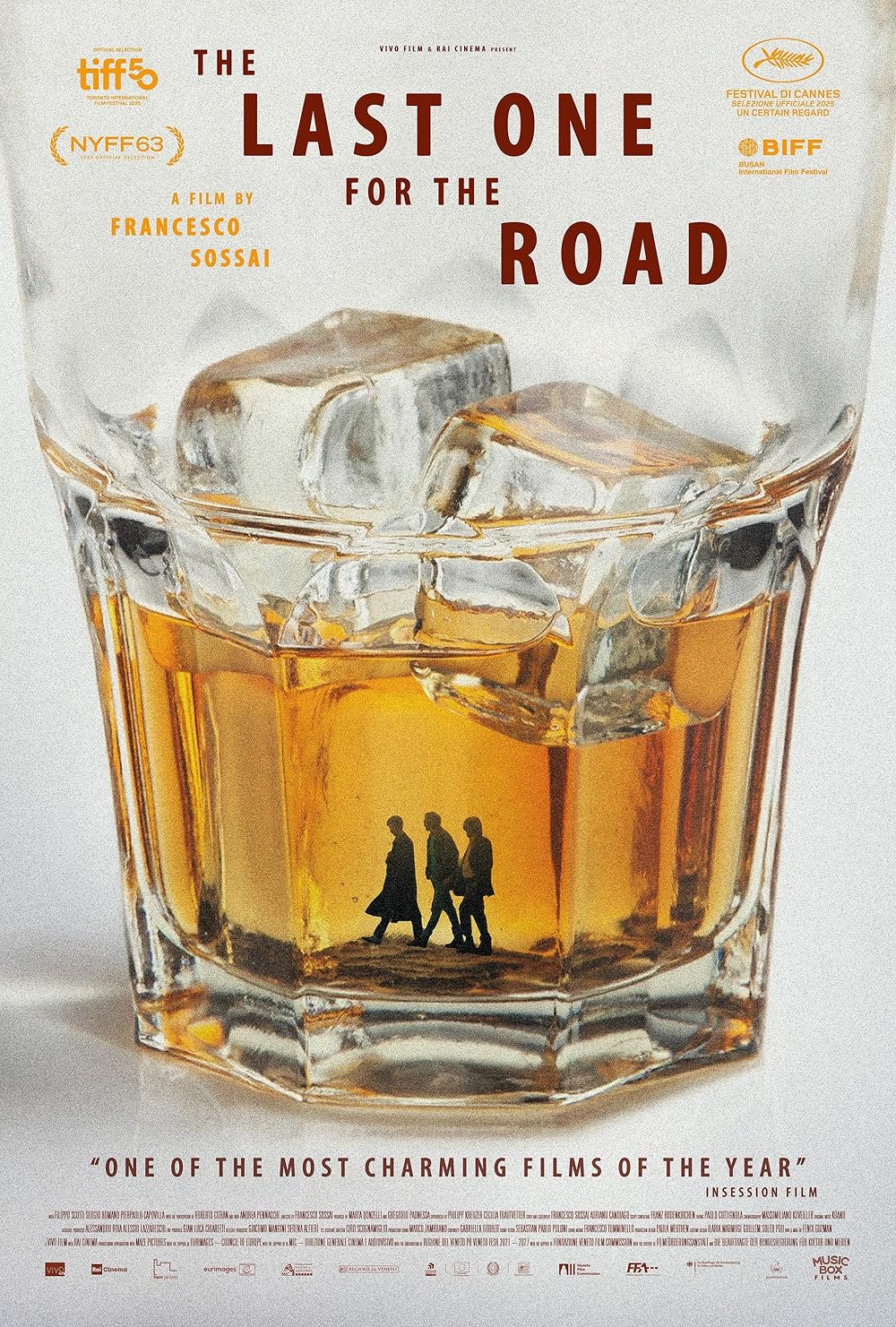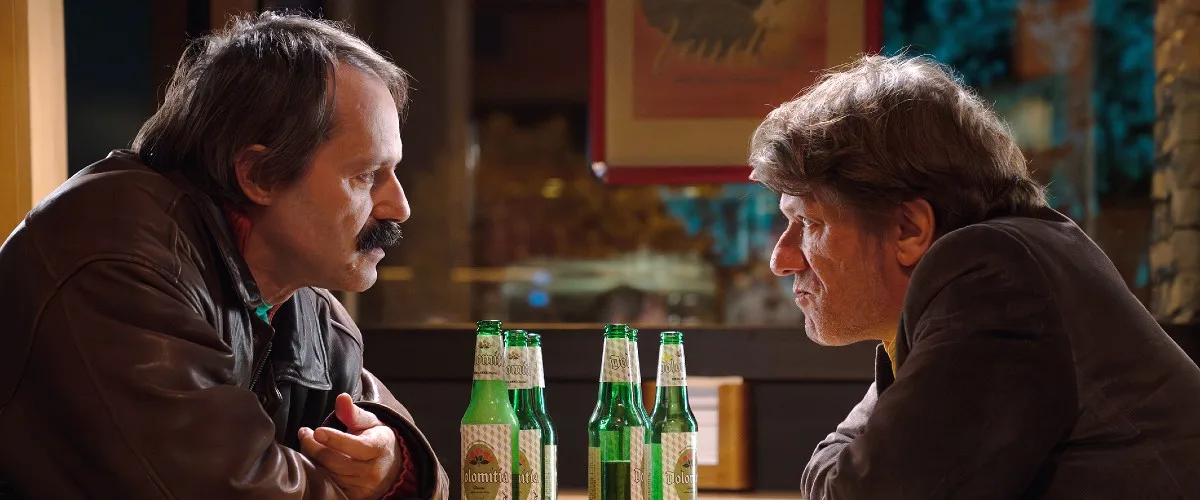
On a superficial level, Francesco Sossai‘s “Last One for the Road” is about a boozy car trip with small-time criminals who are old and broke, sometimes pensive, but mostly still living for the moment. They are in an oxymoronic perpetual search for another “last” drink, life as a perpetual bar crawl. But beneath that is an existential story that is a less bleak and more scenic version of Samuel Beckett’s Waiting for Godot, a psychological journey about connection, regret, memory, and meaning.
And about men—the few women in the story are an off-screen ex-wife who is not missed as much as the dog they shared; an off-screen prostitute; a young woman in a Cleopatra wig who tells the classmate with a crush on her “another time” whenever he asks her out; and a sister who cares for an elderly father and is only briefly hesitant to welcome her drunken brother and his equally drunken friends.
Carlobianchi “Carlo” (Sergio Romano) and Doriano “Dori” (Pierpaolo Capovilla) once worked for a clever crook named Genio (Andrea Pennacchi), stealing sunglasses to sell them. It was a lucrative business until Genio left for Argentina to avoid prison, leaving his mother behind to take the fall. Since then, Carlo and Dori have drifted from petty crime to yet another “last” drink. When they come across an opportunity, they say, “As usual, divine providence has come to our aid,” and jump in. They have no plan or direction, though some vague thought about picking Genio up at the airport, his first time back in Italy in 20 years. The legend is that he hid some cash, and they think perhaps he might lead them to it.
But their conversation has no particular direction, no emotion, just random thoughts and memories, no regrets or lessons learned. The closest they come to an insight is when one says he used to look at houses and think someday he would see the inside, but now he looks at them and thinks about how he never will. One asks, “What happened to that dog you had?” The other responds that the dog has to go to therapy, and his ex says it is all his fault. They barely notice the different vibes of the bars they visit, including one “American”-style bar where customers wear cowboy hats and do a country-style line dance.
One divinely providential opportunity is a celebration with some graduating architectural students, which means just one thing to Carlo and Dori: free drinks. One of the students is quiet, precise, and serious. He is Giulio (a thoughtful performance by Filippo Scotti). We know he is studious because he carries a book bag and has a neat goatee and glasses. Carlo and Dori tell him to get in their car, and while he has turned down his classmates, who want to keep partying, explaining that there is an exam the next day, he impulsively agrees to let them give him a ride.
He keeps saying he needs to get back, and even starts to leave at one point, but he stays with them, and they keep driving. They do see Genio but do not arrive in time to pick him up and catch him just as he is leaving; the encounter is brief and emotionless. They have another divinely providential encounter with a count who mistakes them for architects with an appointment to assess his palatial, centuries-old family home and help him challenge a plan to run a highway through the property. Giulio’s expertise comes in handy, and Dori has a romantic encounter with the count.
The movie benefits from excellent cinematography from Massimiliano Kuveiller, making use of the southern Italy landscapes and settings, from a factory parking lot next to a highway to various bars, the murals of the count’s home, some saturated colors, tactile textures, and some spare but striking images. He shoots the buildings so lovingly that we feel as if we are seeing them through the eyes of an architecture student. The soundtrack includes evocative music from Italian country/rock/soul performer Krano (Marco Spigariol), which suits the film’s bittersweet tone well. He appears briefly in the film, performing his song “Merica” in a bar.
In one of the flashbacks, Giulio sees himself as Genio, lending the story a dreamlike, cyclical quality somewhere between reality and metaphor. The similarity of their names is not a coincidence. There are references to “some other time” excuses, disagreement about the value of paper maps over GPS, and a visit to the famous Brion Tomb. Giulio admires it for its symbolism and beauty, but Carlo and Dori may see it as foreshadowing. A character carves “Long live the first grapes!” into a picnic table in a flashback, and we see that in the present, it is weather-beaten. Characters receive a mistaken ice cream order that turns out to be sweeter than expected. There is a once remembered, one forgotten “secret of the world,” another secret that is drowned out by helicopter rotor blades, and a surprising discussion of the economic principle of diminishing marginal utility. (As a person consumes more units of a good or service, the additional satisfaction—marginal utility—from each new unit decreases. For example, the last spoonful of ice cream is not as pleasurable as the first, and a dollar means less to a wealthy person than to a poor one.)
“It’s still last night for us,” a character says as they go in search of another “last” drink. Most might think of a last drink as a way to cap off an evening, but for Carlo and Dori, the eternal search for a last drink is a search for an evening that never ends.