
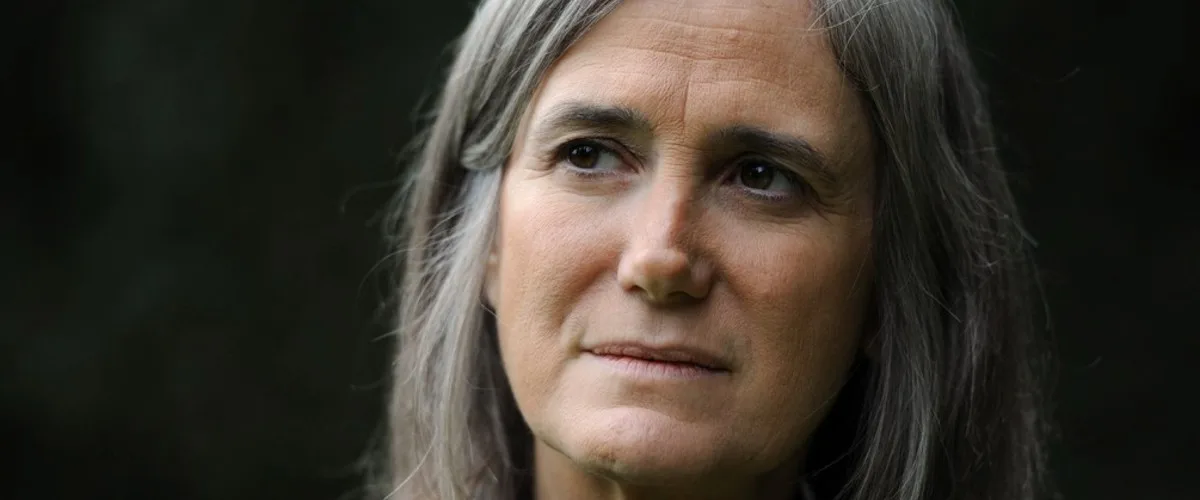
If I were rating Carl Deal’s and Tia Lessin’s “Steal This Story, Please!,” a documentary about journalist Amy Goodman, on content alone, it would get a 4/4. An expansive look at one of the most fearless reporters of our time, the film manages to distill decades of Goodman’s reporting, from covering ground zero during 9/11, the Iraq War, and the ongoing genocide in Gaza, into a tight ninety-eight minutes.
Most media have fallen prey to the trap of engagement farming, often striving not to tell the most important stories but the ones that will get the most clicks and views. But Goodman and her team, who run “Democracy Now!”, have stayed the course, displaying long obedience in the same direction as they call truth to power and give a microphone to voices that might otherwise have been quelled.
It’s evident Deal and Lessin love Goodman, her team, and the work she’s done; within the first couple of minutes, it’s hard not to see why. Filmed with the shakiness and rugged perspicacity of a home video, we witness Goodman attempting to speak to Donald Trump’s climate policy adviser Preston Wells Griffith III at the 2018 U.N. Climate Summit in Poland. Cutting right to the literal chase, she asks, “Can you tell me what you think about President Trump saying climate change is a Chinese hoax?” A startled Griffith tries to evade her, purposely walking into large groups of people to throw her off, and walking up multiple flights of stairs. Goodman, ever persistent, keeps on him, her microphone out, and deals more trenchant questions between breaths. “Can you explain why the U.S. joined with Saudi Arabia in watering down language around the UN report?” she volleys.
That’s a teaser of the persistence she’ll display throughout the film, and it’s refreshing to see her speak so honestly. Her subjects’ non-answers are damning and painfully relatable to people accustomed to influential leaders resorting to silence rather than clarity.
Alas, while it’s inspiring to witness Goodman display that same perseverance (the film eschews a typical cradle-to-career story in favor of centering her varied body of work), it should be more than a curriculum vitae put to screen. At the risk of sounding thankless, the film is almost too reverent toward Goodman, dousing her work with such encomium that it becomes hard to access her work.
Throughout her career, she’s been unwavering in asking questions that rightfully cut people down to size. She’s a queen of nuance, one who never lost sight of humanity’s capacity for goodness and beauty. This documentary lacks that questioning eye towards its subject, settling at times for a kind of god-like admiration that you can’t help but be both riveted and a bit bored by. Ironically, in trying to venerate Goodman and for its thoughtful, meticulous process, it fails in some respects to do the same.
As much as Goodman is the star, one thing worthy of encomium is how generous the camera is to the very people whose stories she is trying to hear. Cliff Charles, Nausheen Dadabhoy, Julia Dengel, Daniel Marracino, and Keith Walker are credited as cinematographers, making the film a potluck that celebrates the diversity of filming styles Goodman has employed throughout her work.
There’s the aforementioned investigative reporting style where she’s trying to get answers from unwilling subjects, but there are a touching number of interviews from people she speaks with when she’s in the throes of her work. During a Pro-Palestinian protest in New York City, Deal and Lessin focus on testimonials from the older Jewish women present. We hear from one whose parents were in the Holocaust, and as a result, she shared that “Never again” for the Jewish people meant “Never again” for everyone. “What else will I do at my age?” another woman quips. Goodman’s work has connected her with people who display the same fighting spirit, and it’s encouraging to meet them, by proxy, through this documentary.
Deal and Lessin also find ways to keep the camera work interesting, with editor Mona Davis’ work shining through in a sequence that retells when Goodman speaks with President Bill Clinton over the radio. We see grainy archival footage of Goodman asking questions, but we are only treated to pictures of President Clinton. Davis intercuts these pictures between the videos to give a playful sense of back-and-forth. It also speaks to Goodman’s vivacious personality compared to the static, clean-cut people in power she often interviewed, who tried to placate her with thoughtful questions and boilerplate responses.
“’We will not be silent’ should be the Hippocratic oath of the media today, Goodman shares at the end of the film. It’s a reminder that’s as sobering as it is incisive. There’s certainly no paucity of stories to report on. It can be easy to hide behind the scale, using the excess as an excuse to report on less important stories, so one doesn’t have to talk about the controversial or difficult. Throughout her career, Goodman has found a way to keep her eye on the prize, focusing on what matters, cutting through the fat, and making sure to platform the very stories that might otherwise be overlooked.
Though didactic, “Steal This Story, Please!” serves as an invitation to embody these values in your own life and work. As Amy might humbly (and facetiously) say of herself, you’d be in great company. Imitation may be the sincerest form of flattery, but in Goodman’s case, thievery is much better.