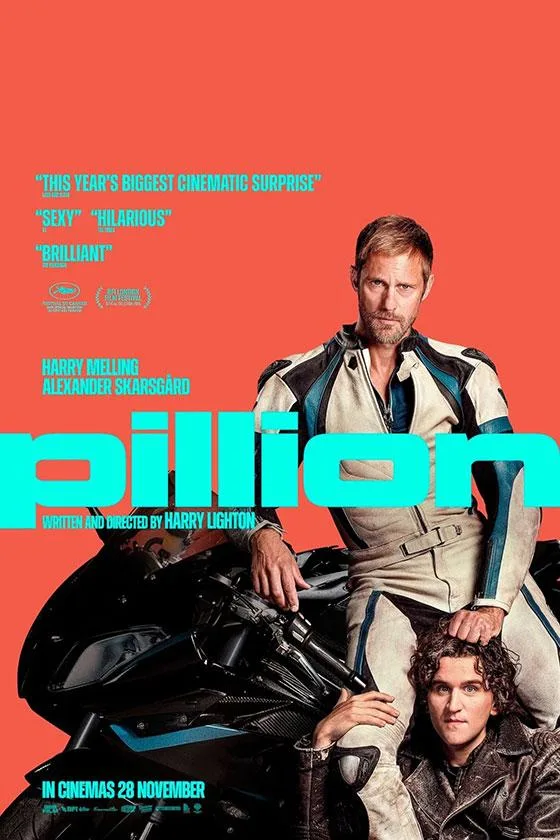
The title of director Harry Lighton’s “Pillion” refers to the seat for a passenger behind a motorcyclist. It’s fitting, given that the film focuses on a sub/dom relationship between two men, one of whom is in a biker gang, but it also refers to the ways that, for so many of us, we can often feel like a passenger in the journey of our lives. It’s easier to cling to the body of whoever is driving and get all of the security with none of the headwind. Yet such pleasures pale to the liberation of knowing the contours of your preferences and desires, and you can only obtain that by sitting in the driver’s seat.
“Pillion” is a quietly devastating ode to the power of that self-discovery, a reminder that perhaps one of life’s greatest tragedies is that we can’t always remain in a relationship with the people we learn the most valuable lessons from.
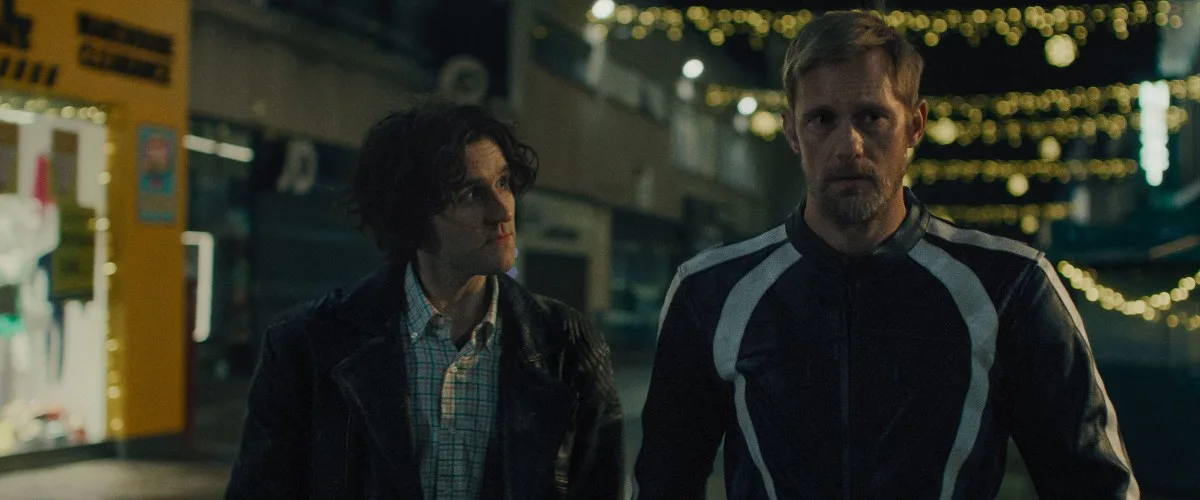
Great humor and even better drama come from putting characters who are opposites into each other’s relational orbit, and from the start, Lighton luxuriates in the sexiness of contrast. It’s telling that we meet Colin (Harry Melling) and Ray (Alexander Skarsgård) while en route to the same destination, but their methods of transportation reveal so much of who they are. Ray is racing down the streets of Bromley in white leather, his helmet covering a steely visage, while Colin is riding in the backseat in his parents’ car. The two collide at a bar where Colin performs with his choir quartet, and after fast and furious fellatio in an alleyway, Colin becomes Ray’s submissive, entering into a world of sexual fulfillment he only previously dreamed of.
From “The Moment” to “Wicker,” Skarsgård has recently worked with directors who have understood how to utilize his 6’4 height to tender and humorous effect. Whether he means to or not, his figure is imposing, and to his (often) shorter co-stars, there’s narrative tension as to whether he’ll be warm or hostile. Lighton understands how to capture the breadth of the Swedish Adonis’ body language on-screen, and tactfully frames him as a source of comfort and mystery. Take the passionate hook-up sequence, where cinematographer Nick Morris has the audience see Ray through Colin’s eyes.
Ray is a meal of a man, whose abs feel like an ocean the singer feels like he can sink into. As Ray begins to undress, Colin’s eyes feel wider than his mouth; he’ll soon wish it’s the reverse once he sees what’s in store for him behind Ray’s zipper. There’s an atavistic joy in witnessing the two live out the fairy tale moments of their courtship as well. As Colin swaps the car to go pillion on Ray’s bike, gripping his dom gleefully while Ray ducks and weaves through traffic, it seems as though the very streets are opening up for them, indicative of the possibilities of recent love.
Despite their charged carnality, such sequences are never divorced from the characters’ inner lives. Melling is bumbling and delightfully relatable, whose suppressed emotions manifest as enthusiastic gratitude: “Thank you!” he hollers to Ray after their alleyway encounter. He communicates longing so palpably, but not in a pitiful way. Skarsgård is much more laconic by comparison, and the ways Ray grows may be more subtle, but they’re just as impactful. There are many moments where Skarsgård allows for a smile or scowl to ever so fleetingly sketch onto Ray’s alluring smoulder. Ray treats these breaks in character like typos in an essay, to be quickly deleted and corrected, but as he allows himself to be more ingratiated with Colin, he can’t help but allow for these foibles to slip and eventually remain.
Colin’s parents are fierce in their love and limited in their understanding, with his mother, Peggy (Lesley Sharp), in particular, ruffling Ray’s suave feathers with accusations that he’s not treating her son appropriately. It’s understandable if you–like me–are initially inclined to agree with her. To his credit, Lighton never explains the dynamics of a dom/sub. So, for the uninitiated, when Colin goes to Ray’s house and is ordered to cook, clean, and sleep on the floor with no questions asked, we feel just as disoriented, if not disrespected, just as Colin himself does. Even when Colin gets a sense of the dynamics at play and compares notes with the other subs of Ray’s biker gang, the dialogue avoids the trap of overexplanation. As Colin learns the expectations of this type of relationship, so do we, such as a moment when a fellow sub mentions he would “go crazy” if his dom didn’t kiss him.
The dynamic between the two is neither healthy nor sustainable, but, critically, Lighton never turns either man into an antagonist. His script understands that it can take a whole lifetime to articulate what we want and understand who we are; fortunate ones can learn those skills early on. Ray isn’t uniquely cruel; he’s just Colin’s first, and who hasn’t, in the name of nascent desire, fallen too hard or given themselves uncritically? The best part of being in love can sometimes be that feeling of being swept off your feet, and Colin soon realizes it’s not the domination that troubles him but rather how it manifests.
Colin’s arc in the film is ultimately one of cognizance of his own limits, what he’s comfortable with, what are non-negotiables, and what his needs are emotionally and physically. Those aren’t easy questions to ask without trial, tribulation, and error, and it’s a gift to witness him go from being far too eager to mold himself around what others want to instead be a bit more sure of what he hopes for. In the absence of naming preference, we can coast on being “down for anything,” but we can’t ride a pillion in our lives forever. We’re deserving of more, and the film celebrates the ways we learn this not by isolating ourselves, but by entering into fellowship with the people around us. We won’t ever leave the same.