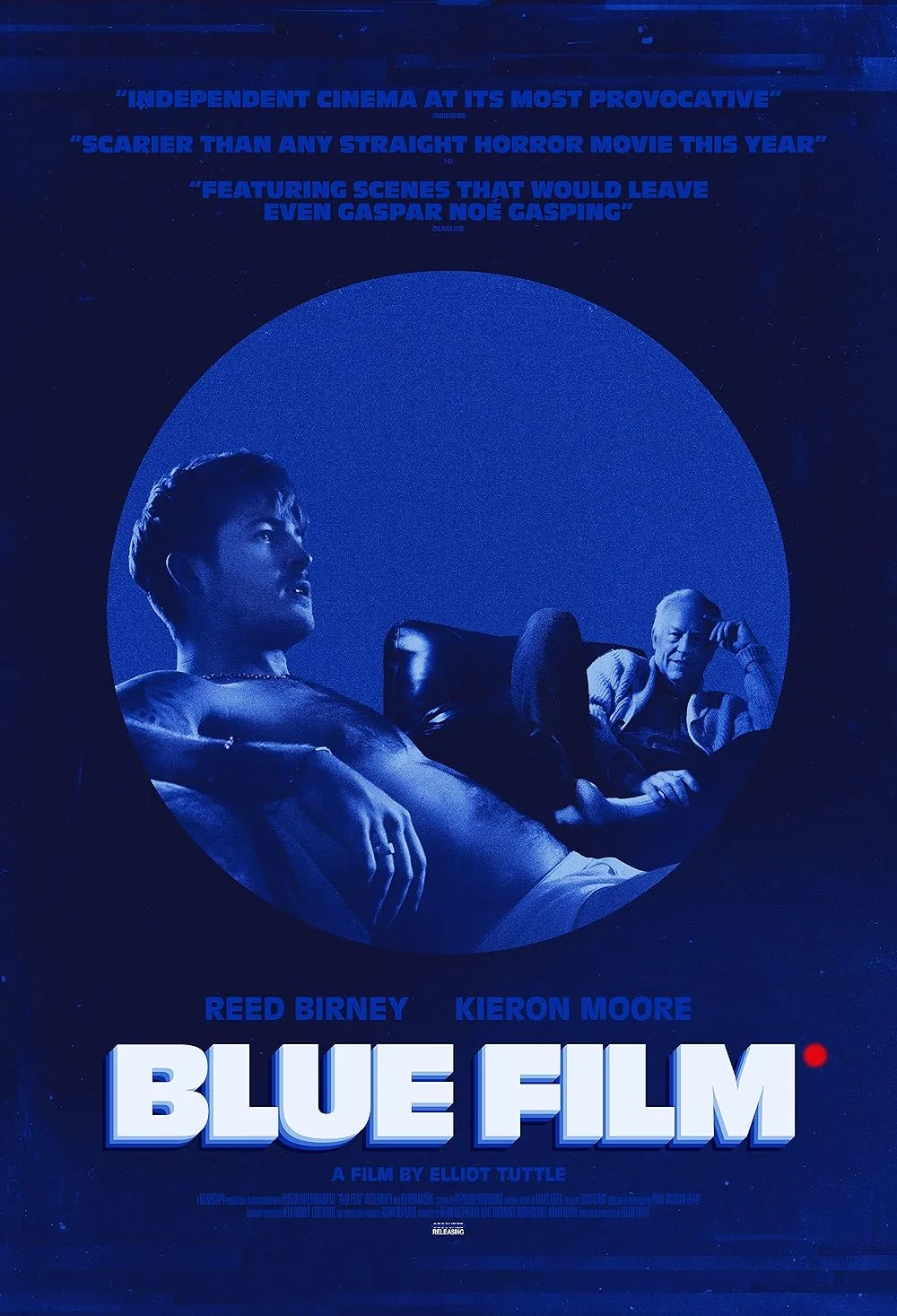


There is an earned edginess that pushes writer-director Elliot Tuttle’s erotic two-hander “Blue Film” down toward difficult-to-reach depths. In the opening scene, for instance, the findom camboy Aaron Eagle (Kieron Moore), performs for his 500+ followers on a livestream. Dressed in only his tighty whities, he arouses his cash pig fans by making carnal demands and by calling them homophobic slurs.
Aaron talks a good game, but even in these early moments, something rings false. We know he’s inherently performing for this audience, but everything from his exaggerated vigor to his mysterious nonchalantness says that he’s also trying to convince himself of a performance even he doesn’t quite buy. That mask slips off during this challenging film’s brief 87-minute runtime when Aaron makes a paid house call to a masked man who’s promised $25k to Aaron if he’ll stay for a single night.
During this lone evening, many provocations happen. And while I usually bristle at contemporary films that promise such inciting wants, Tuttle’s movie doesn’t reach for inflammatory subjects solely for the sake of provocation. There’s sincere emotion attached to each fiery topic raised, and every advance turned down. Because Aaron isn’t showing up for just any John. Unbeknownst to him, at least initially, this is his former high school English teacher, Hank (Reed Birney), a man disgraced years ago for attempting to rape an underage male student. Consequently, the fine line “Blue Film” walks will most likely be too touchy a subject for many viewers to bear. For others, the psychodrama offers a frank conversation about mental illness, identity, and desire.
To make one thing clear: “Blue Film” isn’t working in defense of Hank. But it isn’t telegraphing its judgments of him either. Part of that misdirection arises from Tuttle’s slippery aesthetic choices. Often, camcorder footage of a nameless boy punctuates the hard conversations Aaron and Hank share. Who is this kid? Was the person Aaron once, or another child only known to Hank? We can make guesses, but Tuttle doesn’t give away the answer until the film’s end. That cagey footage also serves to perpetually remind viewers who these characters are at their core: Aaron hides the spirit of his younger self beneath the surface, while Hank is attempting to connect intimately with that past-present Aaron.
Aaron and Hank’s perception of one another and themselves inspires further tension in their wide-ranging discussion, which covers their traumas, early sexual experiences, and hidden secrets. Sometimes Hank prods Aaron by interviewing him (Hank has a camcorder set up in the living room of this rented home). Through his queries, we discover that both hail from a small town in Maine: Aaron left for Los Angeles, where he no doubt picked up his blonde highlights and many tattoos, while Hank remained in town as a pariah. Aaron would eventually find empowerment through sex work; Hank turned to religion.
In this single setting, they remain polar opposites. Aaron demands they have sex; Hank can’t muster up a sexual appetite for this grown version of Aaron. Their wants and hang-ups guardedly shift with each new revelation, with each further uttered truth, with each nimble evasion.
Their respective insecurities intermittently take hold in the visual language, whereby even when a camcorder isn’t present, Tuttle’s filmic decisions—crash zooms and shaky cam—follow patterns similar to that technology’s, creating an effect that harnesses the fragility of this meeting. Conversely, Moore and Birney’s performances rely on a brave commitment to explore every uncomfortable facet of their characters. What actions, words, and fantasies disgust, arouse, and melt Aaron and Hank find unjudgmental space within the pair’s curious approach.
And while the film’s title certainly refers to the azure lighting that bathes every scene with a sense of distant memory, it can also allude to the plaintive mood that lurks beneath Aaron and Hank’s self-created exteriors. Consequently, “Blue Film,” through its many frank observations, stands as a vulnerable work about one’s past colliding with one’s present, in a bid to make peace with one’s true self.