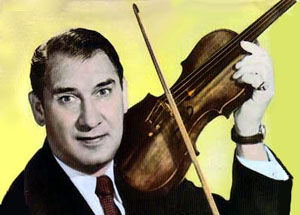
Henny Youngman: “Doctor, it hurts when I do this!”
var a2a_config = a2a_config || {};
a2a_config.linkname = “Roger Ebert’s Journal”;
a2a_config.linkurl = “http://blogs.suntimes.com/ebert/”;
a2a_config.num_services = 8;
var a2a_config = a2a_config || {};
a2a_config.linkname = “Roger Ebert’s Journal”;
a2a_config.linkurl = “http://blogs.suntimes.com/ebert/”;
a2a_config.num_services = 8;
Gathered here in one convenient place are my recent reviews that awarded films Two Stars or less. These are, generally speaking to be avoided. Sometimes I hear from readers who confess they are in the mood to watch a really bad movie. If you’re sincere, be sure to know what you’re getting: A really bad movie. Movies that are “so bad they’re good” should generally get two and a half stars. Two stars can be borderline. And Pauline Kael once wrote, “The movies are so rarely great art that if we cannot appreciate great trash, we shouldn’t go at all.”
“Just Go With It” (PG-13, 116 minutes). This film’s story began as a French farce, became the Broadway hit “Cactus Flower,” was made into a 1969 film and now arrives gasping for breath in a witless retread with Adam Sandler, Jennifer Aniston and Brooklyn Decker. The characters are so stupid it doesn’t seem nice to laugh at them. One star.
“Sanctum” (R, 109 minutes). A terrifying adventure shown in an incompetent way. Scuba-diving cave explorers enter a vast system in New Guinea and are stranded. But this rich story opportunity is lost because of incoherent editing, poor 3D technique, and the effect of 3D dimming in the already dark an murky caves. A “James Cameron Production,” yes, but certainly not a “James Cameron Film.” One and a half stars
“I Am Number Four” (PG-13, 110 minutes). Nine aliens from the planet Mogador travel across the galaxy to take refuge on earth and rip off elements of the Twilight and Harry Potter movies, and combine them with senseless scenes of lethal Quidditch-like combat. Alex Pettyfer stars as Number Four, who feels hormonal about the pretty Sarah (Dianna Agron), although whether he is the brooding teenage Edward Cullen he seems to be or a weird alien life form I am not sure. Inane setup followed by endless and perplexing action. One and a half stars
“Certifiably Jonathan” (Unrated, 80 minutes). Jonathan Winters deserves better than this. Jim Pasternak’s mockumentary is not merely a bad film, but a waste of an opportunity. Nearing 80, Winters is still active and funny, and deserves a real doc, not this messy failed attempt at satirizing–what? Documentaries themselves? Lame scenes involving an art show, a theft and the “Museum of Modern Art” fit awkwardly with cameos of too many other comics, who except for the funny Robin Williams seem to be attending a testimonial. One star.
“The Green Hornet” (PG-13, 108 minutes) An almost unendurable demonstration of a movie with nothing to be about. Although it follows the rough storyline of previous versions of the title, it neglects the construction of a plot engine to pull us through. There are pointless dialogue scenes going nowhere much too slowly, and then pointless action scenes going everywhere much too quickly. One star.
“The Nutcracker in 3D” (PG, 107 minutes) A train wreck of a movie, beginning with the idiotic idea of combining the Tchaikovsky classic with a fantasy conflict that seems inspired by the Holocaust. After little Mary (Elle Fanning) discovers her toy nutcracker can talk, he reveals himself as a captive prince and spirits her off to a land where fascist storm troopers are snatching toys from the hands of children and burning them to blot out the sun. I’m not making this up. Appalling. And forget about the 3D, which is the dingiest and dimmest I’ve seen. One star
“I Spit on Your Grave” (Unrated; for adults only. Running time: 108 minutes) Despicable remake of the despicable 1978 film “I Spit On Your Grave.” This one is more offensive, because it lingers lovingly and at greater length on realistic verbal, psychological and physical violence against the woman, and then reduces her “revenge” to cartoonish horror-flick impossibilities. Oh, and a mentally disabled boy is forced against his will to perform a rape. Zero stars.
“Life As We Know It” (PG-13, 113 minutes). When their best friends are killed in a crash, Holly and Messer (Katherine Heigl and Josh Duhamel) are appointed as joint custodians of their one-year-old, Sophie. Also, they have to move into Sophie’s mansion. But Holly and Messer can’t stand one another. So what happens when they start trying to raise Sophie. You’ll never guess in a million years. Or maybe you will. One and a half stars
“Hatchet II” (Unrated, 85 minutes). A gory homage to slasher films, which means it has its tongue in its cheek until the tongue is ripped out and the victims of a swamp man are sliced, diced, slashed, disemboweled, chainsawed and otherwise inconvenienced. One and a half stars
“The Last Airbender” (PG, 103 minutes). An agonizing experience in every category I can think of and others still waiting to be invented. Originally in 2D, retrofitted in fake 3D that makes this picture the dimmest I’ve seen in years. Bad casting, wooden dialogue, lousy special effects, incomprehensible plot, and boring, boring, boring. One-half of one star.
“The A-Team” (PG-13, 121 minutes). an incomprehensible mess with the 1980s TV show embedded within. at over two hours of Queasy-Cam anarchy it’s punishment. Same team, same types, same traits, new actors: Liam Neeson, Jessica Biel, Bradley Cooper, Sharlto Copley, “Rampage” Jackson, Patrick Wilson. One and a half stars
“Sex & the City 2” (R, 146 minutes). Comedy about flyweight bubbleheads living in a world where their defining quality is consuming things. They gobble food, fashion, houses, husbands, children, and vitamins. Plot centers on marital discord between Carrie (Sarah Jessica Parker) and Mr. Big (Chris Noth), a purring, narcissistic, velvety idiot? Later, the girls are menaced for immodest dress during a luxurious freebie in Abu Dhabi. Appalling. Sure to be enjoyed by SATC fans. One star
“The Good Heart” (R, 98 minutes). Oh. My. God. A story sopping wet with cornball sentimentalism, wrapped up in absurd melodrama, and telling a Rags to Riches story with an ending that is truly shameless. That fine actor Brian Cox and that good actor Paul Dano and that angelic actress Isild Le Besco cast themselves on the sinking vessel of this story and go down with the ship. One and a half stars.
“Kick-Ass” (R, 117 minutes). An 11-year-old girl (Chloe Grace Moretz), her father (Nicolas Cage) and a high school kid (Aaron Johnson) try to become superheroes to fight an evil ganglord. There’s deadly carnage dished out by the child, after which an adult man brutally hammers her to within an inch of her life. Blood everywhere. A comic book satire, they say. Sad, I say. One star
“Nightmare on Elm Street” (R, 95 minutes). Teenagers are introduced, enjoy brief moments of happiness, are haunted by nightmares, and then slashed to death by Freddy. So what? One star
“The Bounty Hunter” (PG-13, 110 minutes). An inconsequential formula comedy and a waste of the talents of Jennifer Aniston and Gerard Butler. He’s a bounty hunter, she’s skipped bail on a traffic charge, they were once married, and that’s the end of the movie’s original ideas. We’ve seen earlier versions of every single scene to the point of catatonia. Rating: One and a half stars.
“Cop Out” (R, 110 minutes). An outstandingly bad cop movie, starring Bruce Willis and Tracy Morgan as partners who get suspended (of course) and then try to redeem themselves by overthrowing a drug operation while searching for the valuable baseball card Willis wants to sell to pay for his daughter’s wedding. Morgan plays an unreasonable amount of time dressed as a cell phone, considering there is nothing to prevent him from taking it off. Kevin Smith, who directed, has had many, many better days. One and a half stars.
“The Lovely Bones” (PG-13). A deplorable film with this message: If you’re a 14-year-old girl who has been brutally raped and murdered by a serial killer, you have a lot to look forward to. You can get together in heaven with the other teenage victims of the same killer, and gaze down in benevolence upon your family members as they realize what a wonderful person you were. Peter Jackson (“Lord of the Rings”) believes special effects can replace genuine emotion, and tricks up Alive Sebold’s well-regarded novel with gimcrack New Age fantasies. With, however, affective performances by Mark Wahlberg, Rachel Weisz, Susan Sarandon, Stanley Tucci and Saoirse Ronan as the victim. One star.
“The Spy Next Door” (PG, 92 minutes). Jackie Chan is a Chinese-CIA double agent babysitting girl friend’s three kids as Russian mobsters attack. Uh, huh. Precisely what you’d expect from a PG-rated Jackie Chan comedy. If that’s what you’re looking for, you won’t be disappointed. It’s not what I was looking for. One and a half stars.
“Old Dogs” (PG, 88 minutes). Stupefying dimwitted. John Travolta’s and Robin Williams’ agents weren’t perceptive enough to smell the screenplay in its advanced state of decomposition. Seems to have lingered in post-production while editors struggled desperately to inject laugh cues.Careens uneasily between fantasy and idiocy, the impenetrable and the crashingly ham-handed. Example: Rita Wilson gets her hand slammed by a car trunk, and the sound track breaks into “Big Girls Don’t Cry.” When hey get their hands slammed in car trunks, they do. One star. View the trailer.
“Did You Hear About the Morgans?” (PG-13, 103 minutes). Feuding couple from Manhattan (Hugh Grant and Jessica Sarah Parker) are forced to flee town under Witness Protection Program, find themselves Fish Out of Water in Strange New World, meet Colorful Characters, survive Slapstick Adventures, end up Together at the End. The only part of that formula that still works is The End. With supporting roles for Sam Elliott and Wilford Brimley, sporting the two most famous mustaches in the movies. One and a half stars.
“The Twilight Saga: New Moon” (PG-13, 130 minutes). The characters in this movie should be arrested for loitering with intent to moan. The sequel to “Twilight” (2008) is preoccupied with remember that film and setting up the third one. Sitting through this experience is like driving a tractor in low gear though a sullen sea of Brylcreem. Kristen Stewart and Robert Pattinson return in their original roles, she dewy and masochistic, he sullen and menacing. Ah, teenage romance! One star
“The Boondock Saints II: All Saint’s Day” . (R, 21 minutes) Idiotic ode to macho horseshite (to employ an ancient Irish word). Distinguished by superb cinematography. The first film in 10 years from Troy Duffy, whose “Boondock Saints” (1999) has become a cult fetish. Sean Patrick Flanery and Norman Reedus are Irish brothers who return to Boston for revenge and murder countless enemies in an incomprehensible story involving heavy metal cranked up to 12 and lots of boozing, smoking, swearing and looking fierce and sweaty. One star. View the trailer.
“Gentlemen Broncos”. (PG-13, 107 minutes) Michael Angarano plays Benjamin Purvis, a wannabe sci-fi Doctor Ronald Chevalier (Jemaine Clement). Alas. the great man rips off the kid’s book, just when get kid has sold the miniscule filming rights. All sorts of promising material from Jared Hess (“Napoleon Dynamite”), but it’s a clutter of jumbled continuity that doesn’t add up, despite the presence of Jennifer Coolidge. Two stars. View the trailer.
“The Fourth Kind”. (PG-13, 98 minutes). Nome, Alaska (pop. 3,750) has so many disappearances and/or alien abductions that the FBI has investigated there 20 times more than in Anchorage. So it’s claimed by this pseudo-doc that goes to inane lengths to appear factual. Milla Jovovich is good as a psychologist whose clients complain that owls stare at them in the middle of the night. One and a half stars. View the trailer.
21 and a Wakeup . (R, 123 minutes). A disjointed, overlong and unconvincing string of anecdotes centering around the personnel of an Army combat hospital in Vietnam. Amy Acker plays an idealistic nurse who is constantly reprimanded by absurdly hostile officer (Faye Dunaway). Plays like a series of unlikely anecdotes trundled onstage without much relationship to one another. One episode involves an unauthorized trip into Cambodia by a nurse and a civilian journalist; it underwhelms. One and a half stars. Visit the website.
“Cirque de Freak: The Vampire’s Assistant”. (PG-13, 108 minutes) This movie includes good Vampires, evil Vampanese, a Wolf-Man, a Bearded Lady, a Monkey Girl with a long tail, a Snake Boy, a dwarf with a four-foot forehead and a spider the size of your shoe, and they’re all boring as hell. They’re in a traveling side show that comes to town and lures two insipid high school kids (Josh Hutcherson and Chris Massoglia) into a war between enemy vampire factions. Unbearable. With Joh C. Reilly, Salma Hayek, Ken Watanabe, Patrick Fugit, and other wasted talents. One star. View the trailer.
“Couples Retreat” (PG-13, 107 minutes). Four troubled couples make a week’s retreat to an island paradise where they hope to be healed, which indeed happens, according to ages-old sitcom formulas. This material was old when it was new. The jolly ending is agonizing in its step-by-step obligatory plotting. I didn’t care for any of the characters, and that’s about how much they seemed to care for one another. Starring Vince Vaughn, Jason Bateman, Faizon Love, Jon Favreau, Malin Akerman, Kristen Bell, Kristin Davis and Kali Hawk. Two stars. View the trailer.
“Fame.”. (PG, 90 minutes). A pale retread of the 1980 classic, lacking the power and emotion of the original. A group of hopeful kids enroll in the New York City School of the Performing Arts and struggle through four years to find themselves. Their back stories are shallow, many seem too old and confident, the plot doesn’t engage them, and although individual performers like Naturi Naughton sparkle as a classical pianist who wants to sing hip hop, the film is too superficial to make them convincing. Two stars. View the trailer.
“All About Steve”. (PG-13, 87 minutes ) Sandra Bullock plays Mary Horowitz, a crossword puzzle constructor who on a blind date falls insanely in love with Steve, a TV news cameraman (Bradley Cooper, from “The Hangover”). The operative word is “insanely.” The movie is billed as a comedy but more resembles a perplexing public display of irrational behavior. Seeing her run around as a basket case makes you appreciate Lucille Ball, who could play a dizzy dame and make you like her. One and a half stars. View the trailer.
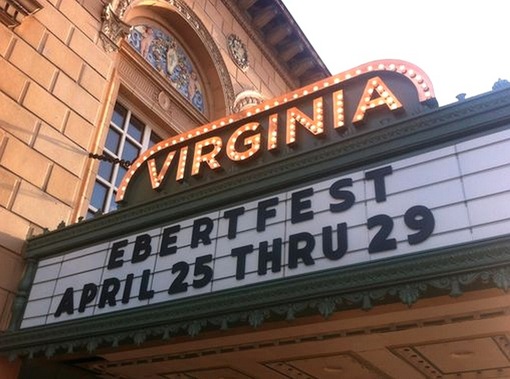
My website is unique for the variety of critical voices it features. At Ebertfest this year, seven Far-Flung Correspondents and five Demanders joined directors, actors and other critics in the panel discussions.
My Funny Valentine
The graphic at the top is from JenniPenni’s Photostream on flickr.
var a2a_config = a2a_config || {};
a2a_config.linkname = “Roger Ebert’s Journal”;
a2a_config.linkurl = “http://blogs.suntimes.com/ebert/”;
a2a_config.num_services = 8;
Amazon.com Widgets
My Funny Valentine
The graphic at the top is from JenniPenni’s Photostream on flickr.
var a2a_config = a2a_config || {};
a2a_config.linkname = “Roger Ebert’s Journal”;
a2a_config.linkurl = “http://blogs.suntimes.com/ebert/”;
a2a_config.num_services = 8;
Amazon.com Widgets
Not in a million years would I even want to be on the inside looking out!
The film critic David Bordwell is sitting in an airport in Denmark and he emailed me these caps from Weekly Variety. Now *that* was a trade paper. In typography it looked more or less as it did when I started reading it in 1967. Blow these up and you can read them. Here is a link to the actual winners that year. Damn, they made some good movies.
Bordwell: Note that Variety believed the numerous members of the Screen Extras Guild held the deciding hand.
‘
After the screening at Telluride, September 1987:
My Great Movies review of “Au Revoir, les Enfants.”
The film is on Instant Streaming at Netflix.
var a2a_config = a2a_config || {};
a2a_config.linkname = “Roger Ebert’s Journal”;
a2a_config.linkurl = “http://blogs.suntimes.com/ebert/”;
a2a_config.num_services = 8;
Click here to enter this week’s contest.
A group of my losing entries, plus my one Winner, and the entry the cartoon editor said online that he liked but it didn’t quite clear the bar on New Yorker’s taste standards.
Alexyss K. Tylor had a program on Atlanta public access TV starting in the 1990s. The woman listening here is her mother. There is no reason she couldn’t be a comedy club star, although I can’t be sure she intends to be funny.
Thanks for the link to Gary Houston.
A folk song from Chennai, India, performed by musicians from around the world.

In Krishna Vamsi’s Bollywood movie “Chanda Mama”

As a children’s lullaby from the Bollywood movie “Vachan” (1974)

Moon uncle will visit the moon in an air plane
Will play hide-and-seek with the stars
The play will satisfy my moon uncle
Happily my moon uncle will return home
Moon mother from far, will cook puye made of boor (sweets)
Moon mother from far, will cook puye made of boor
You will eat on a thali, moon uncle in a cup
Moon mother from far….
The cup broke and mon uncle became angry
The cup broke and moon uncle became angry
Will bring a new cup by clapping
We will please moon uncle with milk and malaayi
The moon from far …
You will eat ….
The moon from far …

Visit my web site rogerebert.com.

Today’s Facebook mystery guest is Marion Cotillard, who won an Oscar for playing Edith Piaf.
Edith Piaf – La Vie En Rose by bigproblem11
var a2a_config = a2a_config || {};
a2a_config.linkname = “Roger Ebert’s Journal”;
a2a_config.linkurl = “http://blogs.suntimes.com/ebert/”;
a2a_config.num_services = 8;
We found a baby picture of mine that Chaz asked our assistant, Carol Iwata, to scan. She took it out of the frame and found this document folded behind it. I must have hidden it there.
Judging by the names Doug Pierre and Mike Russell, this must have been second grade. I have no memory of the Yanks or the Oath, but the little drawings seem vaguely familiar.
I’ve had my doubts about those movies where kids sign childhood pacts. I must learn to be more believing.
Here is the photo Chaz wanted scanned. She said I could use it when readers of my cookbook asked how I got started on The Pot.
var a2a_config = a2a_config || {};
a2a_config.linkname = “Roger Ebert’s Journal”;
a2a_config.linkurl = “http://blogs.suntimes.com/ebert/”;
a2a_config.num_services = 8;
Two foreign exchange students got me started. They gave me a big cardboard box of sci-fi mags they’d accumulated. They lived in a quonset hut behind Jim Moore’s dad’s heating oil company across the street, and were on my Champaign-Urbana Courier route.
They weren’t living in abject poverty. There were a lot of students living in tarpaper quonset huts in those postwar years; they’d been used as cheap military barracks during the war, and now they housed the flood of veterans on the GI Bill.
This seems to be the only photo on the Web of what were called the Parade Ground Units, which stretched away from Memorial Stadium.
They gave their name to WPGU, the student radio station. The huts far lasted their shelf life, and indeed in 1960 I myself worked on that station, which was still housed in a Parade Ground Unit. That was until Bob Auler, the celebrated fascist baby eater, fired me for stubbornly persisting in playing the Sons of the Pioneers performing “Tumbling Tumbleweeds” every morning at 8. I sincerely thought it was a great record. Still do. I told Auler I had better taste than his listeners. Still do.
WPGU is streaming right now .
But I digress. I have hundreds of these magazines in boxes in a closet. A few readers will understand that these rocket ships and Bug-Eyed Monsters awaken faint memories of pre-erotic stirrings — not of sex, but of…something…some promise…some not-yet-experienced world…some possibility…
All erotic thoughts involve anticipation. Memory is never erotic, or gains its charge by the promise of something happening again, or by the fantasy that it is happening now.
Here are these magazines, bearing sacred names like Sturgeon, Asimov, Heinlein, Leinster, and Eric Frank Russell, who I thought had one of the best bloke names I’d ever heard. It is a notable cornerstone of sf magazine tradition that the covers were always original paingtings. Artists such as Kelly Freas, Ed Emshwiller and Chesley Bonstell became famous–to their fans, anyway. How many other magazines commissioned original artwork, except for the Saturday Evening Post?
As you embark on this journey through space and time, ask yourself which better inspires the adolescent imagination: Science fiction magazines, or video games?
The cover at the top, “Sad Robot,” by Kelly Freas, is perhaps the most famous sf magazine cover of all time. The robot is realizing he has violated one or more of the Three Laws of Robotics. Oops!
Can you identify the single most influential person in the history of modern science fiction? I’m not going to tell you who this is, because I’m certain the photo will inspire discussion in the comments.
If you like these covers, there are lot more on the web. One place to start is Crotchedy Old Fan .
•
•The Science Fiction Museum and Hall of Fame.
•
•
•Memory awakes in all her busy train…
•
•
var a2a_config = a2a_config || {};
a2a_config.linkname = “Roger Ebert’s Journal”;
a2a_config.linkurl = “http://blogs.suntimes.com/ebert/”;
a2a_config.num_services = 8;
Tribute page: Dorothy Dandridge: A life unfulfilled..
Carmen Jones Whizzin Away Along De TrackUploaded by NilbogLAND. – Music videos, artist interviews, concerts and more.
Organizing files for the launch of our new website, I came upon this. I grow old…I grow old…I shall wear the bottoms of my ski pants rolled.

January 25th, 1981
The 3rd Annual U.S. Film and Video Festival
Roger Ebert
Park City, Utah – Up here in the mountains above the Great Salt Lake, everybody seemed to have a definition earlier this month of what an independent filmmaker was. It was just that nobody seemed to agree.
An “independent” was someone who worked outside the Hollywood studio system, obviously – except that such established actors as David Carradine and Ralph Waite thought of themselves as independents. An “independent feature” was one made on a low budget, obviously – but there was a large space between the $70,000 budget of “The Haunting of M” and the $700,000 budget of “Heartland”. An independent film had a unique personal vision, surely – except that films such as “Gal Young Un” were visualizations of classic short stories, and films such as “Impostors” looked like no reality anyone had ever seen before.
Maybe… someone suggested late in the afternoon during one of the long, rambling informal seminars around the fireplace… maybe an independent film is one that tells a story that the filmmaker believes has to be told, no matter what. No matter whether it’s “commercial,” no matter whether Hollywood will finance it, no matter whether anyone will ever want to pay to see it, it has to be told.
That was accepted as a provisional definition, during last week’s 3rd Annual U.S. Film and Video Festival, which was born in Salt Lake City and moved this year to the ski resort of Park City, not far from Robert Redford’s Sundance complex. This was the first film festival devoted solely to independent American features, and everybody here knew what an independent film was not: It was not a multimillion-dollar production, it probably had no major stars in it, it was not intended to flatter the lowest common denominator in its audiences.
Independent features have been around for a long time, but they probably never have been as numerous, as visible and as good as they are right now. They had their birth between the late 1930s and the early 1960s in the avant-garde films of such pioneers as Maya Daren, Kenneth Anger, Shirley Clark (“The Connection”), Jonas Mekas, and the young John Cassavetes who made “Shadows”. They have become more common in the last 5 or 10 years for a couple of reasons: idealistically, because film is the language of the new generation, and realistically, because the country is crawling with would-be filmmakers, the universities are turning them out by the hundreds, and there is little opportunity for them to work in overcrowded Hollywood.
Most of the people who graduate from college with degrees in cinema probably never make an independent film. Many of the people who do direct their own features may never have studied film. You don’t get to be a filmmaker by earning a degree. You make it happen for yourself, and in Park City, the countless stories of how independent films were financed and made began to add up into a litany of doing the impossible.
I was on the jury for the festival, which meant that during the week I judged eleven recent American independent features, some of them for the second and a few for the third time. I also saw several independent films that were outside of the competition. What I came away with, after the week, was a genuine sense of challenge and exhilaration. I’d just finished plowing through the commercial Hollywood movies of 1980¬ – the dreariest year in recent history for big movies. I’d survived the routine of the year-end “Best 10” lists, with all of their re¬minders of how few good films there had been all year long.
But now, in the darkness of a cozy little three-screen theater in Park City’s only shopping center, I was remembering how much fun the movies could be, and how easily they could open me up to new experiences and insights. There hadn’t been a week since the Cannes film Festival of… no, not 1980, but 1979… when I’d seen so many interesting movies. Here are some memories:
The first prize in the festival was shared by two features. Richard Pearce’s “Heartland” and Victor Nunez’s “Gal Young Un”. I’d heard of the Nunez film before; it won an award at the 1979 Chicago International Film Festival, but I’d missed seeing it there, and also at Cannes and Toronto in 1980, I finally caught up with it in Utah, and was enchanted. It’s a pointed human lesson based on a short story by Marjorie Kinnan Rawlings, about a rich spinster in the Florida of the Prohibition era, who is wooed and won by a sharpster who’s after her money and her labor. He immediately sets up an illegal still on her property, puts her to work running it, delivers the moonshine in a snappy roadster and brings about his own downfall by mortally offending the woman’s pride. The film is told with a droll sense of humor and a real empathy for the feelings of its heroine, who has a grave and sometimes funny dignity.
“Heartland” is one of the most ambitious independent features ever made. Produced by a group named Wilderness Women Productions in Missoula, Montana, it’s the story of a widow and her daughter who leave Kansas City and take the long rail journey West to where the woman will sign on as the cook and housekeeper for a widowed rancher. This sounds like it’s a setup for a romantic melodrama, but it’s not: “Heartland” is uncompromising in its portrait of frontier life. It is brutally realistic, and when the man and woman finally do get married and form a partnership, it is not a happy ending as much as a pact against nature. And yet the film is filled with a wonderful life, mostly because of the performance of Conchata Ferrell as the woman. (Rip Torn plays the rancher, a man of great silences.)
There were two documentaries among the eleven entries, and they were both given Special Jury Prizes. One was familiar to me: “The War at Home”, the documentary about the anti-Vietnam War protest movement in Madison, Wisconsin, which was compiled from the news film archives of Madison TV stations. It has played here commercially at the Sandburg, and I’ve written about it before.
The other was new: Jon Else’s remarkable “The Day Before Trinity”, which tells the story of J. Robert Oppenheimer’s project to develop an atomic bomb at Los Alamos, New Mexico. One of the reasons this movie was so powerful was that I thought knew the story already. I’d read about it, seen newsreels… It was part of history.
But Else located new footage taken at Los Alamos, and he also located a dozen or so veterans of the bomb project and lis¬tened to their memories. The resulting film is overwhelming, and saddening. We realize that the Bomb, that awful engine of destruction, was created by scientists in a wonderful intellectual summer camp, where all the research was subsidized and there was a heady wartime sense of adventure. Some of the memories are chilling: As scientists bet on how big the first explosion will be, Enrico Fermi takes side bets that Arizona will be vaporized. Through it all comes the story of Oppenheimer, a genius doomed by McCarthyism but also by his own curious loss of mission after Los Alamos.
The festival’s second prize went to a film that already is something of a commercial hit in Los Angeles and New York: John Sayles’ “The Return of the Secaucus Seven”, a funny melodrama about a group of friends who were young political activists in the late 1960s and hold a reunion 10 years after the end of that idealistic decade. The movie’s structure is predict¬able, and it’s a little confused in the opening scenes, but it does open out into a remarkable story of how we are changed by our times, how we are imprisoned by our memories, and how our destinies are sometimes almost visible in our beginnings.
Those were the prizewinners. There were other films that I also admired, among them Anna Thomas’ “The Haunting of M”, a superbly atmo¬spheric Scottish ghost story; Ralph Waite’s ‘On the Nickel”, starring Waite (the father on TV’s “The Waltons”) as a skid row alcoholic and drifter; Mark Rappoport’s “Imposters”, another witty and mannered exercise in style and social observation by the director of “Scenic Route”; Fred Keller’s “Tuck Everlasting”, a charming whimsy based on Natalie Babbit’s novel about a girl who meets a family that can live forever; Andrew Davis’ “Stoney Island”, which was shot here in Chicago and tells the story of a white kid who gets involved in a black blues band, and Rick King’s “Off the Wall”, the most old-fashioned of the films in that it sets itself in the countercul¬ture of six or seven years ago and shows the sometimes comic, sometimes satirical American odyssey of a dropout and outlaw.
There were many other films at Park City shown out of the official competition but reflecting the spirit of independent filmmaking. David Carradine’s “Americana” was about a Vietnam vet who tries to repair a merry-go-round on the outskirts of a Kansas town. Diane Orr’s “The Plan” was a fascinating documentary about a Mormon mother of five children under the age of 6 and how she tries to cope. Connie Field’s “The Life and Times of Rosie the Riveter”, was a sparkling documentary about women forced into the job market by World War II.
And the list continued with larger-budget Hollywood studio pictures that also qualified, in one way or another, as independent in spirit. My favorite was Jonathan Demme’s “Melvin and Howard”, which begins with the story of how a gas-station owner named Melvin Dummar allegedly was named in a Howard Hughes will and continues with Dummar’s own astonishing private search for the American dream. “Melvin and Howard” is scheduled for a Feb. 13 Chicago opening.
All of these films descended in a cascade at Park City. It was possible to see four good and challenging films in a day, after a year in which many months did not contain that many. It also was possible to reflect that many of these films may never find large audiences, because they exist outside the traditional distribution system, that cozy arrangement between the studios and the big exhibition chains. I imagine that a few of the Park City favorites will play commercially in Chicago: “Secaucus Seven” is a hit in L.A. and probably will surface here in an art house, and “Heartland”, correctly handled and promoted, could develop large and ferociously loyal audiences – it’s that kind of movie.
Many of the other independent features at Park City and wherever else they’re found, will find their audiences not in commercial theaters but in film festivals, on campuses, in revival theaters, in new repertory at places such as the Film Center and Facets, and, eventually, on public television or on cable networks (Home Box Office and CBS Cable were both represented at the festival).
It’s too bad that many of them seem closed out of the ordinary patterns of movie distribution, especially when so much genuine garbage is in the theaters. But audiences who seek them out will be rewarded. And maybe moviegoers who don’t care about independent films and their makers are like music lovers who don’t understand jazz. Remember what Louis Armstrong said about them? “There are somf indee folks that… if they don’t know, you can’t tell ’em.”

There were two film festivals there in 1981. The 3rd Park City Film and Video Festival was held in January. Redford admired the first three, however nascent, took over sponsorship, and renamed it after his ski resort. “I am an independent,” he said in his openin speech. At the time he was a superstar, and people scoffed. As events proved, Sundance reinvented the world of indie film, and Redford became the single most influential person in the independant world. If the First Generation was symbolized by Cassavetes, Redford was the poster oboy for the secong.