The “Best” Non-English-Language Films (Round 1)

View image Wim Wenders’ “Kings of the Road” (or literal English translation: “In the Course of Time”). You may recognize the poster image from outside the theater in which “Duck Soup” is playing in Woody Allen’s “Hannah and Her Sisters.” This movie can also save your life.

An ad hoc bunch of 51 online movie enthusiasts (online movie critics, bloggers, et al.), organized by Edward Copeland, the eponymous proprietor of “Edward Copeland on Film,” recently composed our unordered lists of up to 25 most significant (or enduring or even favorite) “foreign-language” talkies.

Eduardo (as he might be known in, say, Mexico or Spain or Uruguay or Nicaragua or Puerto Rico) took on the gargantuan task of tabulating the ballots and coming up with the initial list of 122 nominees. As he explains:

I set a few guidelines for eligibility: 1) No film more recent than 2002 was eligible; 2) They had to be feature length; 3) They had to have been made either mostly or entirely in a language other than English; 4) Documentaries and silent films were ineligible, though I made do lists for those in the future if this goes well. In all, 434 films received votes, not counting those that had to be disqualified for not meeting the criteria.In order to make the final ballot, films had to receive at least three “votes.” I’m happy that most of my initial choices made the finals. And there were five I’ve never seen, so I have these to look forward to: Elem Klimov’s “Come and See,” Sergio Corbucci’s “The Great Silence” (a spaghetti western), Wong Kar-Wai’s “In the Mood For Love,” Bela Tarr’s 7.5-hour “Satantango,” and Hayao Miyazaki’s anime “Spirited Away.” (And I’ve never made it all the way through “Amelie” or “Chungking Express.”)

This exercise also reminded me of a bunch of movies I need to re-watch, because it’s been too long (at least 20 years) and I don’t remember them very well, including: Jacques Rivette’s “Celine and Julie Go Boating” (always hard to see, but available on Region 2 DVD, at least), Carl Theodor Dreyer’s “Days of Wrath,” Lucino Visconti’s “The Leopard,” Kenji Mizoguchi’s “The Story of the Late Crysanthemums” (and, for that matter, “The Life of Oharu,” which deserved to be on the list and which I have on import DVD), and Edward Yang’s “Yi Yi” (which I’ve been meaning to revisit since his untimely death).

Best of all, the list serves as a reminder that the vast majority of these films, available on DVD, are easier to see now than they have ever been since they were made! Most are just as easy to borrow from NetFlix as “Wild Hogs.”

For my Own Personal List, and some observations about the preliminary results, click to continue…

Meanwhile, if any of the participants — or any readers — would like to publish their own lists, please feel free to do so in comments! I’ll show you mine if…
December 14, 2012

Catchiest movie theme music of 2009

The opening credits sequence of “An Education” doesn’t seem fully developed to me, but the music — Floyd Cramer’s 1961 Nashville slip-note piano classic, “On the Rebound” — had me coasting on an endorphin high for half the movie. Here’s Cramer performing it on live TV with Chet Atkins in 1965, followed by a couple other toe-tappin’ numbers…

December 14, 2012

TIFF 2007: Stuck in time

Celia (Keira Knightley). I have a question about these kinds of dresses: Are they meant to be worn more than once? Don’t they get dirty and wear out pretty fast, dragging around on the ground like that?

My dog ate the book. Well, not really, but when I was about 200+ pages into Ian McEwan’s 350-page “Atonement,” my copy somehow disappeared. I found it weeks later, in a dark corner under the bed, and by then was already on to something else. I put it aside, intending to pick it up again soon, but the next thing I knew months had gone by and I was on my way to the Toronto Film Festival where a movie called “Atonement” was being screened.

While watching Joe Wright’s intensely cinematic interpretation of McEwan’s book (co-executive-produced by McEwan and written by Christopher Hampton, best known for adapting “Dangerous Liaisons,” “The Honorary Consul”/”Beyond the Limit,” “The Quiet American,” “The Good Father), I kept wondering how far into the story I had actually read. Every once in a while something would happen and my memories of the book would snap into place. But by the end (actually, by the point Robbie reaches the beach and goes for a drink), I had lost any literary moorings and was completely immersed in the movie.

Actually, I was immersed in the movie from the beginning: a shot that follows a parade of toys on a little girl’s bedroom floor to the desk where she sits before a typewriter, composing her first play, “The Trials of Arabella.” Using a typewriter as a musical instrument in the score may sound a bit precious, but it works cleverly and hauntingly in “Atonement,” the story of a 13-year-old girl — an aspiring writer — who enlists her extended family in her imaginative productions… with, as they say, disastrous results. Her “ruthless innocence” (in a phrase used, I believe, by Kathleen Murphy) spurs her to miscast the roles in a melodramatic fantasy-scenario that’s beyond her understanding. And yet, once she imagines it, she sticks to her story, and crushes lives with her godlike (author-like) will.

Robbie (James McAvoy): An idealized vision.

This is the story of the uncomprehending gaze of pretty blonde Briony Tallis, how fixes her subjects like insects pinned to a board — as in a repeated shot of her cold blue stare through a windowpane. She frames a scene in her imagination and fits it into a false outline of events. The moment is stunning in the true sense of the word — but among the many things Briony doesn’t realize at the time is that she is freezing her 13-year-old self in the same instant. She determines the consequences of what she has witnessed, and what she has imagined, and in those moments has locked herself into her own existential coffin. For the rest of her life, no matter what she does (or writes), she will never be anything but that 13-year-old girl, stuck in the past.

“Atonement” is an intelligently, evocatively directed movie in every aspect, from the adoring ways in which the romantic leads are photographed (who would have thought James McAvoy could be filmed as gorgeously and lovingly as Keira Knightly?), to a long take along the shore at Dunkirk that is one of the most complex and emotionally shattering single shots in movies.

I don’t want to say much more now, until we can have a more detailed discussion about the last ten minutes or so. But as I wrote in a comment earlier, I wasn’t sure the 2,000 or so people at the public screening in Toronto’s grand old Elgin Theater were reading the ending the way I did. When I got home, I delved into the epilogue of the book (it gives nothing away to say it’s set in “London, 1999”) and discovered that Hampton and Wright had conceived an impressively cinematic way to transform what is, almost by definition, a thoroughly literary conceit. I think the ending of the book is even more devastating than the film’s. But let me say this much: It’s based on a moral tale by Ian McEwan, the man who wrote “Enduring Love,” a book (and a fine movie) with a similarly ambiguous title. “Atonement” may describe its subject as acutely as “Do the Right Thing” describes what Spike Lee’s movie is about….

December 14, 2012

The year’s beasts: MSN critics’ top 10 for 2010

Hundreds of sheep a-grazing, two swans a-schizing, one geek a-coding…

The ballots have been submitted, the points (but not the sheep) counted, and the best movies of 2010 have been selected and written about by the contributing critics of MSN Movies. But this isn’t just a list. You’ll find 300-word essays on the winners (each of which is linked to below) by ten — count ’em, ten — of your very favorite crickets! And although I’m still watching and rewatching more movies for crix poll deadlines to come, I present my very first 2010 “best list” below. It seemed like a lackluster year while it was happening, but I’ve found more to get enthused about in the last few weeks, catching up and revisiting newly hatched movies and theatrical releases from earlier in the year. As usual, I’ll be making a wee movie to showcase my Definitive Scanners List (and might even get around to doing the Exploding Head Awards again this year). But now, enjoy these tasty treats:

10. Kat(hleen) Murphy on “Sweetgrass”

9. Don Kaye on “Exit Through the Gift Shop

8. Mary Pols on “Toy Story 3

7. James Rocchi on “Dogtooth”

6. Sean Axmaker on “Let Me In”

5. Glenn Kenny on “Carlos”

4. Richard T. Jameson on “The Ghost Writer”

3. Glenn Whipp on “Winter’s Bone”

2. Kim Morgan on “Black Swan”

1. Jim Emerson on “The Social Network”

December 14, 2012

Opening Shots: ‘The Rapture’

From Nathaniel Soltesz, Pittsburgh, PA:

One of my favorite opening shots is from Michael Tolkin’s “The Rapture.” First, a black screen, menacing ambient music, vague noises of typing, people speaking. The camera rises and we realize we’re looking at the side of a cubicle, and then we begin to move over a dark and shadowy cube farm, where average-looking phone operators perform and say the same maddeningly rote things over and over again. Eventually the camera focuses in on Sharon, our protagonist; but until then she could be anybody, another face in the crowd.

December 14, 2012

WALL-E scrunches Love Guru inVillage Voice/LA Weekly crix poll

Mike Myers’ “The Love Guru” was chosen worst picture of the year in the Second Annual Ninth Annual Village Voice/LA Weekly Film Poll, in which I was but one of 81 balloteers. I may have been fortunate in that I didn’t see it. Nor was I exposed to runner-up Alan Ball’s “Towelhead,” which was followed by a multiple tie for third-lousiest between “Burn After Reading,” “Changeling,” “Doubt,” “Gran Torino,” “Rachel Getting Married,” “Step Brothers,” and “Synecdoche, New York.” The reason I mention this first is that most of these films (OK, not “Love Guru”) were also chosen by some as among the best movies of the year, and they were directed by a few critical darlings: Joel and Ethan Coen, Clint Eastwood (twice), Jonathan Demme, Charlie Kaufman…

This year’s poll favorites:

10) “Synechdoche, New York” (Charlie Kaufman, USA)

9) “Let the Right One In” (Tomas Alfredson, Sweden)

8) “Wendy and Lucy” (Kelly Reichardt, USA)

7) “Milk” (Gus Van Sant, USA)

6) “Waltz With Bashir” (Ari Folman, Israel)

December 14, 2012

Can you “out” somebody who isn’t “in”?

Nathan Lee was doing his job. He reviewed Kirby Dick’s documentary “Outrage” for NPR.org and accurately reported that the film criticized former Idaho senator Larry Craig and Florida Governor Charlie Crist as hypocritical politicians with anti-gay voting records.

That is not news to anyone who listens to NPR, nor are the rumors about both men’s sexuality. Craig is infamous for having been arrested for soliciting an undercover officer for gay sex in an Minneapolis airport restroom. Crist has publicly faced direct questions about his sexual orientation since 2005. Both are elected officials, public figures, who have — by their own actions — made their sexuality relevant to their job performance.

December 14, 2012

Just when you thought it was unsafe to go into the water…

“Pride”: Black Philadelphians can so swim.

Take this — Rush Limbaugh, Snoop “I Can’t Swim” Dogg,Tramm Hudson, Al Campanis and others who have reinforced the stereotype that African-Americans cannot swim well because they lack buoyancy. (I bet Martin Lawrence’s Big Momma could float with hardly any effort at all, though maybe that’s mostly because so much of her body mass is foam-rubber.)

Check out this coming release (March 23, 2007) called, simply, “Pride” (formerly “PDR” for Philadelphia Department of Recreation) — in the tradition of against-the-odds rag-tag underdog movies like “Lean on Me,” “Cool Runnings,” “The Bad News Bears,” “Dangerous Minds,” “The Mighty Ducks,” “Invincible” and, I don’t know, maybe “White Men Can’t Jump”? It stars Terrence Howard (“Hustle and Flow,” “Crash”), Bernie Mac (“Mr. 3000”) and Tom Arnold (“Happy Endings”) in what Lionsgate describes as a “life-affirming drama”:

Based on true events, Lionsgate’s “Pride” tells the inspiring story of Jim Ellis, a charismatic schoolteacher in the 1970s who changed lives forever when he founded an African-American swim team in one of Philadelphia’s roughest neighborhoods. […]

Recruiting troubled teens from the streets, Jim struggles to transform a motley team of novices into capable swimmers – all in time for the upcoming state championships.…

By turns comic, rousing and poignant, “Pride” is a triumphant story about team spirit and courage in the face of overwhelming odds.

Big Momma, beached.

The real-life Ellis says it’s not so much that African-Americans can’t swim [right — like people with Caribbean backgrounds have to avoid the water?], but that, in America, they don’t bother to learn how:

It was my contribution to the black consciousness movement,” Ellis says. “It was doing something they said we couldn’t do. It was a way of getting kids out of the neighborhood, exposing them to other things and greater possibilities.” […]

In 1987 former Los Angeles Dodgers General Manager Al Campanis, explaining on ABC’s “Nightline” why blacks could never become baseball field managers or team executives, argued that swimming proved that blacks didn’t have what it takes to reach the top.

“The just don’t have the buoyancy,” Campanis told an astonished Ted Koppel.

“I put that one on my bulletin board,” Ellis recalls. “For motivation.”

But Ellis believes white racist attitudes aren’t solely to blame. He says many blacks are equally guilty for buying into the stereotype, dismissing swimming as a white country club activity or avoiding the water because it’s better to look good than to swim well.

“You still hear people talking about swimming, black females talking about not wanting to get their hair wet, or folks talking about not wanting to catch colds,” Ellis says with a sigh. The reluctance from within the black community and resistance among some whites within organized swimming to embrace a black swim team didn’t deter Ellis from building his program.

Ellis cites statistics that black kids between ages 5 and 19 are more than twice as likely as white kids to die from drowning. He hopes the movie will encourage more blacks to learn how to swim.

Even Snoop Doggy Dogg-Paddle performed at a pool party in “Old School.”

December 14, 2012

Capranomics: Banking on Character

A boardroom speech from banker Thomas Dickson, written by Robert Ryskin, directed by Frank Capra and delivered by Walter Huston in “American Madness” (1932). Capra and Ryskin collaborated on many films, including “Lady for a Day,” “It Happened One Night,” “Mr. Deeds Goes to Town,” “Lost Horizon” and “Meet John Doe.”

December 14, 2012

Comic-Con games

If you were at Comic-Con in San Diego, you could ride the unicorn from “Harold & Kumar Escape From Guantanamo Bay.” You could learn about upcoming projects, most of them sequels and remakes. (They’re making “Tron 2.” Really.) You could listen to the creators of some of these things talk about what they’ve been working on and what they worked on and promoted at Comic-Con before.

Comic-Con is the new Sundance, the marketing event for people who want to be the first to know about things that other people will envy them for knowing because they knew about them first. (See my earlier ruminations on “Be the first on your block…”) It’s tempting to imagine the attendees as various mutations of the stereotype embodied by Jeff Albertson, aka Comic Book Guy, from “The Simpsons.” As MSN TV Editor K.O. Pemberton writes from this year’s event:

We told our cabbie on the way over that we would be the best smelling group he would have all day and that none of us live in our mother’s basement. His deadpan comment back to us was, “Everyone is 300lbs plus. What the hell? What do they do all day?”

December 14, 2012

Bud Uglly: Back to the Future

Bud Uglly, circa 1998. From ’80s graphic design to the early WWW to today’s MySpace…

(For The Reeler’s Totally Unrelated Blog-a-thon.)

In the mid- to late-1990s, the heyday of Dan’s Gallery of the Grotesque and Justin’s Links From the Underground (the infamous proto-blog), one of the funniest and most distressing sites on what was then called the World Wide Web (even before the unfortunate, now-extinct phrase “trip-dub”) was Bud Uglly.

Remember when everything looked kinda like this?

It took forever to load, it was excruciatingly cumbersome in every way (the exclusive Bud-Nav System© made getting around the site not only near-impossible but meaningless, and made me laugh until I cried), jammed with a whole mess of frames, randomly flashing animated .gifs, garish backgrounds, hideous embedded audio files (MIDI), tortuous typos, spastic fonts — virtually nothing you’d want in a web site and much, much more. In other words, it anticipated the typical MySpace page by several years. In its contrived busyness and unreadability, it also captured the look of nearly every post-punk/”new wave” mag, fanzine and album cover (especially on Arista) of the 1980s — which, in retrospect, far outstrips the 1970s for sheer bud-uglliness. Indeed, Bud Uglly’s nihilistic irreverence (and/or irrelevance) virtually exemplified Postmodernist aesthetics. (Typical instructions: “WAVE your MOUSE around to activate and use this control.”)

They don’t make these colors anymore.

Best of all, it was a commercial pitch for a firm offering “the most cutting edge in webpage manegment and design,” formed by “the Manegorial team” of ex-Studio 27 artist Bud Uglly and his younger brother Berry Uglly, who “is cerently working on ‘Phil’s Carwash on the Web’ as well as a website for ‘Martha’s Stormdoor polishing service'” after “studiing at the Roosevelt grade school for the design impared…”

No caption.

Fortunately for web historians, various incarnations of Bud Uglly, v. 1.0-4.0, have been archived to remind us of that glorious time from September 1996 to October 1998, during which “the site was updated weekly and new features were constantly added until it became so bloated it finally had to be shot.” Then some more stuff happened, too.

Also included: “Scooter Ride Through Hell,” “Uranus Teenysystems 1999 Webputer” Ron’s Too Fast Homepage,” “Photobooth,” “Payne Philburns Jamaican Web-Tan,” “Ow!” and “Crazy Joe’s Internet Bungee Jump.”

December 14, 2012

jim’s ten best favorite movies of 2008: the movie

The best of 2008 in just under 8 minutes. Watch the movie, identify the images (all titles listed at the end). Some last only a few seconds, some for a minute or so. Coming soon: Shot-by-shot commentary (or, why I chose these particular shots for my tribute to the year’s best favoritest.). And, of course, the second annual Exploding Head Awards!

Text list after jump…

December 14, 2012

Ain’t-It-Cool-Times

The Los Angeles Times — which likes to fancy itself as the “paper of record” for the entertainment industry — has officially jumped the shark. Wednesday it inaugurated a weekly column by Jay A. Fernandez called Scriptland, which is to be dedicated to “the work and professional lives of screenwriters.” What this means, evidently, is that the L.A. Times is now in the business of providing free script coverage for the studios, because the first column features a gushy mini-review of a draft of a script by Charlie Kaufman (“Being John Malkovich,” “Adaptation.”). I could barely make it past this without gagging:

I have the new Charlie Kaufman screenplay on my desk.

I’ve read it — no, lived it. I’ve been moved and astounded by it. And I’m tortured by the dilemma of what I should or should not say about it here. I feel a bit like Frodo palming the One Ring. […]

But many people, beginning with Kaufman, do not want me to have the script, do not want me to read the script, and without question do not want me to write anything about the script. Words like “super-sensitive,” “invasive” and “freaked” have been cautiously leveled at me as I’ve reached out to those involved with the project to get their thoughts on it.

In other words: “Hey, I got ahold of something I’m not supposed to have and I feel kinda bad about it, and I don’t have any good reason to write about it, but I just had to tell you! Ain’t it cool?!?!”

No. It’s not. Fernandez isn’t a journalist and he isn’t a critic; he’s a leech, on the level of those self-aggrandizing amateur web trolls who think their premature, uninformed opinions about an unfinished work are “news.” If the L.A. Times is going to play by these rules, it will be publishing its writers’ opinions about leaked manuscripts of books before they are edited or revised by the authors, and unmixed rehearsal tapes of recording sessions. In the interest of fairness, the paper should also run commentary on early versions of L.A. Times stories before they appear in print, so we can see how that sausage is made. Everything needs to be pre-digested, doesn’t it? Meanwhile, expect Times employees to spend a lot of time going through showbiz garbage cans. I’m sure readers will find all this extra groundless speculation — and spoilers — terribly useful and informative.

I hope that movie critics, and actual journalists, will protest. Loudly. This really is a new ethical low, tarring the efforts of the paper’s real reporters by sticking their work with gossip and innuendo. What is newsworthy about a work-in-progress — unless (like Emilio Estevez’s “Bobby” in Toronto) its makers have decided to screen it for the press and ticket-buying public? Fernandez hasn’t seen the movie in any form. Kaufman is set to direct it himself, but hasn’t even finished casting it yet. “Meanwhile,” Fernandez concludes his item (after telling us an image that appears on “Page 1”), “I feel terribly sick to my stomach.” Yeah, he’s not the only one. What a self-serving piece of crap. I have a great idea, L.A. Times: Why don’t you go put your Calendar entertainment coverage behind a web subscription wall again?

(Tip: Hot Blog.)

December 14, 2012

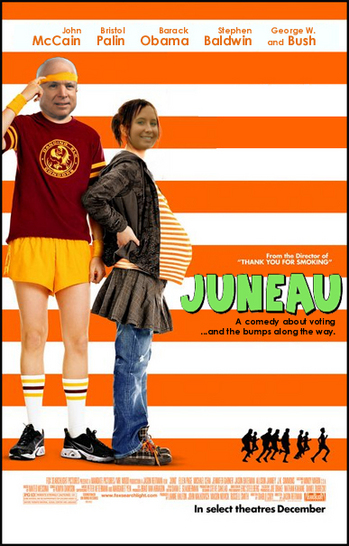
Juneau

No comment necessary. (See previous.) The coincidences are too great. Many thanks to whoever created this. It will soon be everywhere, if it isn’t already.

UPDATE: From Republican conservative pundit and former Reagan speechwriter Peggy Noonan: “I think they went for this, excuse me, political bullshit about ‘narratives.’ Every time Republicans do that, because that’s not where they live and it’s not what they’re good at, they blow it.”

Go back and skim Neal Gabler’s book “Life: The Movie.” This “plot development” is funnier than Spiro Agner, funnier than Dan Quayle. This may be even beyond Billy “Beer” Carter-level funny…

December 14, 2012

Shooting the rapids with Werner Herzog (Part 1)

“People should look straight at a film… That’s the only way to see one. Film is not the art of scholars, but of illiterates. And film culture is not analysis, it is agitation of the mind. Movies come from the country fair and circus, not from art and academicism.”

— Werner Herzog, 1978 interview quoted in

John Sandford’s book, “The New German Cinema” (1980)

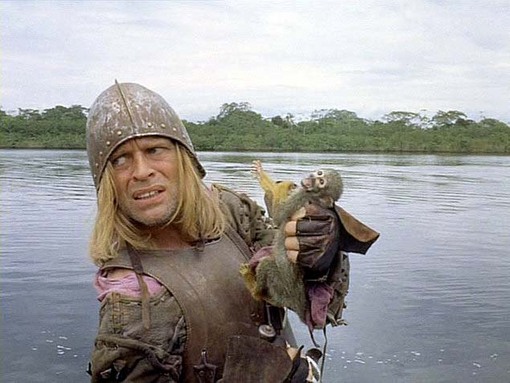
We knew it was going to be interesting. Seeing “Aguirre, the Wrath of God” (1972) for the first time in 25 years (even though I’d seen it many times before) with Werner Herzog, Ramin Bahrani, Roger Ebert and a Conference on World Affairs Cinema Interruptus audience in Boulder, CO, last week reconfirmed that not only is Herzog a magnificent, instinctive director, but a first-class showman in the carnival tradition, a compelling speaker and storyteller, and a wonderful actor. Some of the wild tales he related to the audience in Macky Hall are, I’m told, also on the director’s commentary track of the American DVD of “Aguirre” — and some I’ve heard him tell many times over the years, but there’s nothing quite like hearing Herzog spin his spiels in the flesh — even (or maybe especially) when he’s a booming voice in the dark.

December 14, 2012

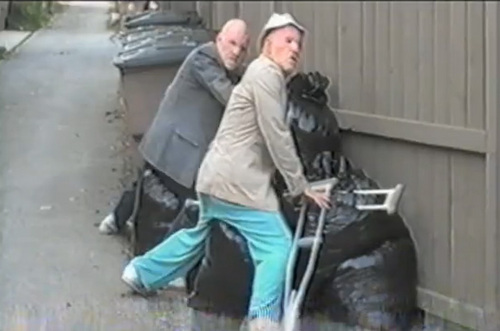
Trash Humpers not banned, hump trash

Part I (before I saw “Trash Humpers”)

Google “Netflix” and “Trash Humpers” and the first result you’ll get is this: Netflix – Watch Trash Humpers. The second result (dated October 20, 2010) is an article from Filmmaker Magazine headlined: “‘Trash Humpers’ too trashy for Netflix?” Note that the head is in the form of a question, because the article/post itself consists almost entirely of a promotional announcement from Drag City, the DVD distributor of “Trash Humpers,” claiming that Netflix was refusing to carry the video, which (according to Amazon.com) was officially released September 21, 2010.

The press release was a useful publicity stunt (what do you expect for a Harmony Korine movie called “Trash Humpers”?), but how much truth it contained I haven’t been able to determine, and I haven’t been able to find any comments from anyone at Netflix. In its widely reprinted (but evidently unquestioned) October manifesto, Drag City said:

… Netflix has deemed the content of Trash Humpers to be too inappropriate for their subscribers to make it available to them. From their perspective, they may be right: they certainly know their subscribers and their tastes, and might have a better awareness of their breaking point (we thought that might have been fuckin’ Avatar). So it’s hard to fault them. But we do love a challenge! We don’t expect Netflix to carry anything they don’t want to, for whatever reason, but it reminds us that this is the price paid when we allow one entity to control the lion’s-share of content distribution.

Drag City provided a link to “actual factual mom-and-pop DVD sales-and/or-rental stores” that were carrying “Trash Humpers,” including Amazon.com, Newbury Comics and Amoeba.

December 14, 2012

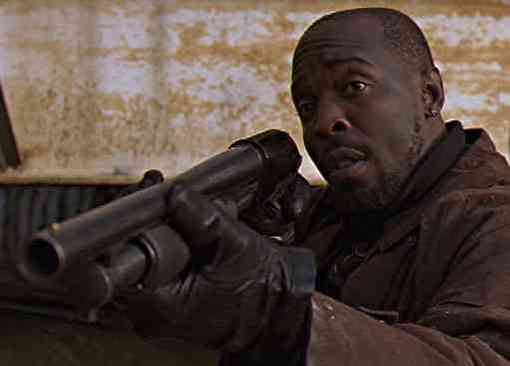
David Simon: Damn right Omar is cool. Get over it.

“The number of people blogging television online — it’s ridiculous. They don’t know what we’re building. And by the way, that’s true for the people who say we’re great. They don’t know. It doesn’t matter whether they love it or they hate it. It doesn’t mean anything until there’s a beginning, middle and an end. […]

I do have a certain amused contempt for the number of people who walk sideways into the thing and act like they were there all along. It’s selling more DVDs now than when it was on the air. But I’m indifferent to who thinks Omar is really cool now, or that this is the best scene or this is the best season. It was conceived of as a whole, and we did it as a whole. For people to be picking it apart now like it’s a deck of cards or like they were there the whole time or they understood it the whole time — it’s wearying. Because no one was there in the beginning, or the middle, or even at the end. Our numbers continued to decline from Season 2 on.*

— David Simon, creator of “The Wire,” “Generation Kill,” “Treme”

I’ve heard some very good film critics make this argument before, too. Of course, a movie has a beginning, a middle and an end (although, as Jean-Luc Godard reminded us, not necessarily in that order). That’s the fabled “three-act structure” all the screenplay manuals talk about. Wim Wenders and other great directors have observed that they always make at least two movies: the one they set out to make and the one they discover while they’re trying to make the first one. Same goes for watching a movie or TV series: there’s always the show you watch when its destination is unknown, and the one you reconsider after you know how it ended up.

December 14, 2012

Marilyn Chambers, 1952-2009

Marilyn Chambers, star of “Behind the Green Door,” “Insatiable,” “The Resurrection of Eve,” David Cronenberg’s “Rabid” (opposite Christopher Walken) and millions of Ivory Snow detergent boxes has died at age 56.

At Salon.com, Mary Elizabeth Williams writes:

As an aspiring model in San Francisco in 1972, she answered an advertisement for a role in a new film being made by strip club owners Jim and Artie Mitchell. The movie was “Behind the Green Door,” a hardcore odyssey involving the abduction and ultimate sexual transformation of a young woman.

It was the same era that “Deep Throat” (1972) and “The Devil in Miss Jones” (1973) were radically reinventing the culture of adult entertainment. Porn was no longer just for creepy guys in seedy theaters — it was something grownups could admit to watching, enjoying and, later, discussing. “Behind the Green Door,” with its taboo-shattering interracial cast, was a benchmark, but it was the revelation that Chambers had appeared on the Ivory detergent box, clutching a baby in a beatific, 99.44 percent pure tableau, that cemented her fame. That such a wholesome, smiling girl could be the assured, adept centerpiece of all manner of exotic acts was fascinating. The ultimate madonna/whore of her era, she represented a dichotomy that perplexes, intrigues and infuriates still.

December 14, 2012
subscribe icon

The best movie reviews, in your inbox