Dina Martina’s Oscar Entertaining Party Hints!

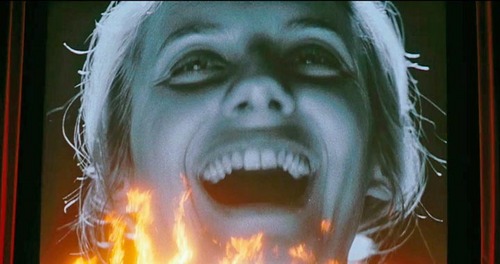
View image Dina Martina shows you how to organize, glamorize, accessorize, extemporize and festivize for Oscar. (photo by David Belisle)

A year later, Dina Martina is back to remind you of how you can make this year’s Oscar festivities the most memorable ones of the year!

– – CLIP-‘N’-SAVE – –

It’s all about the party, people. This year, once again, I have turned to one of my eldest and dearest friends in the biz that we call show, the sparkling professional veteran entertainer Dina Martina (freshly returned from a USO Tour of P-Town), for party tips, decorating pointers, fashion commands and recipe notions. The GLAAD Media Award-nominated celebrity for Best Person in an Off-Off-Broadway Show (because she is glad, for “Dina Martina: Sedentary Lady”), Dina Martina can always be relied upon to present the finest advice in your area. Ladies and Gentlemen, the act you’ve known for all these years: The Oscar expertise goes to… Ms. Dina Martina!

* * * Dina Martina: Your Haute Guide to Entertaining Oscar-Style! * * *

by Dina Martina

It is now a very short time before the 2007th 2008th annual Academy Awards telecast graces billions of tiny silver screens around the world, and I’m as antsy as a kid in a china shop. I’ve made quite a reputation for myself over the years as a hostess who throws parties, and I’d love to share with you some of the finer points of how to throw an Academy Awards party that will leave your guests talking all the way through the Barbara Walters Special. Ready? Here goes!

1) Plastic Surgery.

All the stars are doing it (heck, Kenny Rogers is doing it and doing it and doing it), so why not you? I say, treat your face like you’d treat the fabled Red Carpet – remove the unsightly wrinkles by pulling it nice and tight before your guests arrive. Below the neck, however, I’m going against the grain this year by foregoing the requisite liposuction. All the other girls can be underfed fish in big ponds, but not me; I’m getting a tummy augmentation! The only way to stand out in sea of skin and bones is to fight lank with lard, and if it means I’ll be noticed — and remembered — I’ll be proud to resemble the Hindenburg, surrounded by skeletal, radio tower-looking waifs. Goodbye size 2, hello sleep apnea!

View image Dina Martina, America’s Sedentary Lady of Technicolor, Alive! In Performance.

2) Host your own “Red Carpet” segment on the front lawn.

Surprised? Excited? Confused? Well, my friend, studies reveal that the red carpet segment is everyone’s fave part of the show anyway, and since I began including this Oscar staple in my party plan, attendance has steadily increased each year by an average of .8%! It makes your guests feel truly glamorous, and your PHQ (Party Host Quotient) just goes bonkers! But before you freak out over just how to successfully pull off this crucial portion of your gala, let me first plant a few seeds in your cranny regarding what I refer to as “RCNs,” or Red Carpet Necessities:

December 14, 2012

Opening Shots: ‘Aguirre, the Wrath of God’

From Nadia Aboufariss:

“Aguirre, the Wrath of God” begins with a shot of a huge, wooded mountain side, shrouded in the mist. We can just barely make out the figures who are slowly descending the slope, little bigger than specks on the screen. As in other Werner Herzog movies (such as his recent film “Grizzly Man” ) this opening shot suggests the utter indifference of the natural world to the exploits of man. The Spanish conquistadors who are descending the mountain, with their priests, women, and slaves are embarking on a noble quest to find the lost city of gold, “El Dorado,” while simulataneously bringing the grace of God to the local savages.

December 14, 2012

Watching movies again. And again…

“Blade Runner”: I could watch it again right now just for the pretty colored lights.

I’ve fallen behind on my movie blog reading in recent days, so now I’m catching up on some good stuff. Like this, from girish:

I’m curious about the nature and degree of re-viewing practices. I tend to re-view films a lot. I noticed that last year, about one out of every four films I saw was something I had seen before.

One reason for re-viewing is to get closer and deeper into films or filmmakers whose work we already feel a strong degree of comfort and familiarity with. These are works whose cinephilic pleasure is more or less assured. Our previous, pre-existing response to the work is not likely to be seriously questioned. But these repeat visits are nevertheless valuable. They take us further, each time, into the work and its constituent details (its very ‘molecular structure’), allowing us a greater intimacy and thus fluency in thinking and talking about it. For me, some examples here might be: Hitchcock, Hawks, Renoir, Fassbinder, Lang, Lubitsch, Demy, Wong, Wes Anderson.

Sometimes, this can be taken to obsessive extremes. There are films one has watched more times than one really needs to, chiefly because their pleasure-giving capacity is endless, even if (at this point) each subsequent viewing yields diminishing returns in terms of critical insight. Nevertheless, these films are evergreen, hard to tire of. I know I’ve probably done this with: e.g. Demy’s “The Young Girls of Rochefort,” Sirk’s “All That Heaven Allows,” Wong’s “Happy Together, “Hartley’s “Surviving Desire, “and (idiosyncratically) Roman Polanski’s “Frantic.”

No qualifiers necessary for “Frantic,” girish — I love that movie. It’s Polanski’s “North By Northwest” and it’s almost as funny, perverse and thrilling.

I have certain movies I never tire of watching over and over again, mostly because they’re always fun and exhilarating experiences for me — the aforementioned “North by Northwest,” Lubitsch’s “Trouble in Paradise” (a perfect movie), “Ball of Fire,” “Stop Making Sense,” “Do the Right Thing,” “Waiting for Guffman,” “Dazed and Confused,” “The Big Lebowski” and (yes) “Kids in the Hall: Brain Candy,” for example.

The damdest thing I ever saw — and I never get tired of seeing it.

And there are others I return to because I find them endlessly renewing and I always discover some little detail or connection I hadn’t picked up on before: “Nashville” and “Chinatown” (of course), but also “Vertigo” and “Barry Lyndon.” The last four (and the Lubitsch) are among my very favorite films, and even after all these years I don’t consider them “easy” viewing. I’m fully engaged with them every time, because they’re alive to me. I can fasten onto one thing — a color, or a character, or a visual motif — and watch each of them from a whole new angle for a change, so that I never feel like it’s exactly the same experience as the last time I saw it (no matter how much I love to sing along with every nuance in every song in “Nashville” — especially Haven Hamilton’s).

Still others I’ve watched repeatedly because I want so much to appreciate them more than I do, and I keep waiting to discover some unifying Eureka! vision that will lift the veil between me and the movie and allow me to see it as the masterpiece others claim to see. I had this experience only the second time I saw “Eyes Wide Shut” (my initial viewings of Kubrick movies since “A Clockwork Orange” have often been unreliable or self-deceiving). I’ve seen “Blade Runner” (in all its various versions) umpteen times and (although the versions have improved) it’s never cohered into the masterpiece I’ve always wanted it to be. But it is gorgeous, even if it doesn’t quite hold together. Am I repeating the same behavior expecting a new result? Maybe. But Ridley Scott says he’s got a definitive director’s cut of the movie coming out this year…

December 14, 2012

“Just look at how far we’ve come…”

Can Tina Fey get an Emmy just for this? I know, it’s almost too easy. But she’s flawless. I knew she was a terrific writer and comedian (er, “comedienne”?), especially from “30 Rock,” but I don’t think I ever fully realized what a brilliant actor (er, “actress”) she is.

And now, conservative columnist David Brooks of the New York Times on a word familiar to “SNL” viewers: “prudent”…

December 14, 2012

Why bad endings don’t ruin everything(we just remember them that way)

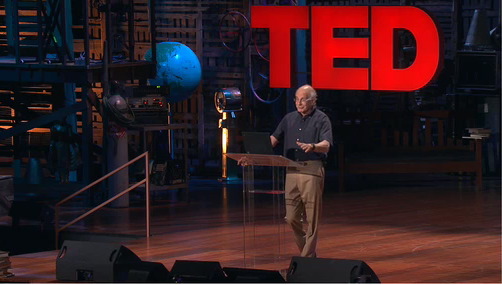
“Why do we put so much weight on memory relative to the weight that we put on experiences?”

Think of the implications of that question, and how it affects how we think about our lives. I’m tickled and intrigued by some of the things psychologist and Nobel laureate Daniel Kahneman has to say in this TED talk, “The riddle of experience vs. memory,” and how they apply to our experiences (and memories) not only of our lives, but of works of art. He tells a story of someone who said he had listened to a wonderful symphony, but how a “dreadful screeching sound” at the end “ruined the whole experience.”

But it hadn’t. What it had ruined were the memories of the experience. He had had the experience. He had had 20 minutes of glorious music. They counted for nothing because he was left with a memory; the memory was ruined, and the memory was all that he had gotten to keep.

December 14, 2012

The curious coolness of Benjamin Button

Todd McCarthy of Variety, who’s old enough to know better, writes at the end of his review of “The Curious Case of Benjamin Button”:

Still, for what is designed as a rich tapestry, the picture maintains a slightly remote feel. No matter the power of the image of an old but young-looking Benjamin, slumped over a piano and depressed about his fading memory and life; it is possible that the picture might have been warmer and more emotionally accessible had it been shot on film. It has been argued that digital is a cold medium and celluloid a hot one and a case, however speculative, could be made that a story such as “Benjamin Button,” with its desired cumulative emotional impact, should be shot and screened on film to be fully realized. These are intangibles, but nor are they imaginary factors; what technology gives, it can also take away.

[Don’t worry — no spoilers.]

This makes about as much sense to me as blaming the weather on Doppler radar pictures. It may be the second-most misguided thing I’ve read about movies all year (after Patrick Goldstein’s assertion that a “dumb summer comedy” is more worthy of contempt that a dishonest or inept film that expects its ambition to be taken more seriously).

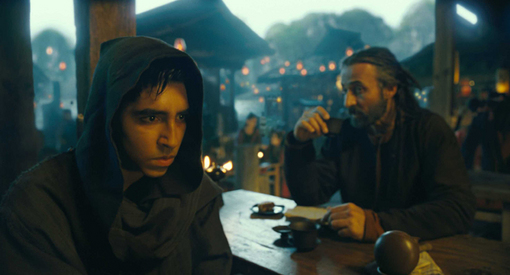
OK, let’s say the movie feels “cold” to you, and you attribute this feeling to something in the film. You could acknowledge the movie’s predominantly wintry settings and sepia color pallete (exemplified by the fully digital image, set in the dead of night in an empty hotel lobby in the middle of the Russian winter, above). Or contemplate the loneliness of the emotionally detached title character/observer/narrator, who is born an old man in a decrepit body and is cursed to grow physically younger while watching everyone around him age and die.

And you might very well consider the Kubrickian sensibility of the director, David Fincher (“Se7en,” “Fight Club,” “Zodiac”), the most deliberate and precise of filmmakers. Not known as Mr. Warm ‘n’ Cozy — even when working from a Gumpian screenplay by the writer of “Forrest Gump.” If the film is dark and cool in tone, it’s not because Fincher chose digital technology. It’s because Fincher chose to make it dark and cool. You may dislike the countless ways in which the movie emphasizes these qualities (in every composition, every cut, every performance), but don’t pretend it’s the video that’s doing it.

December 14, 2012

Where I’ve been

My father died unexpectedly the first week of April, three days before I was scheduled to leave for the Conference on World Affairs. The day before I left, my dog Frances surreptitiously ate two containers of dog treats in my parents’ garage and nearly exploded, but after an emergency trip to the vet she’s now OK (and seven pounds lighter). At my mom’s insistence I went to Boulder (with “Chinatown”) and then we had the reception for my dad at their house (there was no funeral or memorial service — he didn’t want ’em) when I got back. Two days after that, it was off to Ebertfest, where I was greatly heartened to see Roger Ebert in such high spirits. So, that’s what’s been going on. Hope to get back to posting regularly now…

December 14, 2012

One shot: They wrote that

View image To some, it’s just another genre picture. Composition, color, movement, texture, shapes, faces, expressions, bodies — that’s where you begin to experience what this montage sequence is “about.”

If film is first and foremost a way of seeing (and I believe that to be the case, even if not everyone sees seeing the way I do), then what we see in a shot, or a series of shots, is as important as… as anything. The movie is what the film does, as the mind is what the brain does. One of my oft-used analogies is Picasso’s “Guernica.” Now, you can know or not know what the painting is “about” — the story it depicts, the historical-political events upon which it is based. You may even sense the emotions the artist is expressing and the techniques he’s using to express them. But all those things don’t even come close to adding up to “Guernica.” “Guernica” is a large composition designed to evoke responses in the viewer. That’s where you begin to discover the thing itself.

All of which serves as an introduction to one image from “No Country for Old Men” that I would like to point out (separate from the longer piece[s] I’m working on now). It’s a second or two of film that occurs just after Llewelyn Moss (Josh Brolin), who is being chased through the desert by a truck at night, jumps over a river bank and glances back and up to see how close his pursuers are. It involves seeing dust produced by the braking truck, illuminated by the headlights as it breaks over the edge of the bank, darkly silhouetted against the light from above. It’s Moss’s POV, and it’s a detail we notice because he notices it. The hounds of hell are loose on his trail (or will be in moments), but here’s this moment of sinister beauty develops from it, and sticks around just long enough to register before more urgent matters assert themselves.

It’s a directorial (and photographical) coup in many ways, but I was delighted to discover that it’s one of those images the Coens visualized in advance and actually chose to record in an early version of their screenplay (which deviates from the finished film in several significant aspects):

Moss is almost to the steep riverbank. Another whump of the shotgun.

Shot catches Moss on the right shoulder. It tears the back of his shirt away and sends him over the crest of the river bank. Moss airborne, ass over elbows, hits near the bottom of the sandy slope with a loud fhump.

He rolls to a stop and looks up.

We hear a skidding squeal and see dirt and dust float over the lip of the ridge, thrown by the truck’s hard stop.

That moment, in the middle of a deadly chase, is a “privileged moment” of a kind that, perhaps, Francois Truffaut did not have in mind when he coined that phrase, but it sure is one. For all we know, it could be the last play of the light that this man will ever see — and we share the site with him. It’s natural, it’s what perhaps anyone in this situation could see, but the Coens make sure that we do see it. The next several images I don’t want to describe right now, but they are among the most electrifying and surreal in all of cinema — at least since the relentless approach of the nightmare dog in Buñuel’s “Los Olvidados” (1950). But at this moment, we’re awash in sensations: the squeal of the tires, the clang that tells us something or someone is getting out of the unseen truck atop the bank, the cold river into which the wounded and disoriented Moss is about to plunge…

View image Luis Buñuel’s “Los Olvidados” (1950).

But I just wanted to point this out, and that they wanted to be certain it was not just in the film, but even in the screenplay (which in other respects is somewhat different than the film itself). Writers often do that kind of thing, and the credit (or blame) for a shot or sequence will usually be attributed to the director, even if it was right there in the script. But it is the director who bears responsibility for realizing those images, and sequencing them, and presenting them so that they do what they need to do. The Coens, being their own writers, directors, producers and editors, pretty much understand what they’re looking for. And they recognize what they’ve got when a miracle drops in their lap: the birds, and shadows of birds, over the highway in “Blood Simple”; the pelican plopping into the ocean at the end of “Barton Fink”).

“Content, as I see it, is a series of connecting shocks arranged in a certain sequence and directed at the audience.” Sergei Eisenstein, you are so right! (I wish I liked your movies more.) Shocks as content — the junior-high equation [ART = FORM + CONTENT] trembles, previously secure elements threaten to swap sides. What Eisenstein theorized about cinema goes for writing, too: words as shocks; shocks arranged in a certain sequence. Words call up images and the images recur, mutate, cross-refer as the words extend in linear space and the reading-experience extends in time.”

— Richard T. Jameson, “Style vs. ‘Style'” (Film Comment, March/April, 1980)If Michael Bay turns everything up to 11 and assaults you until you feel bludgeoned and numb, the Coens do the very opposite. Bay, from the Alan Parker school of airless imagery, tries to shut you down, to restrict your imagination to fit his literal forms. (If you feel like cattle being funneled through the slaughterhouse, so be it.) The Coens open up the doors of perception, so that you become hyperaware of the many vibrant sensations — light, color, sound, motion — that are in the world around us every day, the kinds of living details to which most (flat, inert, mechanical) films just aren’t attuned.

So, one brief shot of the dust in the headlights — it’s a small thing, but it makes all the difference. It’s just one of the thousand natural shocks that flesh is heir to, and one reason I emerge from a movie like “No Country for Old Men” feeling like my senses, my emotions, my mind, have been stimulated, invigorated rather than dulled.

December 14, 2012

Watching (and listening to) Fincher’s Girl

“The Girl With the Dragon Tattoo” has been a 2005 book (the first part of the late Stieg Larsson’s “Millennium Trilogy,” translated into English in 2008), a 2009 Swedish-language feature film by Danish director Niels Arden Oplev, and a 2011 English-language Hollywood movie. In 2012 it will also become a DC graphic novel, but my feeling while watching the new movie was that the material had reached its apotheosis as A David Fincher Film.

I haven’t read the novels (I’ve paged through some of “Dragon Tattoo” in English), but even fans I’ve talked to don’t make any claims for Larsson as a great writer (albeit in translation), and the Swedish movie version struck me as little more than a straightforward work of adaptation: “OK, we’re going to take this story and put it on the screen.” It did that, but except for the presence of Noomi Rapace as the titular Lisbeth Salander I didn’t find it very exciting to watch.

So, I wasn’t particularly looking forward to seeing another version of “The Girl with the Dragon Tattoo.” I was only curious because of Fincher, whose “Fight Club,” “Zodiac” and “The Social Network” I think very highly of. I saw the Fincher movie The Way It Was Meant To Be Seen™ (in Sony 4K Digital Video projection!) and, I admit, I was literally rocking out in my rocking theater seat from the first riffs of Trent Reznor and Atticus Ross’s biting cover of Led Zeppelin’s “Immigrant Song” — an icy blast of frigid air over a deep black credits sequence in which our Girl Lisbeth endlessly shape-changes into various forms and substances — all of them integral to who she is. (“Aaaaaaaaaaaaaaaaaaaah! Aaaaaaaaaaaaaaaaaa! We come from the land of the ice and snow, from the midnight sun where the hot springs flow…” Too on-the-nose? Maybe. But the squall of sound practically rips open the screen.)

December 14, 2012

Thumbs up for Roger

Thumbs up for a quick recovery.

Roger Ebert is in serious but stable condition after suffering a burst blood vessel near the site of an operation two weeks ago to remove cancerous growths from his salivary gland. These kinds of things are always scary, and I can’t concentrate on much of anything but wishing for Roger’s quick recovery. Thanks, too, to all of you who have sent e-mails with your best wishes. I’m saving them up to send to Roger and Chaz once he’s out of the hospital.

Just to keep the positive recuperative vibes flowing, I’m posting this picture — one of my favorites — that I took at an Overlooked Film Festival reception at the Playboy Mansion in 2000. Here he is with Mark Borchardt of “American Movie” (who’s holding a beer and a screwdriver — which was pretty much the case for the entire evening). The great thing about this shot is that Roger did his thumb gesture just as I was about to take the picture, and Mark immediately put both his drinks in one hand so he could reciprocate. Just one of many great times I’ve had with Roger, and here’s to many more!

UPDATE 07/04/06: Chaz Ebert has an update on Roger’s condition.

December 14, 2012

Will Airbender (mercifully) kill the 3-D fad?

Above: What THIS scene needs is more dimensionality!

Roger Ebert says that M. Night Shyamalan’s “The Last Airbender” is such an “agonizing experience” that it “puts a nail in the coffin of low-rent 3D”:

it’s a disaster even if you like 3D. M. Night Shyamalan’s retrofit [shot in 2-D, digitally reprocessed for 3-D] produces the drabbest, darkest, dingiest movie of any sort I’ve seen in years. You know something is wrong when the screen is filled with flames that have the vibrancy of faded Polaroids. It’s a known fact that 3D causes a measurable decrease in perceived brightness, but “Airbender” looks like it was filmed with a dirty sheet over the lens.

December 14, 2012

CE3K 30 3.0

The light is the movie.

In celebration of the 30th anniversary three-disc DVD release of three — count ’em, three — versions of Steven Spielberg’s masterpiece, “Close Encounters of the Third Kind,” I offer yet another quotation from Richard T. Jameson’s “Style vs. ‘Style'” (Film Comment, March/April, 1980):

“Energy” has become the new cliché of film criticism, which is a damn shame since the cinema is a medium of energy… “Energy” as a cop-out for mindless noise and jitter is reprehensible. But energy, sans quotes, can be lucid, multivalenced, aesthetically informed, and beautiful in ways unique to cinema.

Steven Spielberg misapplies it in “1941,” but illuminates the world and his medium with it in “Close Encounters of the Third Kind.” “Close Encounters” is, like any other good movie, about mise en scène, the transliteration of energy. “The sun sang to me last night,” an old derelict beams. The dissonant but regular chant on a mountain in India is echoed on the toy flute of an Indiana boy, while his mother finds herself painting an odd rock formation into all her pictures and a newly-ex power-company employee (he’s chasing a new power) looks for it in rumpled pillows and bowls of mashed potatoes. Form finally compels its own content. Music becomes light, gesture, mathematical formula, the patterns described in space by a celestial craft in motion. The metamorphosis of reality, the rediscovery of possibility, the translation of an idea into visual action: what movies do: why movies exist. The foremost pleader of the UFO cause is played by one François Truffaut, movie director.

This is energy as style, style as energy. It’s radiant because it’s been defined by a cinematic sensibility: What Spielberg’s seeing and the way he sees it are one.

I get chills reading that, because it puts me back in touch with the sense of awe I get from a movie that sings… like the sun.

December 14, 2012

Who Killed the Electric Car?

Where did these cars go?

“To preserve our children’s future, we have to waste every resource we’ve got.”

No, that was not Dick Cheney. That was Stephen Colbert, endorsing General Motors’ $1.99 gasoline promotion: Buy one of their guzzlers and they’ll reimburse you for fuel costs at the end of one year so that you wind up paying no more than a buck ninety-nine a gallon. (If you remember to send in your receipts with that mail-in rebate form, that is!) Colbert heartily endorses the deal, using flawless logic: The only way we’re going to get more efficient fuel technology is to use up all the oil we can, as fast as we can.

Oddly, this is much the same logic behind the death of GM’s electric car, the EV1, in the mid-1990s. According to the new documentary (and technological murder-mystery) “Who Killed the Electric Car?,” there was simply too much easy money remaining to be made from old technology and the remaining trillion gallons of crude oil beneath the Earth’s crust. So, anti-free-market forces (oil companies, petro-politicians, automakers) killed off an existing, and quite successful, fuel cell vehicle that was already available in California and Arizona. Emissions: None. Speed: Up to 184 mph. Operating cost: The equivalent of buying gasoline at 60 cents a gallon.

December 14, 2012

Why Soderbergh is retiring soon

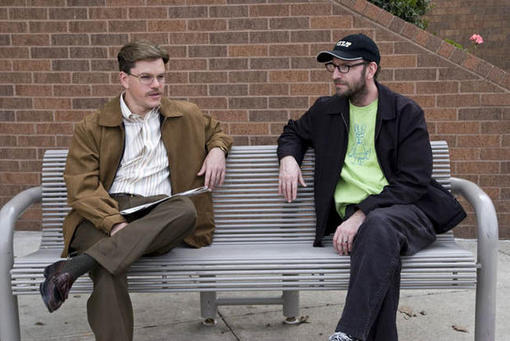
The LA Times’ 24 Frames blog quotes Matt Damon on Steven Soderbergh’s plan to retire from directing after three more films:

“He wants to paint and he says he’s still young enough to have another career,” Damon said. “He’s kind of exhausted with everything that interested him in terms of form. He’s not interested in telling stories. Cinema interested him in terms of form and that’s it. He says, ‘If I see another over-the-shoulder shot, I’m going to blow my brains out.’ “¹ […]

“After I worked with Clint [Eastwood] I went back and said, ‘Look, Clint is having a blast and he’s going to be 80 years old.’ And Steven says back, ‘Yeah, but he’s a storyteller and I’m not,'” Damon recounted. “If you’re an actor or a writer or someone working in film, it’s such a waste. For me, I’m going to spend the next 40 years trying to become a great director and I will never reach what he’s reached. And he’s walking away from it.”

– – – –

¹ I know the feeling.

December 14, 2012

District 9: Alive in Joburg

This six-minute 2005 short, “Alive in Joburg,” by South African director Neill Blomkamp, forms the basis for his “District 9.” Unlike the feature, it is set in 1990 under the apartheid government, during which time (in actual history) thousands of black South Africans were relocated from an area of Cape Town known as District 6 to make it an “all whites area.” (The same was done in Sophiatown, Johannesburg, setting of the feature film.)

December 14, 2012

Bordwell’s Basterds

In his two-part round-up of summer movies, David Bordwell finds himself not only impressed with Quentin Tatantino’s latest film (after finding “Death Proof” “merely proof of the director’s creative death”), but with the quality, quantity and intensity of the online analysis of it:

It’s a measure of the changes wrought by the Internets that “Inglourious Basterds” has in about a month amassed a daunting volume of serious commentary. Without benefit of DVD (let’s be charitable and assume no BitTorrenting), dozens of online writers have dug deep into this movie. As if to demonstrate the virtues of crowdsourcing, this flurry of critical discussion has shown that most professional movie reviewers have tired ideas, know little about film history, and are constrained by the physical format and looming deadlines of print publication. At this point, I’m very glad I’m not writing a book on Tarantino; the sort of secondary sources that normally take years to accrete have piled up in a few weeks, and the pile can only grow bigger, faster.

(He also offers well-deserved praise for the “knowledgeable readers” here at Scanners!)

December 14, 2012

Opening Shots: The Dark Knight

The corporate logos are deep blue and black: Warner Bros., Legendary Pictures, DC Comics. Then, out of a silent explosion of blue flames and black smoke, the familiar Batman shadow appears. Cut to bright afternoon daylight. The camera glides with surreal smoothness above a recognizably real American cityscape, over the rooftop of a large, squat building toward a cluster of shiny glass skyscrapers. This is not the forbidding, neo-Gothic Gotham City we expect to encounter at the beginning of a Batman movie, a densely stylized urban forest of inky comic-book noir. It’s almost like Phoenix at the start of Alfred Hitchcock’s “Psycho”: Anywhere, USA.

And that may well be the idea: The camera closes in on a colossal mirror, a wall of tinted windows in the side of a building. What are we looking for? How much closer can we get before something has to happen? (Where’s the helicopter? You’ll catch a glimpse of it at the far left, just at the moment your eye is distracted by an exploding window near center frame.) For a fraction of a second we may wonder about the fate of the people inside the room, and the pedestrians on the street below who are about to be showered with bits of glass. But before that can quite register we’re on the other side of the blown out window with a pair of clown-masked gunmen. This is part of some diabolical plan… which turns out to be a bank robbery in progress. (See other notes on this shot, and the rest of this sequence, here.)

Turns out, the building we’ve just passed over is the most important element in the shot; the glass wall is just a means to an end. Smoke and mirrors…

December 14, 2012

The dogs are loose! (Part 2)

My MSN Movies gallery feature article about Great Movie Underdogs (i.e., dogs whose proper names are not in the titles), is live. And, after the jump, the answers to last week’s movie dog quiz — and a couple of delicious bonus treats.

Regarding great movie doggerel doggies:

My dog Edith does not much like dog movies. At least I don’t think she does. Whenever a canine appears on our 55-inch HDTV screen, or any of the surround speakers, she lunges, barking, growling, whining and emitting other noises that sound like a wounded vacuum or a gargling siren.

If Edith were a bit less excitable and territorial, if she were better able to maintain a critical distance, she would appreciate how many fine screen performances have been given by members of her species, if not of her particular mixed-breed-of-color. […]

December 14, 2012

A letter about essential things from Albert Einstein

I like this Einstein fellow’s intellectual attitude (see the final paragraph, below). While firmly disagreeing with someone’s philosophical stance, he nevertheless insists that they may have much to say to each other “if we talked about concrete things.” (Hey, what do I always say? Any valid exchange of ideas must be rooted in specific, mutually recognizable observations and solid reasoning, no matter what your opinions. Einstein said so, and he was no dummy!)

This letter, dated January 3, 1954, was written to Erik Gutkind, author of the book “Choose Life: The Biblical Call to Revolt,” which had been recommended to Einstein by a mutual friend, Luitzen Egbertus Jan Brouwer. (Full document at Letters of Note.)

Still, without Brouwer’s suggestion I would never have gotten myself to engage intensively with your book because it is written in a language inaccessible to me. The word God is for me nothing more than the expression and product of human weakness, the Bible a collection of honorable, but still purely primitive, legends which are nevertheless pretty childish. No interpretation no matter how subtle can (for me) change this….

December 14, 2012
subscribe icon

The best movie reviews, in your inbox