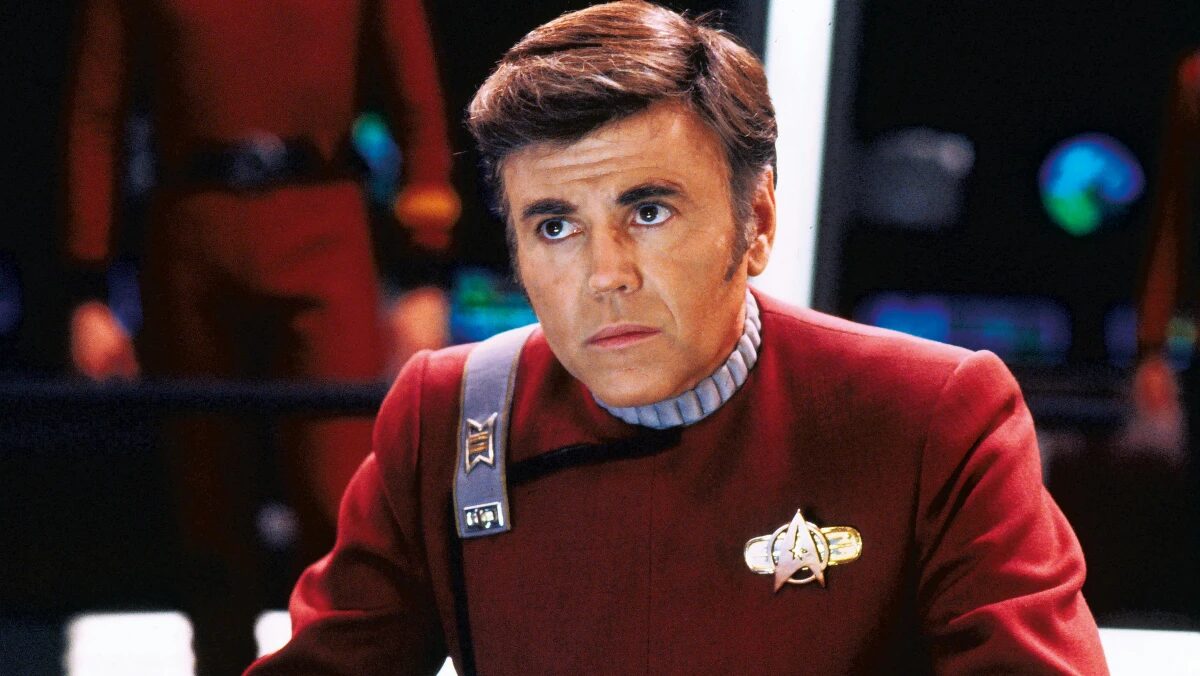
Looking back on “Star Trek”‘s storied sixty-year history, it’s hard to believe Walter Koenig‘s Ensign Chekov wasn’t on the show from the start. (In fact, 1982’s “The Wrath of Khan” simply retcons him being on the U.S.S. Enterprise during the events of Ricardo Montalban’s classic episode “Space Seed”; I guess he was just in the bathroom the whole time.)
But ever since Koenig’s chipper cosmonaut joined the original series cast in 1967, he’s felt like a fundamental part of “Trek” history. And as we look back on his life and work after his passing at 90, he was a foundational pillar of science fiction television in ways that go beyond the mop-topped navigator.
Koenig was born in Chicago, Illinois, in 1936, to a pair of Russian Jews who emigrated from the Soviet Union to America. As a child, the family moved to Manhattan, where he grew up; he later graduated from UCLA with a degree in psychology before the acting bug bit him and he returned to New York City to study at the Neighborhood Playhouse School of the Theatre.
His first big acting role was, fittingly, under “Trek” creator Gene Roddenberry, as a Marine Corps sergeant on “The Lieutenant”—many future “Trek” alumni would hail from that series. Of course, he didn’t join the show until its second season, when Roddenberry saw the need to broaden its appeal to younger audiences. (That, combined with the then-30-year-old Koenig’s already receding hairline, led to the Monkees-esque mop top he’d wear through most of his tenure.)
Tales that Chekov’s Russian heritage came from Roddenberry responding to a Pravda complaint that his utopian future had no Russian characters are apocryphal. Even so, his presence felt significant in a 1960s TV show that envisioned Americans and Russians working together as a visionary resolution to the Space Race.
Even so, Chekov remained a welcome addition to the Enterprise crew for the show’s second and third season, with his thick, marble-mouthed Russian accent (with all those ‘v’s switched to ‘w’s) and his naive insistence that a little old lady in Russia invented everything under the Sun.
As “Trek” supporting cast members go, he, like everyone not named Shatner, Nimoy, or Kelley, got short shrift, mostly answering Captain Kirk’s orders or reading damage reports. But he got his focus in plenty of episodes, like “The Deadly Years,” where his immunity to a rapid-aging disease proves vital to the crew’s cure, or “The Trouble with Tribbles,” where he joins Scotty in a barroom brawl with some Klingons who trash-talk the Enterprise.
He was comic relief, the doe-eyed innocent, and stalwart space adventurer all in one, and when the show focused on him, Koenig leapt at the chance to fill the screen with his infectious enthusiasm.
Like his fellow castmates, Koenig struggled after “Trek”’s cancellation, especially to find new acting roles. But he paid the bills by becoming a television writer, notably contributing episodes to “Land of the Lost,” “The Powers of Matthew Star,” “The Incredible Hulk,” and, ironically, “Star Trek: The Animated Series.” Then, when Hollywood came calling to bring him and the rest of the original crew back to the big screen for 1979’s “Star Trek: The Motion Picture,” he came right along.
Watching Koenig in the Kirk “Trek” movies is fascinating, especially as someone so baby-faced; he maintains his bright-eyed naivete into middle age. He still has the mop top, of sorts, and still feels like the baby of the crew, even though by the movie series’ heyday he’s in his late forties.
His real spotlight moment comes in “The Wrath of Khan,” where he gets a significant subplot separate from the Enterprise crew as the first officer of the Reliant, which Montalban’s Khan Noonien Singh takes over (but not before turning Chekov and his captain, played by Paul Winfield, into his thralls thanks to some space-slug shenanigans). Here, he gets to play darker, more haunted dimensions to Chekov, and even some body-horror terror as he sells the pain of struggling against a creature controlling your mind. It’s hardly Shakespeare, but they’re effective moments that sell what was, to date, the darkest “Trek” story yet.
Of course, Koenig got to play into his more comic layers as well, most notably in 1986’s “The Voyage Home,” where he gets to run around San Francisco at the height of the Cold War asking police officers where the “nuclear wessels” are in a thick Russian accent. As in the original show, he often shared a console with his seatmate, George Takei’s Lt. Sulu, who served as the other half of this particularly odd couple. Of his friend’s passing, Takei wrote on Facebook, “Walter was more than Chekov. He was a writer, a teacher, a thoughtful man, and a loyal friend… To the fans who loved him for so many years, thank you. He loved you too. Rest well, my dear friend. Keep navigating a steady course.”
He was also one of only three original “Trek” cast members to cameo in the “Next Generation” intro “Generations,” essentially standing in for Dr. McCoy in a clumsy prologue that he nonetheless made the most of.
While his acting roster didn’t extend much beyond Chekov, his other major notable role is important to cult sci-fi fans as fan favorite Alfred Bester on the 1990s show “Babylon 5,” a “Psi-Cop” who frequently dropped by the station to serve as a thorn in the side (and occasional ally) to the crew of the station. Slimy and supercilious where Chekov was warm and welcoming, Koenig clearly relished playing the baddie and balling his leather gloves into fists as he sneered one veiled threat after another.
From there, he’d largely serve as an ambassador emeritus for “Trek,” appearing at conventions and doing occasional voice work as Chekov for one game or audiobook or another. (I remember him fondly for appearing alongside Takei and Shatner in the 1990s FMV game “Starfleet Academy,” where he was one of several teachers instructing new recruits on the finer points of starship captaincy.)
He wasn’t the only actor in his family; he married actress Judy Levitt, with whom he acted in several “Star Trek” movies and “B5.” (She passed in 2022.) They had a son, Andrew, who earned his own cult-hit TV fame as “Boner” on the ABC sitcom “Growing Pains,” before dying in 2010 at 41. He’d live to see his pet role played by the gone-too-soon Anton Yelchin in the J.J. Abrams-produced “Star Trek” reboot trilogy, and he celebrated his first name in a voice cameo in a 2023 episode of “Star Trek: Picard,” playing Pavel’s son, Anton.
Even as he fell victim to the kind of typecasting that comes with starring in a cult-hit show, Walter Koenig made the most of his fate, remaining inextricably tied to a bona fide cult phenomenon. In an interview with the Archive of American Television, he described his fans as having “a sense of humanity and a sense of justice and a sort of political bent…people who had imagination.” As one of “Trek”’s foundational members, he’s an enormous part of that tradition. Not a bad legacy to leave, even as one departs this world for the stars beyond.