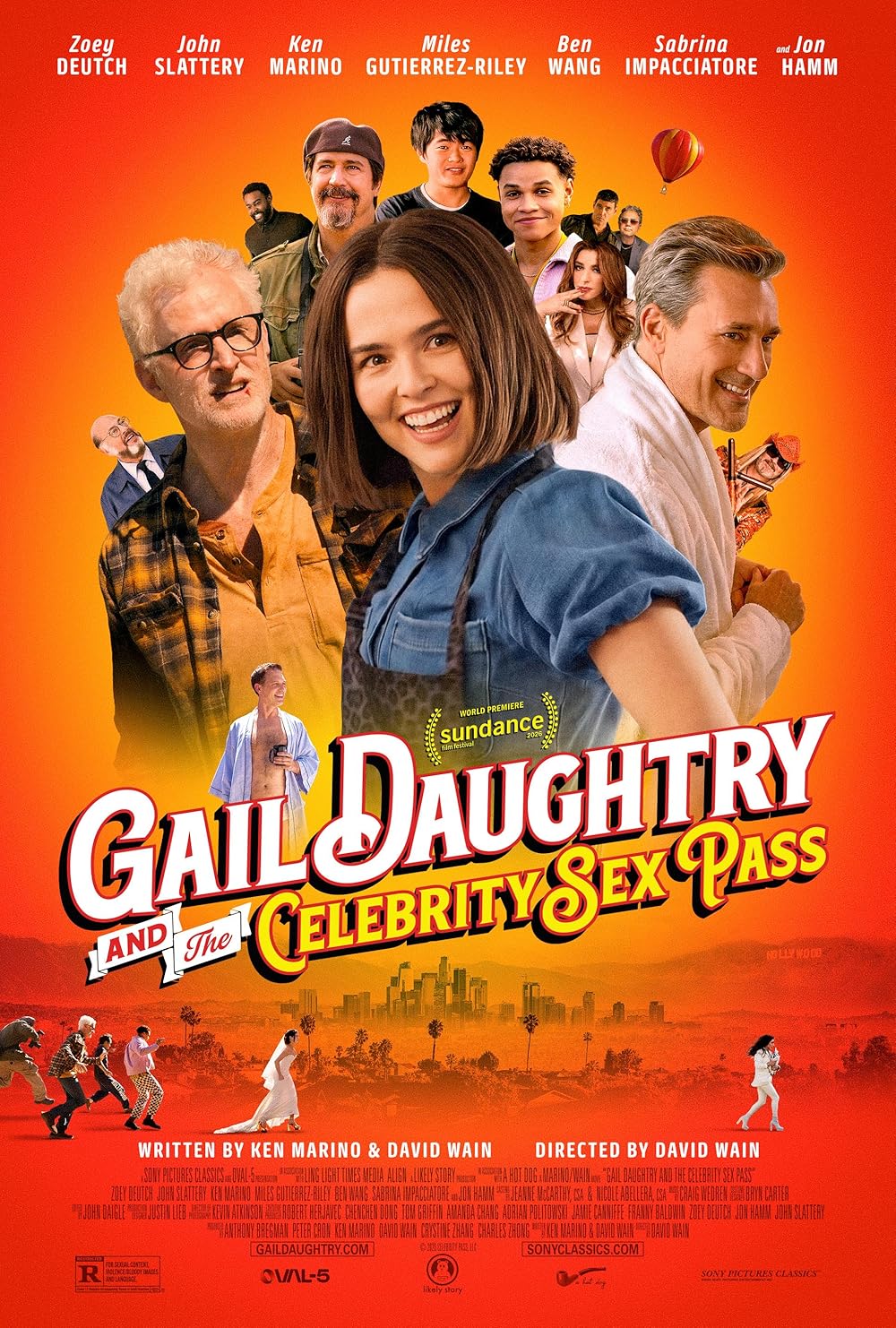

The deadpan absurdist comedy is a rare, gossamer thing these days; no wonder, then, that the prospect of a new project from David Wain might excite those of us who yearn for the days of Mel Brooks and, well, Wain’s own “Wet Hot American Summer.” Wain, a veteran of legendary sketch troupes Stella and The State, has a now 25-year history of mining the tacky conventions of certain basic-cable staples—”Wet Hot,” the teens-and-tits summer camp movie, “They Came Together,” the mid-aughts rom-com—for beautifully surreal gags. (You can say that again.) This year, he’s got “Gail Daughtry and the Celebrity Sex Pass,” which has a similar throw-gags-at-the-screen approach but with a less focused satirical target: this time, it’s a heady mix of your classic ingenue-in-Hollywood picture and, of all things, “The Wizard of Oz.” That lack of focus means it doesn’t quite fire on all cylinders like Wain’s prior pictures, but when the bone-dumb gags fly this gleefully (and frequently), it’s hard to care overmuch.
The mouthful of a title also helpfully sums up the premise, though if you missed anything, Wain gamely hires Fred Melamed and his golden voice to serve as narrator, an increasingly put-upon mailman who’s a bit sick of having to explain the whole thing as the film goes on. You see, Gail (Zoey Deutch) is a preternaturally moon-eyed hairdresser and bride-to-be living in Kansas (get where this is going?), who learns mere minutes after a light-hearted conversation with fiancé Tom Soursap McNoodleman (Michael Cassidy) about what celebrities they’d agree they could have sex with if they ever met that he has, indeed, just screwed Jennifer Aniston (herself) in the back room of a bookstore. (The silliest, best layer? He hasn’t even seen “Friends”; “I’ll get my assistant to mail you the DVDs,” Aniston moans between thrusts.)
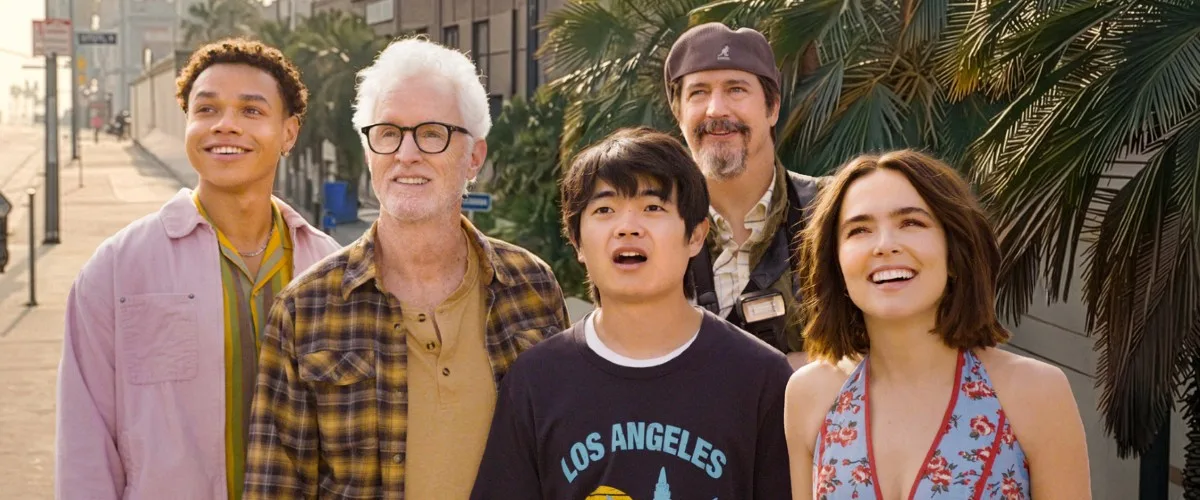
Heartbroken and confused, Gail decides to even the score by accompanying her gay bestie Otto (Miles Gutierrez-Riley) on a trip to Los Angeles, hoping to locate and lay her pick, “Mad Men” star Jon Hamm. Along the way, like her namesake before her, she and TotoOtto collect a grab bag of companions who gleefully skip down Hollywood Boulevard to aid her on her quest: an enthusiastically inept aspiring agent (“Karate Kid Legends” star Ben Wang, a highlight), a down-on-his-luck paparazzo (frequent Wain stalwart Ken Marino, who cowrote the script) hoping to nail that career-redeeming candid snap of Hamm, and eventually, Hamm’s “Mad Men” co-star John Slattery, playing a hangdog version of himself who’s fallen on hard times.
The parallels to “Oz” are apparent, albeit hazy; Hamm’s the wizard, LA is Oz, the Chateau Marmont is Emerald City, etc. We even get a subplot involving a switched-out bag and a mysterious Italian supervillain (“The Paper”‘s Sabrina Impacciatore) who stands in, kinda sorta, for the Wicked Witch. (If you somehow have trouble pinning down the archetypes, the closing credits helpfully, and obviously, pair each character with their L. Frank Baum equivalent.) But apart from those light signposts, “Gail Daughtry” is chiefly a joke factory for the clash between the romance with which Hollywood sells itself and its reality: Deutch’s wide-eyed joie de vivre and bright, beaming smile clash with what we know is the seedier side of Hollywood, even cheering on Otto as he follows a concierge’s advice to get a back-alley mouthbeezy from a stranger behind a Foot Locker.
It’s these kinds of jokes that keep “Gail Daughtry” afloat amid the apparent airiness of its structure; most scenes are mere vehicles to sell one absurd gag after the next. Wain’s specialty is finding the right amount of overstatement to give a gag, and it mostly works here—finding the right number of times to slam a door on Slattery’s foot, or to telegraph the fact that the gang has trespassed onto “Weird Al” Yankovic‘s mansion, and he’s about to chase them down with an AR-15. Sometimes, though, the joke truly does go on too long, or too much of a meal is made out of how unfunny a remark might just be, which sucks a lot of the air out of the room. (Some of the biggest casualties involve some of Wain’s former “The State” co-stars; for every Kerri Kenney-Silver as a surprisingly accurate psychic, there’s also a Tom Lennon as a cartoonish hairstyling celebrity who hosts “Blow-Out Blow Outs” and speaks with an unidentifiable European accent.)
The first half works way better than the back half, as the aforementioned suitcase switch-out puts Gail and crew in the crosshairs of a shadowy cabal peddling state secrets and the film descends into a laugh-light setpiece inside the faded facade of a Hollywood Western town. But before that, we get one-scene wonders like Richard Kind as a cabbie who won’t shut up about Elizabeth Perkins, or Tobie Windham’s Terrence, Hamm’s bodyguard, who mysteriously (and frequently) threatens the gang that he will make them very sick. Even if the whole thing doesn’t quite hold up as a unit, it’s hard to fault the laughs Wain and Marino eke out of these little bursts of silliness.
“Exceptions can be made for even the most important rules when celebrities are involved,” mutters one character midway through “Gail Daughtry.” That feels like the closest thing to the film’s overriding thesis as one can get amid all the jokes-for-jokes-sake: There’s Hollywood, then there’s everywhere else, and heaven help the people who enter the former without a good head on their shoulders. Or some courage. Or some brains. Or a heart.
Wain’s film doesn’t quite follow this thesis through to its logical or emotional conclusion; he’d rather give us a couple more throwaway jokes on the way out of the theater. But don’t we want a few more of those kinds of movies in this day and age? We as a culture failed “Barb and Star Go to Vista del Mar,” after all. While that’s leagues better than this, we should be thankful that someone’s out there making incredibly dumb joke delivery systems like this.