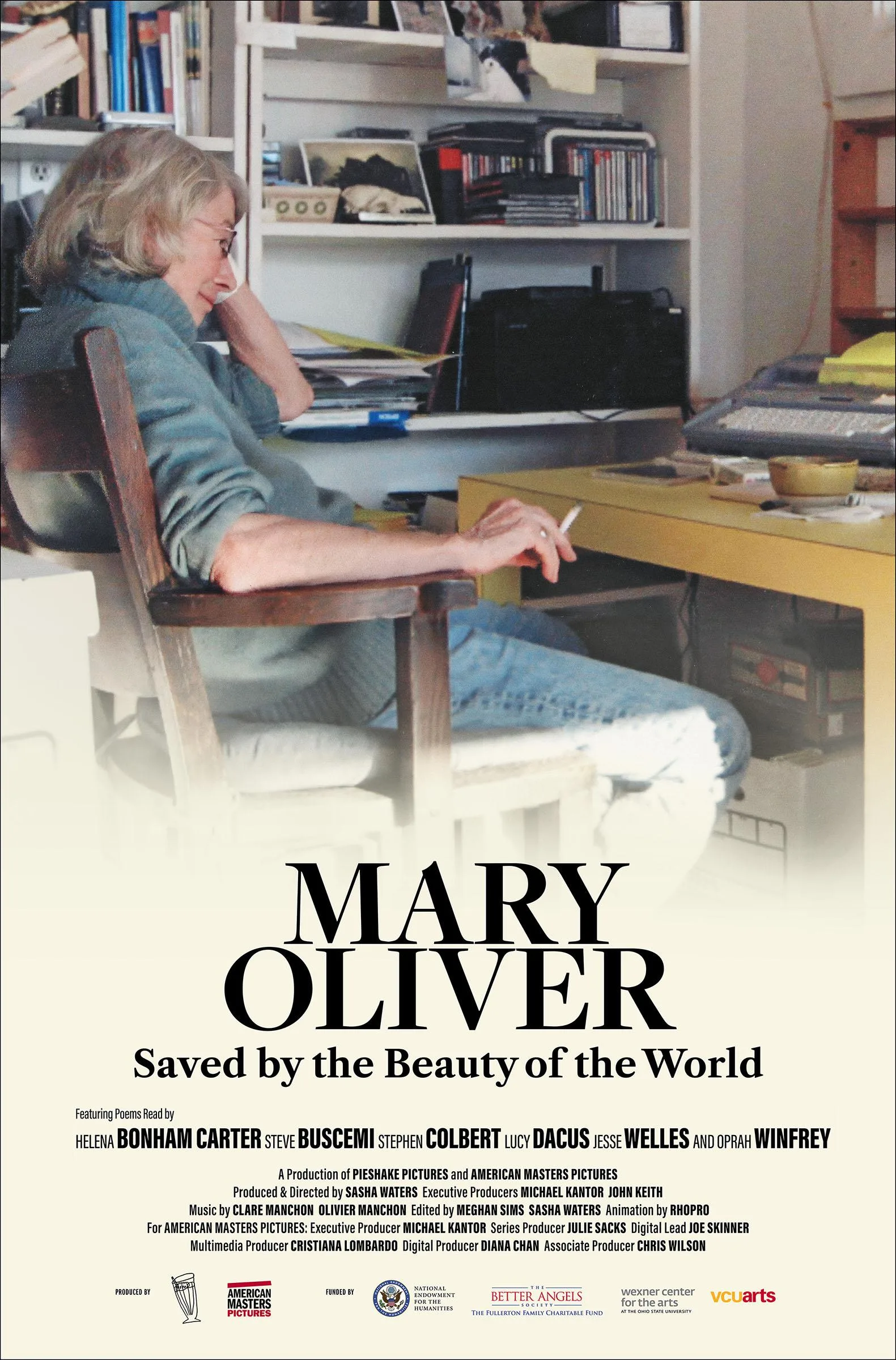
Former talk show host Stephen Colbert is among the many public figures in “Mary Oliver: Saved by the Beauty of the World” who discuss the poet’s importance to English language literature and their own lives. The first time we see Colbert, he tries to read one of her most famous poems, “The Summer Day,” which he sends to his children every year on their first day of school. But he has trouble reading it without getting choked up. In his initial attempt, Colbert breaks down at the very first line: “Who made the world?”
The first time I read the title of Sasha Waters’ documentary, I misread it as “Saved by the Beauty of the Word.” The misreading would do just as good a job of describing this appreciation of the United States’ bestselling poet, and one of its most acclaimed. Oliver’s ability to summon emotions with words is uncanny. Waters’ documentary is proof.
This is a gentle, attentive and moving work of art about an artist. The only thing that can be said against it is that it doesn’t have much film or video of Oliver. But that’s not the movie’s fault. Oliver rarely did interviews, and her many public appearances didn’t generate much of a cinematic record, although there seems to be lots of audio of both her interactions with the press and her poetry readings. But that built-in limitation proves—from this viewer’s perspective, anyway—to be counterintuitively liberating, because it forced Waters and her collaborators to devise a stylistic workaround. Their solution is a cascade of images of people and nature that doesn’t so much illustrate Oliver’s words as react to them.
This is also a much needed record of significant contemporary poets who have been forging their own paths, despite residing in a country that has never cared about homegrown poets, save for outliers like Walt Whitman, Langston Hughes, Gwendolyn Brooks, Allen Ginsberg, and others. The names you know are in the American canon because they started to show up in textbooks and on classroom reading lists late in life, or posthumously. Mark Doty, Ada Limón, Donika Kelly, Major Jackson, Nick Flynn, David Keplinger and Gabrielle Calvocoressi all appear and read Oliver’s work, analyze its style and themes, and speak from the heart about why they treasure her. I’m an avid reader, but rarely of poems. I hadn’t heard of most of these poets before watching this, and I’m thankful it provided me with a reading list.
The film also spotlights masters of other professions, including Steve Buscemi, Helena Bonham-Carter, and Oprah Winfrey, who says Oliver’s words “speak the language of my soul, and, I think, multiple souls around the world.” Musician Jesse Wells is introduced strolling through a field and does his interview sitting cross-legged in tall grass—an appropriate choice given Oliver’s lifelong fascination with nature, and her belief that it’s connected to feminine energy and can heal damaged souls.
Oliver was one of them. Born in suburban Cleveland in 1935, she was a solitary girl who felt like a misfit. “The only record I broke in high school was truancy, ” she told an interviewer. Her sense of dislocation and disinterest in school originated in sexual abuse by her father. Although that experience can be detected in poems that aren’t officially “about” the abuse, Oliver didn’t openly deal with it until her 1986 collection “Dream Work.” The most quoted poem in that book is “Rage,” which describes her father as:
“[a] red song
in the night,
stumbling through the house
to the child’s bed,
to the damp rose of her body,
leaving your bitter taste.
And forever those nights snarl
the delicate machinery of the days.”
She herself was saved by words, specifically those of Walt Whitman. (Asked what poets she read, she replied “Whitman, Whitman and Whitman,” and wasn’t entirely kidding. At the same time, the young Oliver grew to love nature, and clung to it whenever the pain threatened to become too much. “The two things I loved from a very early age were the natural world, and dead poets,” she once said. She was gay, but didn’t embrace that until she was a teenager working as a secretary for the sister of one of her idols, the poet Edna St. Vincent Millay. That’s how Oliver met her future mate and manager Molly Malone, a short-haired, pugnacious photographer employed by The Village Voice who was ten years older.
Malone and Oliver visited Provincetown in 1964 when it was thought of as a haven for beatniks and never left. The movie portrays Malone as a rock who gave Oliver the confidence to develop her voice, push for recognition, and shake off rejection. Oliver’s obituary for Malone describes her as beautifully as Oliver’s poetry did the rest of the world. Among the many things she learned from Malone, Oliver said, was that “attention without feeling is only a report.”
The most-quoted part of “The Summer Day” is its ending, which asks, “Doesn’t everything die at last, and too soon? Tell me, what is it you plan to do with your one wild and precious life?” Oliver did plenty with hers, from a position of stability, thanks to Malone; a belief in simplicity; and an appreciation of nature’s rhythms.
In a 2011 interview with Maria Shriver, Shriver paraphrases the poem’s beloved ending when posing a question: “What do you think you have done with your one wild and precious life?”
“What I have done is learn to love and learn be be loved,” she said.