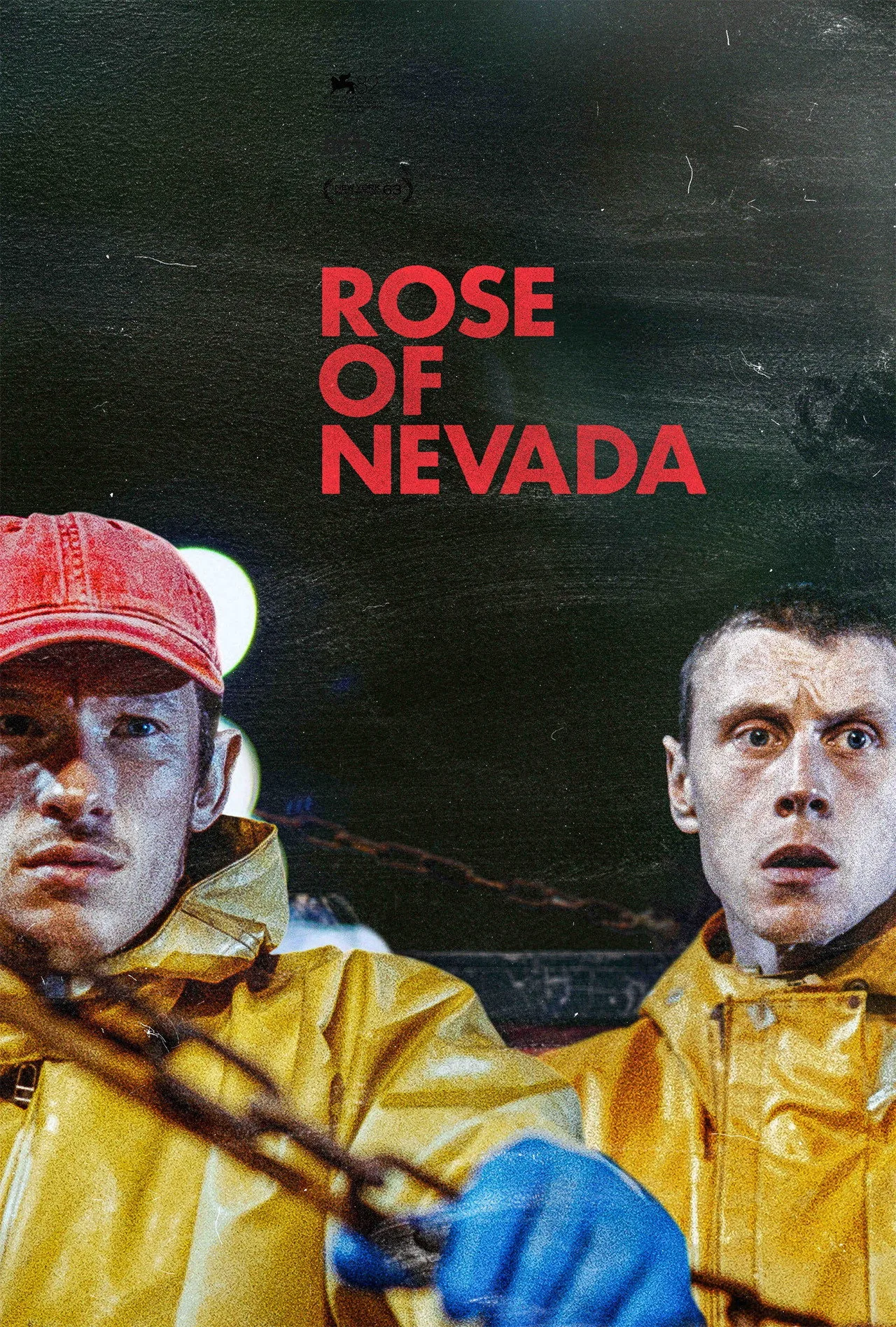

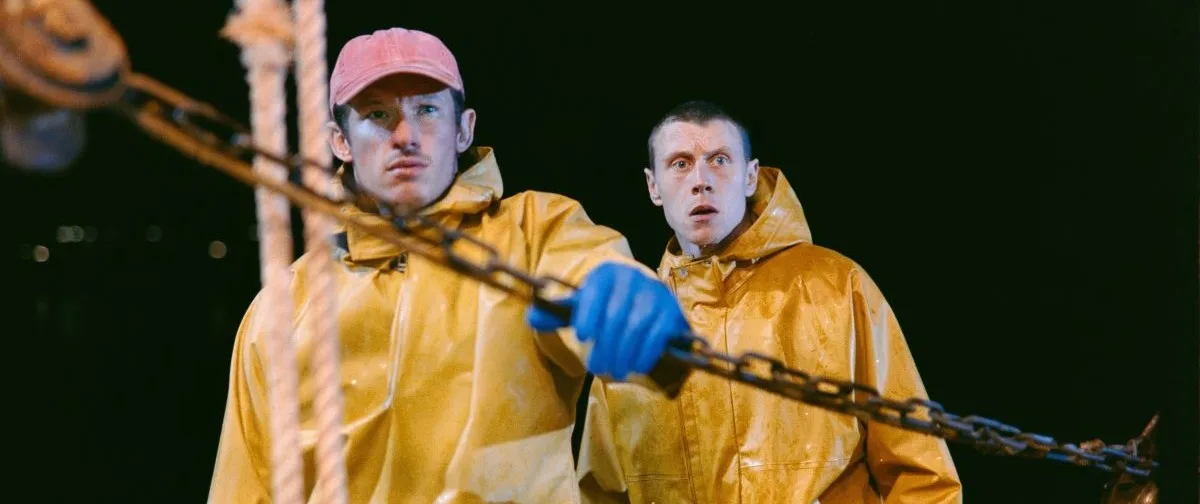
“Rose of Nevada,” writer/director Mark Jenkin’s uncanny psychological drama, unrelentingly echoes with regret and mourning. Jenkin’s cold, frightening film destabilizes one’s senses and perspective, causing one to question whether our protagonist is a reliable observer or simply mad. At the outset, we’re overcome by a swirling sensory language of seagulls cawing and waves lapping, with background images of fishing material—a weathered skiff, a rusting anchor, and chains—being reclaimed by the earth. Jenkin, who wrote, shot, and edited the film and composed its eerie score, leaps between characters—the worn boat owner Mike (Edward Rowe), a desperate Liam (Callum Turner), and an overwhelmed Nick (George MacKay)—before settling on a red fishing trawler.
Like Jenkin’s other angling-minded works (“Enys Men” and “Bait”), “Rose of Nevada” enjoys confounding the viewer, forcing one to look askance at the words uttered by opaque characters, at the sights shown that appear disconnected from their origin, and at the sounds whose post-sync pitch is as muffled as the narrative’s ruminative events. Even the picture’s handsome appearance, shot on pristine 16mm, suggests wariness more than beauty. And when that red fishing boat reappears, it’s something akin to a William Carlos Williams poem—“so much depends on a red wheelbarrow”—inciting immense dread and false opportunity upon its return to Cornwall, England.
To begin, Jenkin does attempt to “center” us with a few passing details. The vessel disappeared in 1993, before Nick and Liam were even born. On board are a red cap belonging to one of the former occupants and a photo of their girlfriend, Tina (Rosalind Eleazar), who now has two adult daughters. With its return, Mike needs a crew. First, Murgey (Francis Magee), a craggy skipper whose bearded visage approaches Mike like a memory in the fog, volunteers his services. Before long, Liam, a drifter staying in a damp shed, offers to sail too. Nick, who’s married with a child and has a cracked roof in need of repair, comes aboard as well despite being warned by an elderly woman about his mysterious role in the boat’s questionable past. Neither man is a fisherman by trade, but you soon get the sense it’s in their blood. Does their ease arise from fishing being the village’s primary, though moribund industry? Or have they run these lines and filled this hull before?
Nick is the one who indirectly asks these questions when the boat docks again after endless days and evenings at sea. The harbor and pubs are surprisingly full; many more residents fill the streets. Nick’s family no longer lives at their home, and his neighbors are noticeably younger. Both Nick and Liam are seemingly mistaken for two missing sailors. And just for good measure, the year appears to be 1993. While Liam finds no qualms taking the family of another man as his own, Nick can’t fathom what he’s lost or, maybe, what he never had. As the film spins into kaleidoscopic patterns, Nick begins to experience things as they are, were, and will be.
If one allows themselves to be swept away by Jenkin’s alluring folktale, then they will question whether what they witnessed at the beginning of the film was reality or if this newfound past holds greater believability. Like a line in the water, Jenkin gives just enough slack for viewers to bite down on the hook. Liam acknowledges the mix-up to Nick, but is Nick imagining their agreement? The innocuous events that preceded them appear to have been critically caused by them. Jenkin’s keyboard organ score from the first half of the film also reverses itself into wispy notes that clip these incidents, by virtue of Jenkin’s kinetic cutting, with the rush of a stranger disappearing into a crowd. Like a kind of Victorian phantasmagorical story, sea mist and the night’s smoke bend and twist time from a linear construct into a force happening all at once, oftentimes within the space of a hushed crosscut.
Within this murky nightmare is the emotional clarity provided by Turner and MacKay. Both actors have become specialists—Turner in “Atropia” and “Eternity,” and MacKay in “The Beast” and “The End”—at grounding high concepts within palpable inner lives. Through their unfettered physicality around one another and their impassioned frankness, they translate the sense that Liam and Nick are the rare ships that meet in the night with the assuredness of the hand that spins uneaseful fate. Both men express their confusion and angst with equal openness, walking the very fine line of never knowing where their experiential truth begins and where it ends in a way that doesn’t sacrifice the core of who they are.
By acutely matching this fishing folktale’s uncertain vibe as a film not about ghosts but about madness, Turner and MacKay’s “Rose of Nevada” moves with a perfectionist control through unknowable waters.