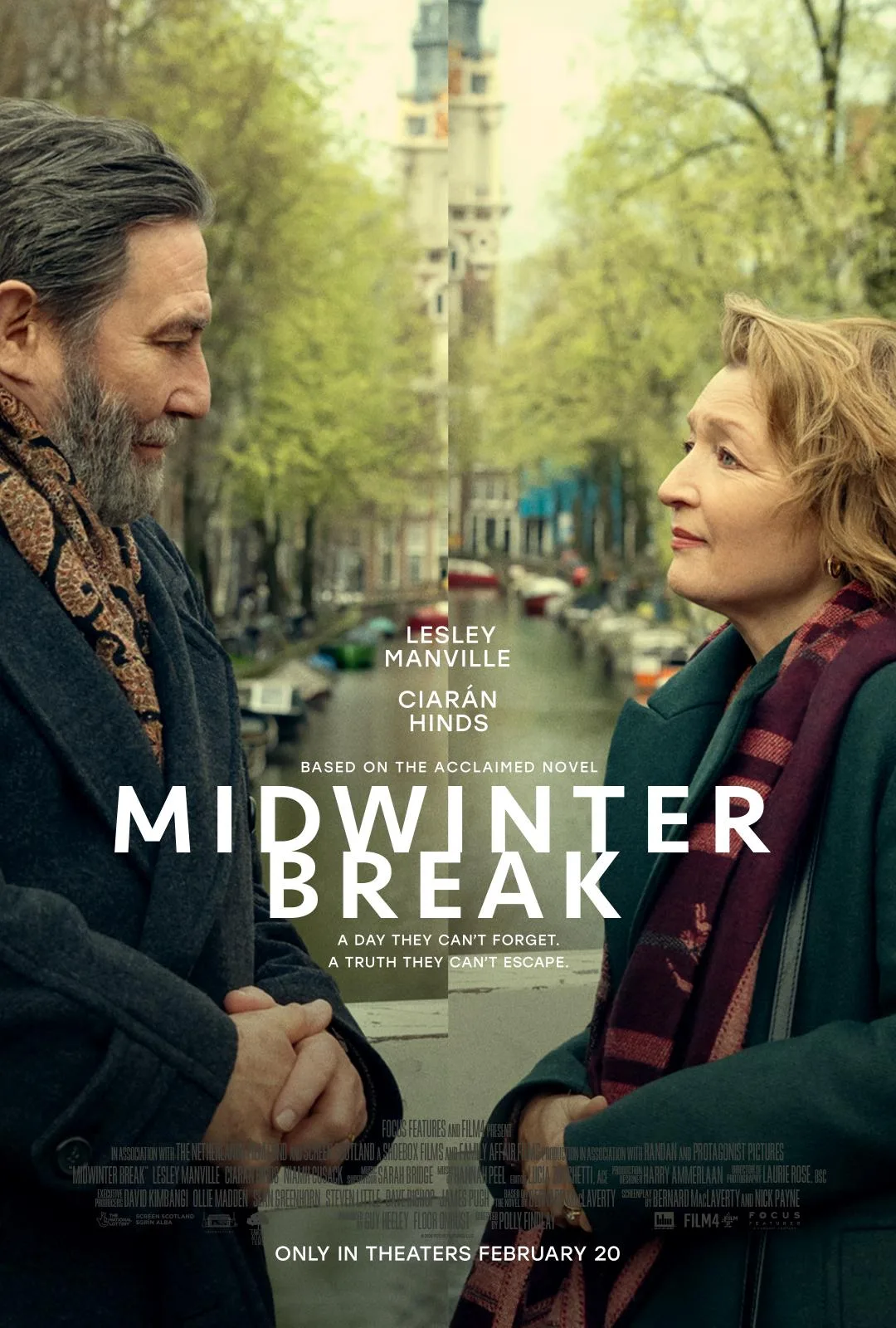


At first glance, “Midwinter Break,” the debut feature from British theater director Polly Findlay would appear to be the kind of film that most self-respecting film critic types would want to champion. For one thing, it is a project that is unapologetically aimed squarely at the kind of adult audience that is continually underserved these days. For another, it is a project based not on an earlier film, comic book, video game or some other form of flashy IP, but on an actual, honest-to-goodness novel, the 2017 book of the same name by Bernard MacLaverty, who also co-wrote the screenplay with Nick Payne. Finally, it serves as a vehicle to allow Lesley Manville and Ciaran Hinds, two of the finest actors you could hope to see these days, showing off their considerable talents by playing a long-married couple. On paper, this sounds like a potentially fascinating combination but the film emerging from it proves to be anything but that. Instead, it proves to be such an overly ponderous exercise that, by the time it finally comes to an end, you may feel so sapped of energy that find yourself struggling to get up out of your seat.
Manville and Hinds play Stella and Gerry, who left their home city of Belfast during the height of the Troubles over forty years ago when a then-pregnant Stella underwent a violent experience—the details of which are doled out throughout the film via gradually-expanding flashbacks—to relocate in Glasgow. When we initially glimpse them, they seem to have eased into an all-too comfortable groove over the years despite their mundane differences—she is a devout churchgoer while he has a fondness for the drink that he is not nearly as clever at hiding as he thinks he is. Nevertheless, they seem perfectly content and while their interactions may lack what one might refer to as “passion,” there still seems to be a fondness and respect between them.
Therefore, when Stella surprises Gerry with a Christmas gift of a short trip to Amsterdam for the two of them, it doesn’t seem particularly strange at all. Once they arrive, they do exactly the kind of things that you could easily imagine a couple like them doing in such a situation—they remark on how surprisingly roomy their hotel room is, they sightsee at the usual sites and Gerry somehow manages to find the one Irish pub in the area to visit. (This last aspect rings especially true. My parents once made a trip to Paris and on their first night there, my father apparently chose a restaurant specializing in Chicago-style pizza, an incident that would become a bone of contention for decades to come.) However, Stella has a very particular reason for wanting to come to Amsterdam in the first place and when she finally reveals it to an incredulous Gerry, it drops a bomb on their seemingly placid relationship and forces them face the hard truths about who they are and how they have changed over the years.
I won’t reveal the specifics of what Stella has in mind except to note that it is deals with issues involving religious faith, a buried secret from her past and how they have drifted from what they once were in ways that all too obvious to her but which he barely seems to notice. The problem with the film is that while these issues could have formed a compelling narrative, they haven’t done so here because none of them seem to have any real connection to each other. Perhaps in its original book form, they were developed in a way that allowed them to accrue the kind of emotional power that might allowed them to eventually pay off in some kind of thoughtful and meaningful manner. In a film clocking in at just over 90 minutes, though, there just isn’t time for any of that to happen and as a result, when Stella finally unloads decades of dissatisfaction on Gerry while the two of them are stuck at an airport during a storm, we are almost as surprised as he is because those simmering tensions have not been properly or convincingly established.
“Midwinter Break” is also fairly tepid from a cinematic perspective. Granted, this is not the kind of film that requires grand visual pyrotechnics by any means but for the most part, Findlay’s approach to the material ends up mirroring the marriage at its center—it looks nice enough on a purely surface level but beyond that, it is pretty much just going through the motions. It is the kind of film where you can practically call what each shot is going to look like before it arrives but will struggle to remember any of them once it ends. It certainly makes Amsterdam look nice, even in the largely overcast weather on display here, but too often, despite the locations, it has a stagebound feel to it throughout that further adds to the film’s draggy nature.
What does work in “Midwinter Break,” at least to some extent, are the performances from Hinds and Manville. This shouldn’t come as much of a surprise because, as I noted earlier, they are two excellent actors who are almost constitutionally incapable of hitting false notes in their work. And yet, while they do an excellent job in the early scenes of establishing the seemingly comfortable rut that is their marriage, even they find themselves struggling to put over a screenplay that just doesn’t give them much to work with in the end. Even though the potential histrionics are kept to a minimum, they cannot help but overshadow the material. And while there are some pleasures to be had in seeing them do just that, they aren’t enough to make “Midwinter Break” worth watching.