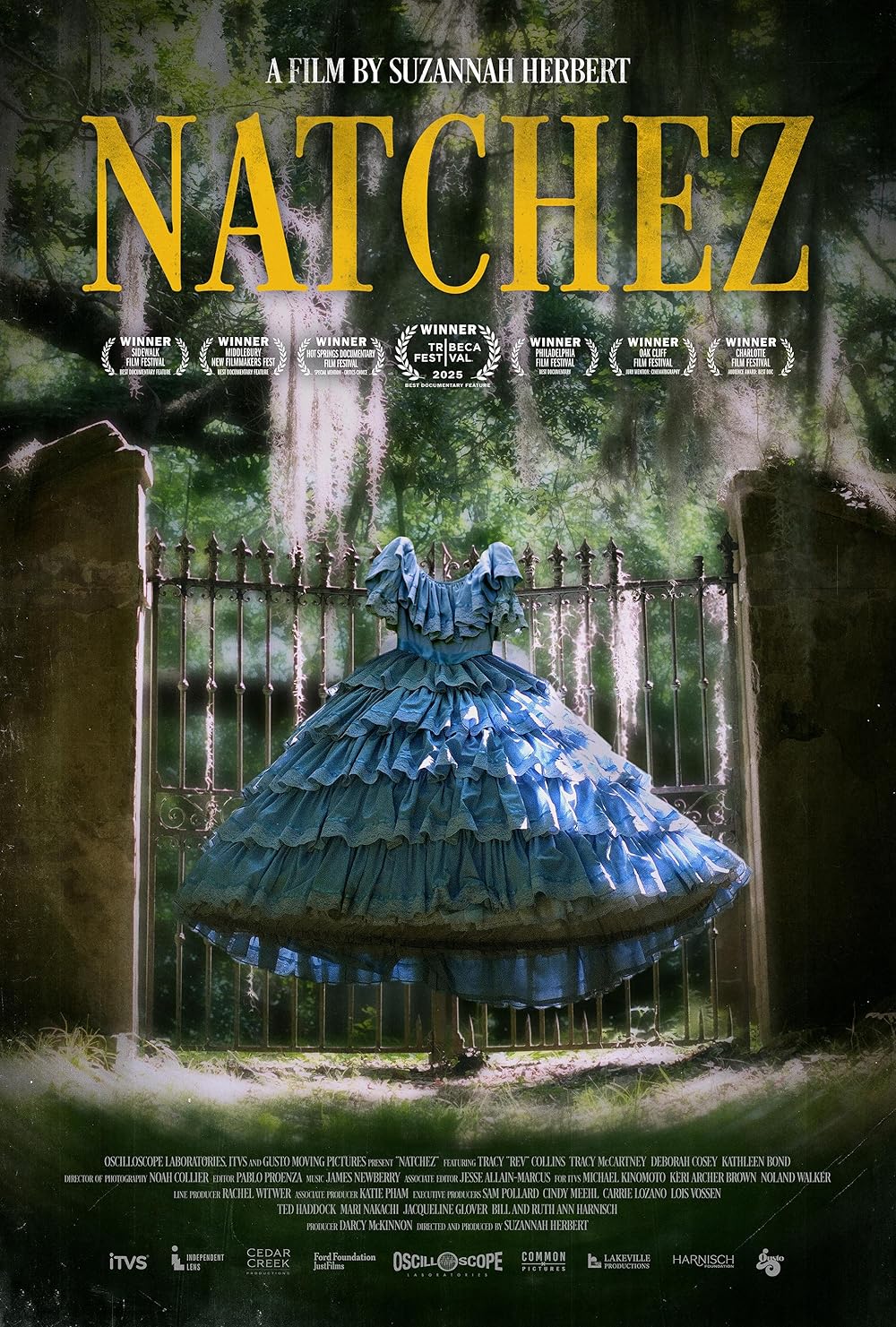

It is often said that history is written by the victors. But it’s equally the case that those who are not the victors will try to make themselves the center, and even the heroes, in their versions of the stories. Consider the Alamo. And consider current fights about school curricula, national monuments, and museums. The question of how we see our history and who gets to decide is powerfully presented, with respect and insight, in the documentary “Natchez.” It is about the personal, cultural, and commercial pressures in a small Mississippi town where the economy depends on a sanitized version of the era of wealthy plantation owners who used enslaved people to pick cotton, a version that is increasingly more difficult to maintain as residents and paying visitors want a more honest story.
The movie opens with an old-fashioned riverboat playing “Swannee” and a horse-drawn carriage. When we first meet the Garden Club ladies, at an elegant luncheon in one of the mansions, the special guest is their gregarious mayor, who says, “I appreciate and love all our history, even the bad,” and wants to “come together in love.” What loving “even the bad” history means is explored throughout the film.
The current population of Natchez is about 14,000. From the early to mid-19th century, the cotton crops made it one of the wealthiest towns in the country, with most of that wealth in a few families who built huge, grand homes filled with exquisite furnishings, crystal, and porcelain. When the cotton fields were wiped out by boll weevils in the early 20thcentury, the economy was wiped out, too. We learn in this film that the town was saved by the women in the town’s Garden Club. They saw that the town’s greatest remaining asset was the magnificent homes. So they made the houses a tourist attraction for annual “Pilgrimages” in the spring and fall. The lady tour guides dress in hoop skirts. A local man struggles to explain why they decided a few years ago that the gentlemen would no longer wear Confederate uniforms, but we get the idea.
Writer/director Suzannah Herbert, who spent three years in Natchez, lets the story unfold organically. The Natchez residents tell their own stories. We are in the historic rooms, cars, and outdoor spaces alongside them, and the filmmakers are barely evident on screen or in audio. The editing is where the director’s judgment becomes crucial. Herbert’s selection and timing of telling moments are exceptional. She allows us to consider one figure as quirky, then gains our sympathy, before revealing his appalling racism.
Herbert helps us become increasingly aware of meaningful parallels throughout the film, mostly through the different perspectives on the same historical facts. The costumed guides refer to the people who worked in the mansions as “servants,” a term that implies paid and voluntary employment. Other guides use the accepted contemporary term, “enslaved people,” explicit about the humanity of the individuals involved and the imposition of forced servitude.
One man sees a piece of land as property for his car repair business. A National Park Service official sees the same land’s history as the second-biggest location for the sale of enslaved people, a place she wants to buy to expand the tiny memorial across the street. The guides in the mansions point to a fabric ceiling fan called a punkah and explain its origins in India. A more expansive tour guide tells the story of the enslaved child who operated it as the “punkah wallah.” Although the laws of the time prohibited educating enslaved children, the guide explains that as they wafted manufactured breezes through the dining rooms, the children listened and learned, one of whom moved to Chicago and became a lawyer.
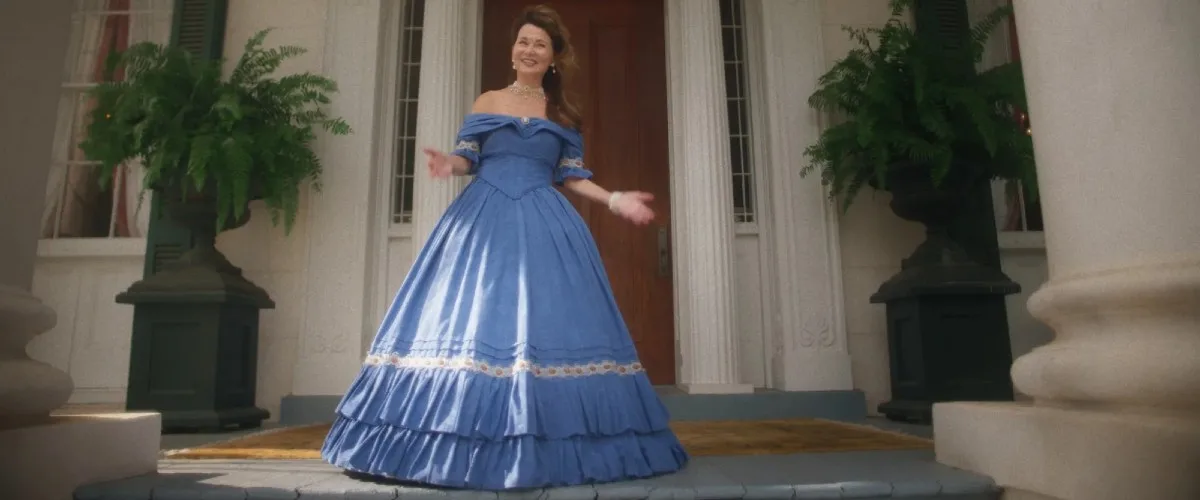
The foundation of the film is another parallel, an eerie mirror view. The two central characters, a white woman and a Black man, both born in 1964, are both named Tracy. The male Tracy is known as Rev, because he is a pastor. But he is also a tour guide who tells a broader story, one that focuses on the child rather than the mechanism and origins of the punkah. His tour includes the site across from the car repair shop, with a plaque about the slave auctions. In the early scenes, the female Tracy tells us about her childhood in poverty and, as an adopted child, her struggles to find a place that feels like home, even after marriage to an older, wealthy man. She tells us how much she loves being in character for the Pilgrimages, feeling like a princess in the hoop skirt, her hair in an elegant updo. In later scenes, she is divorced and drawing a new sense of herself and her community as she takes the Rev’s tour.
The Garden Club, described by one figure as “the blue-haired Mafia,” came to power almost a century ago to save the town. The film shows that while the paying customers born in the baby boomer era are entranced by the romanticized antebellum illusion, their children and grandchildren are more interested in a fuller, more honest story. Just as they once found a way to use their past to support the town, they may discover that economic reality pushes them where history did not.