Man of Steel
The title "Man of Steel" tells you what you're in for when you buy a ticket to this immense summer blockbuster: a radical break from…
Claustrophobia isn't often considered a cinematic asset beyond tales of suspense and horror. But "Fill the Void," an award-winning Israeli drama about a naive 18-year-old…
"The Ballad of Narayama" is a Japanese film of great beauty and elegant artifice, telling a story of startling cruelty. What a space it opens…
Patrice Leconte's "Monsieur Hire" is a tragedy about loneliness and erotomania, told about two solitary people who have nothing else in common. It involves a…
Here are some ways to celebrate Roger's birthday (a birthday shared by Sir Paul McCartney).
A remembrance by Roger Ebert's book editor Donna Martin: "I had never even seen "Siskel & Ebert" on television when I knew I wanted to…
Suicide glamour and magazine-shaming; how American textbooks dumb down Vietnam; remembering the late investigative journalist Michael Hastings; why sex on the first date is not…
Here are some ways to celebrate Roger's birthday (a birthday shared by Sir Paul McCartney).
Kevin B. Lee reports on the film series at MoMA that he co-curated.
Katherine Tulich talks to Julie Delpy, Ethan Hawke and Richard Linklater about returning once again to the characters from "Before Sunrise" and "Before Sunset" for…
Andy Ihnatko recalls the passion for pulp literature that he and Roger shared.
Excerpts from interviews and profiles of Roger Ebert, from Esquire, The New York Times, The Boston Globe, Publishers Weekly, and Fresh Air.
Named after the David Cronenberg film, this is the blog of RogerEbert.com founding editor Jim Emerson, where he has chronicled his enthusiasms and indulged his whims since 2005. Favorite subjects include evidence-based movie criticism, cinematic form and style, comedy, logical reasoning, language, journalism, technology, epistemology and fun. No topic is off-limits, but critical thinking is required.


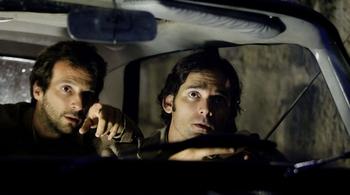
They don't grind 'em out like "Raw Meat" anymore. I don't know if horror movies will ever seem as seedy as they did in the first half of the 1970s, when even the emulsion itself seemed to carry dread and disease. In this British horror-thriller, released in the UK as "Death Line" and directed by Gary Sherman ("Dead & Buried"), there's Something in the Underground. Yes, there's a through-line to "The Descent" here. And Guillermo Del Toro ("Cronos," "The Devil's Backbone," "Pan's Labyrinth") considers it one of his favorites.

A Semi-Important Brit (with mustache and bowler hat) is seen checking out various porn shops and strip clubs in a seamy area of London, before descending into subway where he attempts to pick up a prostitute and is then found dead. That begins an investigation by Inspector Calhoun (a tartly over-caffeinated Donald Pleasence) and long-suffering Detective Sergeant Rogers (Norman Rossington -- the put-upon manager, Norm, from "A Hard Day's Night"). Christopher Lee also appears as an MI5 operative, doing what seems to be a nutty send-up of Patrick MacNee's Steed on "The Avengers."

The opening shot itself begins with an out-of-focus blur of colors, accompanied by a dirty, grinding, sluggish, metallic guitar/bass/drums riff that sounds like Angelo Badalamenti's score for the endless-nightmare Roadhouse scene in David Lynch's "Twin Peaks: Fire Walk with Me." As the image comes into focus we see a Magritte-like silhouette of a British gent looking at dirty magazines. Then the shot goes out of focus again. The pattern is repeated throughout the titles sequence as the naughty fellow visits one unseemly establishment after another: out of focus (indistinguishable, unidentifiable); then in focus (ah, that's what we're seeing/where we are); then back out again. And, wouldn't you know it, that's the shape of the mystery (and the investigation) itself: Someone's whereabouts are unknown. Then he is seen. Then he disappears. The aim is to fill in those out-of-focus parts, to figure out where he came from, how he got there, and where he went.
I'm sure "Raw Meat" is not as shocking as it must have seemed in 1972, but Sherman's use of real, atmospheric locations is still eerily effective. And for fans of long takes, this guy loves 'em! There are whole stretches where the camera simply prowls around underground, revealing its horrors one by one. The film was cut for its original release in the UK -- some gore, a bit with a rat's head, an attempted rape -- and wasn't passed by the censors until the DVD release in 2006.
Next Article: Opening Shots: 'Greetings' Previous Article: Take the Opening Shots Poll!
As we mourn Abrams’ macho Star Trek obliteration, it’s a good time to revisit that most Star Trek-ian of accomplishme...
I cried yesterday at a retreat while listening to Michael Buble's rendition of "Smile." The tears came from out of no...
Lateral tracking shots can get to the heart of a film more quickly and succinctly than any other technique. What are ...
Please help me welcome the new Editor-in-chief for Rogerebert.com, Matt Zoller Seitz. What Roger and I found refresh...