Star Trek Into Darkness
Less a classic "Star Trek" adventure than a Star Trek-flavored action flick, shot in the frenzied, handheld, cut-cut-cut style that’s become Hollywood’s norm, director J.J.…
Who
"The Ballad of Narayama" is a Japanese film of great beauty and elegant artifice, telling a story of startling cruelty. What a space it opens…
Patrice Leconte's "Monsieur Hire" is a tragedy about loneliness and erotomania, told about two solitary people who have nothing else in common. It involves a…
Asghar Farhadi ("A Separation") returns with another look at unsolvable dilemmas, an erotic thriller goes all the way, and Hirokazu Kore-eda ("Nobody Knows") tells another…
Two very different documentarians, Marcel Ophüls and Clio Barnard, premiere new work at Directors' Fortnight.
Mother’s Day I awakened to spirited calls from my children and grandchildren. As Roger wrote in his memoir, “Life Itself,” I came from a large family of nine, and I had four brothers and four…
Los Angeles, CA: Sundance Institute will remember and celebrate journalist and film critic Roger Ebert by honoring him with the Vanguard Leadership Award in Memoriam,…
Ray Harryhausen told us, time and again, the story of how he saw the original "King Kong" (1933) on the big screen when he was…
Dedicated to memories of Roger Ebert, for the simple reason that talking about movies is so thrilling. He did not like lists, but I love…
Dear Roger,You emailed me the questions to this interview on March 15, 2013. In your March 16th reply to my email, you said: The piece…
Tilda Swinton leads 1,500 people in a dance-along to Barry White's "You're the First, the Last, My Everything" during Roger Ebert's Film Festival in the…
Named after the David Cronenberg film, this is the blog of RogerEbert.com founding editor Jim Emerson, where he has chronicled his enthusiasms and indulged his whims since 2005. Favorite subjects include evidence-based movie criticism, cinematic form and style, comedy, logical reasoning, language, journalism, technology, epistemology and fun. No topic is off-limits, but critical thinking is required.
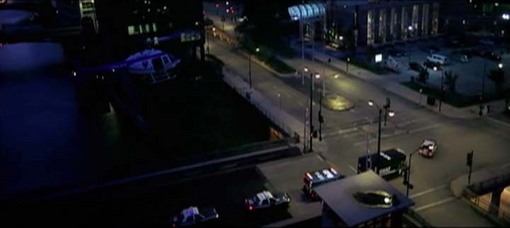
We've been discussing (with regard to "In the Cut Part I: Shots in the Dark (Knight)" what kind of film grammar Christopher Nolan was using (it's traditional narrative continuity editing -- most of the time). One of my key questions was: Is it, "as the filmmakers have said, more concerned with realism -- photographing real objects, including actors and miniatures, in real space? We can see how it does what it does. The question is: What's the result? How do these stylistic choices enhance or diminish the impact of the movie?"
Just came across this 2005 interview with Nolan (by Sean Axmaker, for GreenCine), talking about his approach to reviving the Batman movie franchise. In a word? Realism, according to Nolan:
For me, the exciting opportunity was that you had a studio with this phenomenal character, wanting to re-introduce the character to the big screen and looking for a fresh way to do it. I felt I had never seen a superhero story tackled with a real degree of reality, of seriousness, in a way, and Batman, to me, as the most mortal, the most ordinary in terms of abilities, of superheroes -- he has no super powers -- he's the natural choice for trying to tell a superhero story in a realistic manner. I just felt that would be something I've never seen before and something that would be really fun and exciting to do. [...]
It presents enormous physical challenges for the crew, particularly because I insisted on doing things for real rather than employing visual effects, so there was a tremendous amount of stunt work and so forth. And I insisted on doing everything main unit, not using any second unit action crews. We wanted the whole film to have a consistency that applied to the action set pieces as well as to the character scenes.
Part II of "In the Cut" began with this quote from David Bordwell, which I think presents essential follow-up questions and considerations:
Realism, as usual, is simply a fig leaf for doing what you want. Virtually any technique can be justified as realistic according to some conception of what's important in the scene. If you shoot the action cogently, with all the moves evident, that's realistic because it shows you what's 'really' happening. If you shoot it awkwardly, that presentation is 'realistically' reflecting what a participant perceives or feels. If you shoot it as 'chaos'... -- well, action feels chaotic when you're in it, right? Forget the realist alibi. What do you want your sequence to do to the viewer?
And there's the heart of the matter: Do the film's techniques "make the chase more exciting, or just more confusing?" We can agree on what the film shows, but viewers have a range of opinions on how it affects them...
Next Article: Tony Bennett, movie critic (Alec Baldwin, SNL) Previous Article: Drive: An under-the-hood manual
Asghar Farhadi ("A Separation") returns with another look at unsolvable dilemmas, an erotic thriller goes all the way...
Two very different documentarians, Marcel Ophüls and Clio Barnard, premiere new work at Directors' Fortnight.
Michał Oleszczyk falls for offbeat gay thriller "Stranger by the Lake" and gloriously eccentric essay-film "A Story o...
Barbara Scharres has a few choice words for François Ozon's "Young & Beautiful" and Sofia Coppola's "The Bling Ri...