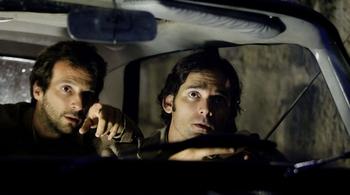
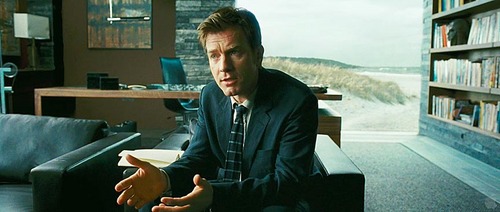
F.X. Feeney, writing in the L.A. Weekly, thinks so: “… relentless in its suspense; funny when you least expect it; above all, deeply conscious of political power and its corruptions.” The film was in the final stages of post-production when Polanski was arrested in Switzerland (he finished it while under house arrest) and Feeney sees in it themes that lead, as all Polanski themes must, through the filmmaker’s life and, inevitably, back to “Chinatown“:
Noah Cross (owing to Robert Towne’s superb screenplay) could proclaim a demonic philosophy when cornered, saying: “Most people never have to face the fact that at the right time and right place, they’re capable of anything.” [Tom] Wilkinson’s smooth operator conceals what he’s thinking at all times, usually behind an inscrutable grin and lighthearted (if poison-tipped) reproaches: “A less equable man might find your questions impertinent.”
“The Ghost Writer” is thus less heartrending than “Chinatown” but intellectually more ambitious. Behind its most dominant figures there operates a globally vast, falsely benevolent corporate entity called “Hatherton” — Halliburton, anyone? — whose philanthropies mask weapons sales, proclaiming: “We Keep You Safe From Harm!” In such a world, no head of state is ever truly in charge — nor is any organized populace. That is the real terror at work here, and for this lucidity Polanski is in debt to co-screenwriter Robert Harris, author of the novel on which the film is based. The news media are mindless pawns of these powers-that-be, inciting swarms of crazies to camp at the former prime minister’s gate and cry “Murderer!!!” as he enters his retreat on Martha’s Vineyard. (The whole British government appears to be camped in exile on this American isle of wealth, which gives the proceedings a certain Shakespearean, fairyland quality.) One can only wish we lived in an America where “war crimes” alleged against recent heads of state are so vehemently protested. Polanski’s absurd bad luck is that his own wrongdoing of three decades ago is still causing such commotion, when more recent and more historically consequential crimes go unexplored.
The idea of guilt in the world of Polanski is a messy, muddled, fluid one. It is contagious, permeating everything. “Of course, he has to swim in the same water we all do,” Jake Gittes says of his old partner back in Chinatown, describing the predicament of all who inhabit the sewer of corruption known as Los Angeles (controlled by the monolithic Department of Water & Power, a private/public institution whose Mabuse-like influence courses through the entire city). Not only is everyone tainted, but each person’s guilt enables and reinforces the others’.
“I don’t blame myself,” says Noah Cross.
And Feeney writes, of “The Ghost Writer”:
The public figures that the swirling mobs so furiously denounce as guilty may certainly be guilty — most people never have to face the fact that at the right time and right place, they’re capable of anything — yet there is always someone far worse, or a host of someones far more evil, who are making a clean getaway.”