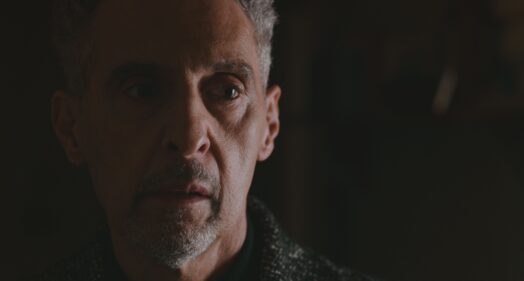
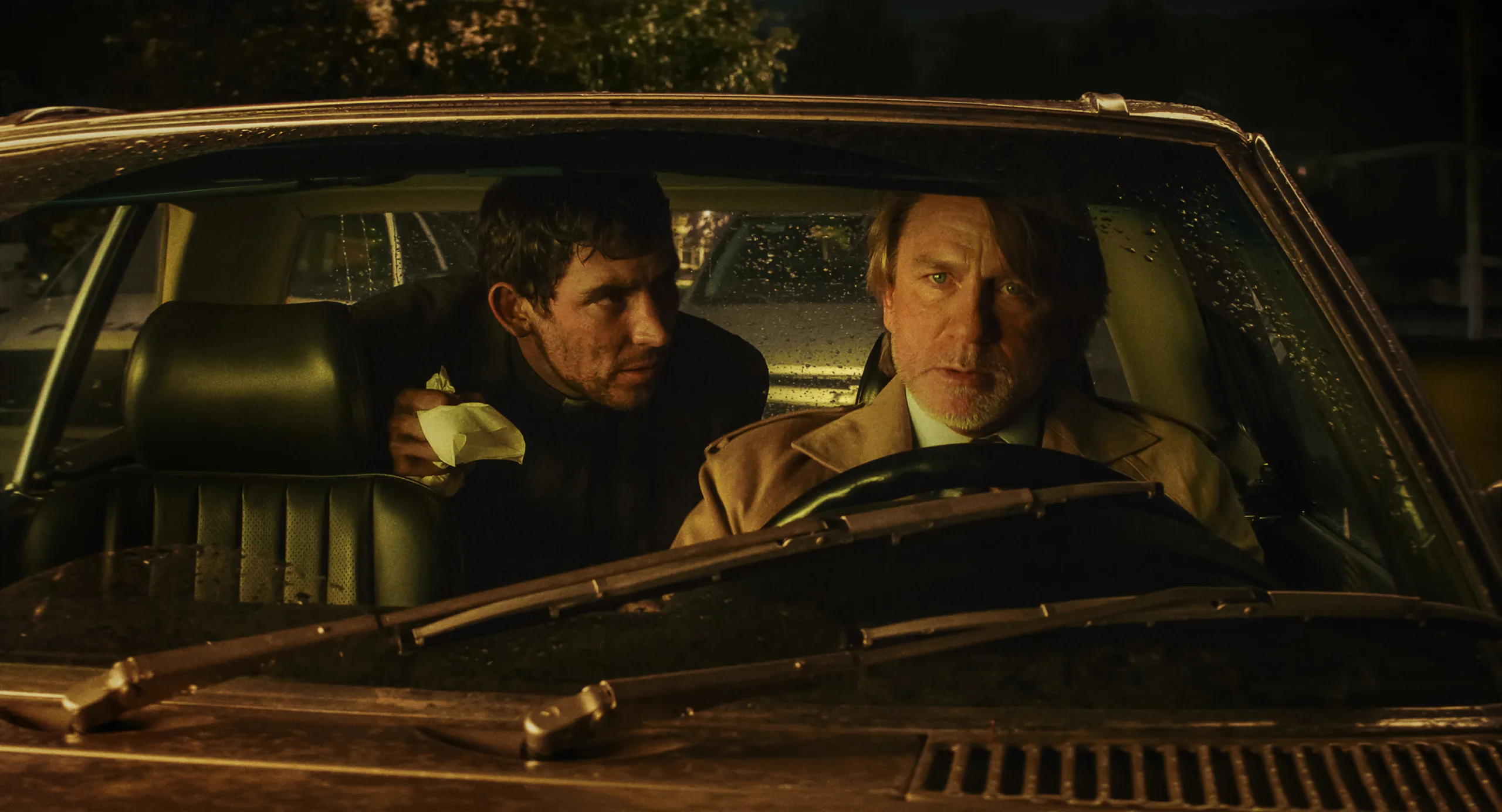
Master detective Benoit Blanc (Daniel Craig) solves intricate murder puzzles in writer/director Rian Johnson’s “Knives Out” movies, but each pays tribute to a different genre. “Wake Up Dead Man” is tonally gothic, centered on two priests, Josh O’Connor as a sincere young Father Jud and Josh Brolin as fiery and manipulative Monsignor Wicks. In an interview for rogerebert.com, Johnson talked about how he wove his own experience of faith into the story and why one scene that has nothing to do with the murder mystery was especially meaningful.

I had a lot of fun talking to your cousin, Nathan, who composed the music for all three “Knives Out” movies, and he mentioned the movies you made together when you were growing up. What did you make?
We were always just telling stories together. We had a lot of cousins, and we were all really close. We would all take our vacations together, and on every vacation, we would basically get all of the younger cousins together and put them to work making a movie with us. We would waste their entire vacation using them as extras. We made a parody of “Ghostbusters” called “Beebusters,” because there was a wasp hive in our playhouse.
Like “Knives Out,” a song by Radiohead, the two sequels all have song titles, “Glass Onion” from the Beatles” and “Wake Up Dead Man” from U2. Do you think of the song you want to use first and then go from there? Or the other way around?
It’s all at once. I do have the song title at the beginning of the process. This one arose in tandem with knowing I wanted to center it around faith and knowing that I was going to do an impossible crime type thing. And I had the idea of the big wake up dead man twist in the middle of it.
Let’s talk about the portrayal of faith in the film. I really love that you have a central character who is so sincere and devoted. One of my favorite scenes in the movie is when Father Jud is on the phone with the character played by Bridget Everett. He has to decide between the urgency of what he needs and his calling to be of service.
That’s the running through-line of the movie, and how it relates to my own experience. I grew up not Catholic, but Protestant, very, very Christian and not just in a churchy family. I was very personally Christian through my childhood, teenage years, into my early 20s. I’m not a believer anymore, but it’s something that I still have deep roots in and have a lot of feelings about it.
In a way, the entire movie is my attempt to have sort of a multifaceted conversation about faith, about this thing that I’ve carried around in me since childhood, because it never really leaves you. That moment specifically with Bridget Everett, I mean, a running through line of it is, of the whole movie is the selflessness of having a servant’s heart and the notion of bringing Christ’s love to people being an act of opening your arms, as opposed to putting your dukes up and the war footing of us against them.
That’s something that runs through the whole thing. In the beginning, it’s framed as Jud versus Monsignor Wicks, and it’s obvious who’s in the right. To me, the more interesting part is when Blanc comes in and sort of takes over, because it’s the exact same conflict of selflessness and service versus an us-against-them mentality. But the us-against-them mentality is represented by Blanc and the murder mystery game, and the genre itself that we’re inside, and sort of the gamified version of “we’re going to find the guilty person, the bad person, and we’re going to bring them to justice, and we’re going to get you out of this.” And Jud gets swept up in that gamified version of it. He knew to push back against it in the form of Wicks. With Blanc, he’s seduced into it, both out of his own self-interest of getting himself off the hook, but also because we’re in the murder mystery, and it is gamified, and it’s fun.
So the Bridget Everett scene was my attempt to build up that momentum and have the audience get swept up into it, too, and then present Jud with a human need. It just is a full stop of, “Wait a minute. This is the antithesis of what I’m here to do. I’m here to actually be of service to this person who’s right in front of me, who’s in pain.” The idea of having it be a hard reset for him in that moment that tees up the rest of the movie, that felt really powerful to me.
Because I didn’t grow up Catholic, one of the steps when I was writing the movie was in addition to just doing lots of research online, talking to young priests. My aunt and uncle who live in Denver are very Catholic. I went out to Denver and had dinner with their priest, Father Scott, who ended up being a consultant on the movie. And he invited like five other young Denver-based priests to this dinner.
And we got to have a great dinner and a big, long conversation about what their lives are like. And one of the things that they told me that really struck me. They said, “Look, when we go to the grocery store just during the day, just to get eggs or whatever, wearing the clerical collar. I’ll just be going, just trying to get in and out of the store and do my grocery shopping and someone will come up to me and start sobbing because their husband is dying or will come up and start screaming at me and getting in my face.” The notion that they are of service, 24 hours a day as priests. That directly informed that Bridget Everett scene. That’s where that came from, the idea that you’re going about your day and then this need steps in front of you like an immovable wall.

When you create a movie like this or the television series “Poker Face,” part of the deal is that to make it a puzzle, you have to have a lot of potential suspects, so you have to have a lot of characters. How do you manage that so that we feel like we know all of them well enough to enjoy trying to solve the puzzle ourselves and be satisfied with the real solution?
It’s definitely one of the harder things about writing a movie like this, the amount of characters you have to come up with. But the way I approach it is I start with thinking about what the central hub of the movie is, in this case, faith and my own relationship to faith. And then to really distinguish each one of those suspects, it’s not enough just to have them be different physical types or have different jobs. I really think about each one of them being a different fragment of my own experience with faith.
Each of them I can relate to in a different way in terms of my experience with faith, even and especially the most, quote unquote, despicable ones. I need to be able to find something I deeply understand and empathize with. And so that means I’m writing each of them from a place of empathy, first of all, but that also means they’re all gonna be connected to the central thing the story’s about, but they’re all gonna be genuinely coming at it from a different direction.That more than anything is what makes them each distinct, I think, and leads to the audience truly feeling like they’re all different people, but connected to the center of it.
Simone, Cailee Spaeny’s character, is one of my favorites. I wanted to create a character whose need was very naked and the need was embodied in a physical pain that she’s trying to take away. And so she represents the desperation of the need to find something bigger than you that can take that burden away from you.
For every single one of them, the starting point is a pain that they have or a need that they have, even the character of Cy, who is the influencer and is a little jerk but even he’s looking for belonging and he’s looking for a place in the world. Wicks is a strong father figure who gives him an option for that.
All three of the “Knives Out” films have had been set in very striking buildings. In this one, the church plays a crucial role.
Our production designer was Rick Heinrichs, also did “Glass Onion” and “The Last Jedi.” He is incredible. He came up working with Tim Burton. Part of what makes Rick so great is he can get to an emotional impact by creating things of grand scale. The uh the outside of the church was a location about an hour outside of London and the church is definitely a few hundred years older than it should be if it was in the states, but I justified it because there are buildings here that are designed to look old. The inside of the church was a set that Rick built and it was a 360 degree, like the entire interior of the church. That meant that we could control the light for the interiors and all of those dramatic lighting changes that my cinematographer, Steve Yedlin, did, pre-rigging all of that and coming up with a light control system so we could make all that happen.
And is your next project another “Knives Out” movie?
No, I’m actually writing something completely different to make next, an original, one-off thriller movie. But it’s not because I’m burned out and I’m making these. I actually feel energized after making this one. So, I hope down the line I’ll come back to Benoit Blanc.