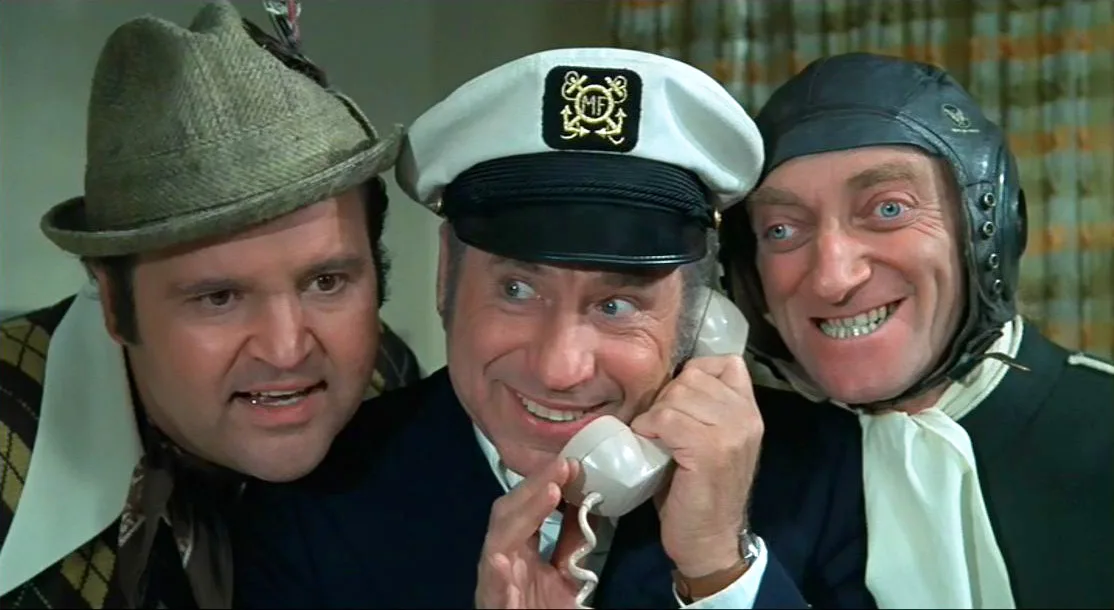
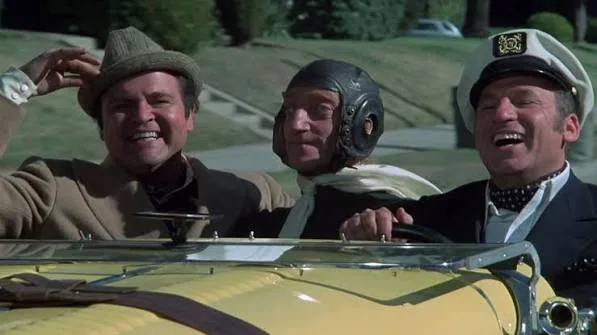
Mel Brooks’ “Silent Movie,” released 50 years ago this week, is a beautiful beast of a film. It’s about a director named Mel Funn (Brooks in his first leading role) who, alongside his two faithful friends Marty Eggs (Marty Feldman) and Dom Bell (Dom DeLuise) embark on an ambitious project: to make a film that will, by making so much money at the box office, save their home studio Big Pictures from being gobbled up by a commercial company called Engulf and Devour.
The rub is that Funn, a recovering alcoholic, wants to make a true, “old-fashioned silent movie” in the ‘70s. When pragmatic studio head Studio Chief (Sid Caesar) nearly shuts the idea down—who would ever watch a silent movie in the ‘70s!—Mel Funn says that if they hire big stars to play themselves in the film, each star’s devoted audience will watch the film, ultimately yielding a big payout for Chief. Chief agrees, and Mel, Marty, and Dom go on their merry way to sign the likes of Burt Reynolds, James Caan, Anne Bancroft, Liza Minnelli, Marcel Marceau, and Paul Newman. It’s not a smooth ride, though, for Engulf and Devour tries, up until premiere night, to foil Mel Funn’s plans, all in an effort to engulf and devour Big Pictures.
Brooks wrote the film alongside Ron Clark, Rudy De Luca, and Barry Levinson. Clark approached Brooks with the idea, and together, like Mel Funn, the two went to Alan Ladd Jr., the then-head of Twentieth Century Fox. According to Brooks in the autobiography All About Me!, Ladd responded like the studio chief in “Silent Movie.” At the time, Brooks had just completed “Young Frankenstein” for Fox—a film he was allowed to shoot in rich black-and-white, itself a radical act in 1974. “So with ‘Young Frankenstein’ you take away color, and now you’re coming to me, and you say you want to make a movie that takes away sound?” Ladd told Brooks. “What else are you gonna take away? If I let you go unrestrained, you’re liable to turn Twentieth Century Fox into a vaudeville house!”
But Brooks was determined. He wanted to craft a “tribute to Charlie Chaplin, Buster Keaton, Harold Lloyd, Mabel Normand, Fatty Arbuckle, Mack Sennett, and the Keystone Kops,” all performers he adored during the course of his Brooklyn childhood. “Here was another genre that I dearly loved, and I knew I could have so much fun both satirizing and saluting it at the same time.” Brooks finally persuaded Ladd by promising him that if he was allowed to make a silent movie, “it will be the end. After that, I promise I will make regular movies like everybody else.” Ladd agreed and Brooks, of course, went on to break his promise many times over.
Ladd and Studio Chief had a reason to be apprehensive about greenlighting a silent picture. By the ‘70s, young audiences wouldn’t have been very conversant in the forms and rigors of the silent film. The last time a silent film was in theatres was before WWII, in the ‘30s, meaning that by 1976, most of the people who would’ve seen a silent movie in theatres would have been in their 40s or 50s. These films would still run on TV because stations could air them cheaply, but, by and large, they wouldn’t have been as intuitively familiar as mainstream contemporary films.
Brooks maintained the silent film’s vocabulary—intertitles instead of dialogue, a swelling and sensitive score by frequent Brooks collaborator John Morris, elastic slapstick, and endless car chases — but also added his own acumen. He kept what continues to make people laugh, and added what couldn’t be said in the past.
Ever since the enormous success of “Blazing Saddles” and “Young Frankenstein”—in the same year, 1974—one of Brooks’ major goals has been to serve two kinds of audiences simultaneously: the one that gets every film reference and all of the subtext, and the one that hasn’t seen or heard of any of the material being spoofed.
So Brooks built the story around the battle between art and money, an eternal conflict familiar to everyone. In the ‘70s, corporations with no moviemaking experience and who saw cinema mainly as a gateway to hang out with film stars, attend awards ceremonies, and claim credit for awards won by actual filmmakers were buying movie studios. Gulf + Western, for example, had recently gotten hold of Paramount, which is why the studio in “Silent Movie” is a subsidiary of Engulf & Devour. “The bottom line was that they had no regard for what kind of movies they were making as long as they brought in money,” Brooks later wrote.
Of course, even in Buster Keaton’s day, studios had the last word on what got made and what didn’t, but it wasn’t the kind of single-minded, vigor-sapping oversight represented by companies like Coca-Cola, whose aim in buying Columbia Pictures six years after “Silent Movie” was pure unadulterated profit. Engulf and Devour is ridiculed for its lavishness (their bathrooms are nicer than most people’s homes!) as well as the incompetence of its executives (one of whom can’t even put a coat on without help).
The studios themselves aren’t immune to criticism, either. In Mel Funn’s world, studio chiefs facilitate art by giving artists money, but they are not artists. The studio chief doesn’t know what kind of art speaks to people. Moments after Brooks has earned belly laughs from us by having a car buck under the weight of a very pregnant woman, the studio chief insists that slapstick is dead and greenlights a clearly unfunny and nonsensical project. The studio chief doesn’t know how to separate good work from bad, working as he does for a studio whose motto is “Ars Est Pecunia”: art is money. Like most Brooks films, this one ridicules power, portraying it as hypocritical, out of touch, and absurd.
And so, in the same breath that Brooks pays homage to the classics through cameos by performers like Fritz Feld, Henny Youngman, and Harry Ritz, he also delivers us a story with heart. Even if audiences aren’t familiar with Youngman or any of the Ritz Brothers, the jokes land because they are silly, conveyed visually, and play on irony and our expectations.
Later in his autobiography, when talking about “History of the World, Part I,” Brooks says that “we all know a lot more about human nature than history books tell us,” which is why some of Brooks’ liberties with historical figures and events are still able to get his moral point across. I would argue that the same holds true for comedy—we still laugh at the same jokes because if they are good, they will transcend culture, language, and time. Mel Funn looking into a liquor shop window at a display featuring a cartoonishly large bottle of whiskey surrounded by normal-sized bottles, then walking out with the cartoonishly large bottle, will not be funny.
His tumbling around while struggling to get a Murphy bed to work will never not bring tears of joy to my eyes. Marcel Marceau, the mime, uttering the film’s only line of dialogue, will always be uproarious.
And because many of society’s problems seem to be repeating themselves and even getting worse, “Silent Movie”’s heart continues to thrum under our floorboards. What Brooks communicates about the soullessness of commercial entities and about how money and power are antithetical to good art holds true. Much of the world is controlled by a handful of people who have too much money to remain truly human, too much to keep them connected with the life coursing through our veins. These powerful people control where the money goes, the kind of art that is allowed to become visible, and what we can see and think. Shades of Engulf and Devour endanger our humanity to this day.
That’s why “Silent Movie” far surpassed the expectations of studio bosses, both real and fictional, earning $36.1 million in its initial release, nine times its budget. And it’s why, even though Brooks’ greatest films are decades old, they are as alive to me as silent movies were alive for Brooks in 1976.