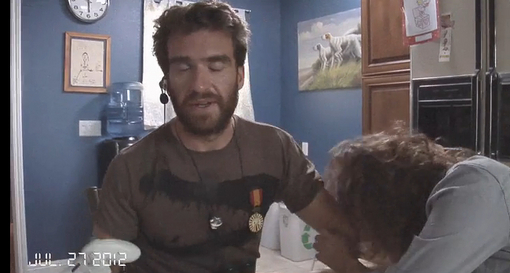
The NRA’s goofy anti-Obama ad, and an ad in response by Funny or Die
…in response to which, the website Funny or Die has created this video:
NRA – Stand and Fight Parody – watch more funny videos


…in response to which, the website Funny or Die has created this video:
NRA – Stand and Fight Parody – watch more funny videos
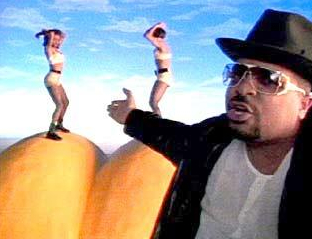
The YouTube poster, “dondrapersayswhat,” says this: “Clips from 295 movies used to recreate Sir Mix-A-Lot’s Baby Got Back, because I’m just that much of a nerd. Click the closed captioning button for movie titles.”

☑ Links to my Pages for Twitter are in the right margin.
var a2a_config = a2a_config || {};
a2a_config.linkname = “Roger Ebert’s Journal”;
a2a_config.linkurl = “http://blogs.suntimes.com/ebert/”;
a2a_config.num_services = 8;

I’ve been known to say that in movies, I prefer b&w to color. A b&w film adds by subtracting: The world is in color, so we get that free. B&W steps in and imposes another dimension, separating the content from the mere realistic recording of it. Once, for the fun of it, I adjusted my TV set and watched the color film “LA Confidential” entirely in black and white. Try a little of that someday. You may be surprised. Thanks to Maggie Galloway for the first link.
CYBORG FOUNDATION | Rafel Duran Torrent from Focus Forward Films on Vimeo.
Under this video on Vimeo, I read:
“Neil Harbisson was born with achromatopsia, a rare condition that causes complete colour blindness. In 2004, Harbisson and Adam Montandon developed the eyeborg, a device that translates colours into sounds.
Harbisson has been claimed to be the first recognized cyborg in the world, as his passport photo now includes his device. In 2010, Neil Harbisson and Moon Ribas created the Cyborg Foundation, an international organization to help humans become cyborgs. The foundation has also experimented with other sensory devices, including an “earborg,” which translates sound into color, and a “speedborg,” which allows people to detect movement through electronic earrings that vibrate.
Directed & Produced & Edited by: Rafel Duran Torrent

By Kevin Lee, Our Far-Flung Correspondent
In the age of YouTube and Vimeo, one of the most exciting developments in film culture are online video essays that explore different aspects of the movies. These videos take footage from films and reconfigure them using editing, text, graphics and voiceover to reveal startling observations and insights, visualizing them in ways that text criticism can’t. These videos are typically produced independently by using consumer-level equipment, demonstrating that just about anyone with a computer can be both a filmmaker and a critic. The only limits are those of imagination and intelligence.

On my walks in Lincoln Park, one of my favorite destinations is the Shakespeare garden at the south end of the ponds. Here a little path meanders through plantings of (allegedly) all the flowers mentioned by Shakespeare. On four boulders are mounted plaques bearing the words of his Sonnet #18. There are a few benches to pause upon, and often somebody reading a book. Not far away is the statue of Shakespeare. He has his back turned to the city and is regarding flower beds.
Shall I compare thee to a summer’s day?
Thou art more lovely and more temperate:
Rough winds do shake the darling buds of May,
And summer’s lease hath all too short a date:
Sometime too hot the eye of heaven shines,
And often is his gold complexion dimm’d;
And every fair from fair sometime declines,
By chance or nature’s changing course untrimm’d;
But thy eternal summer shall not fade
Nor lose possession of that fair thou owest;
Nor shall Death brag thou wander’st in his shade,
When in eternal lines to time thou growest:
So long as men can breathe or eyes can see,
So long lives this and this gives life to thee.
Photograph of open workbook by Murky at flicker.com: “These are the notes I made on Shakespeare’s 18th sonnet for my Open University course ‘A103: Introduction to the Humanities’.”
var a2a_config = a2a_config || {};
a2a_config.linkname = “Roger Ebert’s Journal”;
a2a_config.linkurl = “http://blogs.suntimes.com/ebert/”;
a2a_config.num_services = 8;
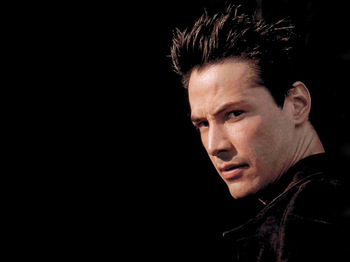
• Roger Ebert / April 7, 1996
In an age when young movie stars are famous for their clothes, their homes, their cars and the clubs where they hang out, Keanu Reeves is famous for his suitcase. He’s been living out of one for nearly three years, occupying hotel rooms in the cities where his movie career takes him.
In the cold winter of 1996, it brought him to Chicago, to make a movie named “Chain Reaction.” One day in February he was inside a vast old warehouse over near Lake and Paulina, shooting a scene with Morgan Freeman, about a conspiracy to suppress a new source of low-cost energy. Reeves and Freeman are both on Hollywood’s A-list these days, and the movie is a big-budget production with heavy names attached: The producer is Richard D. Zanuck, and the director, Andy Davis, is still hot after his hit with “The Fugitive.”
Davis has shot almost all of his films in Chicago–he uses locations here better than any other filmmaker ever has–and that’s why the movie, which could be set anywhere and partly takes place in an underground bunker, was being filmed here. We were in the bunker right now, in fact, for a confrontation between Reeves, as a young man who knows of a sensational breakthrough in energy, and Freeman, as a man who heads a foundation that allegedly supports such breakthroughs but may, in fact, be a front for efforts to contain them.
The bunker set was large and sleek and glossy: Lots of glass, steel, marble, wood, suggesting a wealthy and powerful organization. We were allegedly hundreds of feet underground, somewhere near the Argonne National Laboratory. Reeves and Davis had just finished a low-key script conference at the organization’s board table, and now there was a break while the cinematographer lit the scene. Reeves was costumed in jeans and a scruffy flannel shirt, open over a T-shirt.
He has been acting for nearly 10 years, often in roles that required him to be sensitive, poetic, doomed or romantic, but it was his hard-charging action role in “Speed” that made him a box office factor, a “bankable” lead for a major production like this one.
So are you still living this peripatetic life? I asked him. Living out the legend we’ve read in the magazines, that you exist out of two suitcases in hotel rooms and don’t own a house and….
“Yes,” he said. “Sounds quite bohemian and gypsy-like, doesn’t it?”
And very simple.
“It’s getting simpler. I’m down to one bag now, and smaller rooms in hotels. Yes, I am.”
He twinkled. I think. Maybe he was serious. He was right in between somewhere.
Yeah, I said. In your business, why have a house, when you’re not home for months on end…
“Hopefully, if you’re working,” Reeves said. “Hopefully you’re working to buy a house and put furniture in it if you want to.”
Can you sort of walk around a strange city and not have people asking for your autograph?
“Sure.”
Do you have little tricks that you do?
“I don’t need them. I kinda look like a normal guy, so….”
Truman Capote, I said, walked down Fifth Avenue once with Marilyn Monroe, and she said, “Watch this.” And for one block she wasn’t Marilyn Monroe and for the next block she was and he couldn’t see what she was doing but for the first block she was totally ignored and the second block she caused a riot.
“Truman Capote was great.”
So what do you travel with? Books, a computer….
“I don’t have a computer. Books and a couple of things of clothes.”
When you finish reading a book, where does it go?
“Piles up. I have a nice little pile in my hotel room.”
But at some point you move hotel rooms and then what happens?
“They go to my sister’s house. She’s got all my books from the past year, all in different boxes. Just recently, I’m missing a lot of my belongings. I miss some of my clothes, some of my books. It was nice to have them around when I did have a house, you know. It’s nice to come home. But…”
That may be a pre-house buying feeling that you’re experiencing.
“I’ve gone looking for houses but I could not find one that I liked and could afford. The ones I like I can’t afford.”
You mentioned the word bohemian, which is a nice old word.
“Yes, it is a nice old word. Like existential.”
He smiled. Is this lifestyle, I asked, almost a way of maintaining your balance, because you’ve had transition into this weird existence of being known as a movie star?”
“I don’t really feel that movie star thing. I don’t think I……from the response that I’ve gotten workwise…”
You could choose to feel that way if you wanted to.
“I think of Morgan Freeman as a movie star, you know. My perception from the feedback that I get from the street, the feedback that I get from the people I work with, roles offered and all that sort of thing and the attention, it’s just…..you know, I’ve been lucky enough to work in some films that have, you know, been good, and people have gone to see but I don’t think movie star is quite…I’m not on that level.”
Maybe this peripatetic lifestyle is part of protecting against that. Because the moment you live in a house you have a staff of people helping you and they’re all treating you in a certain way…
“Maybe or maybe not; you never know. I think that term, movie star, is a label that’s concocted that really kind of is trying to encapsualize so many things that aren’t real, really, except they exist in print. They exist in journalism and to a certain extent they work as in cinema in the sense of being able to draw a certain amount of people, I guess…”
As we’re talking, grips are moving furniture around and lighting guys are dangling wires overhead, and the cinematographer and director are peering through their lenses and trying to visualize the shot, and Morgan Freeman is walking back the forth in the big board room of the secret organization, perhaps thinking about the scene, perhaps not. And of course there are a lot of people on cellular phones.
Keanu Reeves. To look at a list of his roles is to wonder how the directors of half his movies could have visualized him in the other half, and vice versa. This is the actor who made two of the most harrowing films of all time about teenage angst, “The River’s Edge” and “Permanent Record.” And the same actor who played one of the key predecessors of the dumb-and-dumber movement, in “Bill & Ted’s Excellent Adventure” and “Bill & Ted’s Bogus Journey.” The same actor who was an average, if troubled, teenager in “Parenthood” and an 18th-century rake in “Dangerous Liaisons,” and a male hustler in “My Own Private Idaho.”
He was even in an action movie before “Speed.” It was titled “Point Break,” it was made in 1991, and it combined surfing, sky-diving, bank robbery and Zen. I liked it.
When you made “Speed” in 1994, I said, the industry said it showed that you could make an action picture. (Hollywood has a minute attention span, and had already forgotten “Point Break.”) Is this an action picture, too, or is there another dimension?
“I think Fox wants it to be an action picture, and Andrew Davis and I and Morgan and everyone are trying to make it a little more than an action picture. It’s not a classical action picture; I would say it’s more drama with some action bits thrown in for fun.”
Did the success of “Speed” give you more leeway in terms of career choices?
“Yeah, it did for two years. It’s kind of over now. I mean, I got to do ‘A Walk in the Clouds.’ I got to do a film called ‘Feeling Minnesota.’ It hasn’t come out; we just finished it, with Vincent D’Onofrio, Dan Ackroyd, Cameron Diaz. That got made because I was in “Speed,” you know. The producers said, ‘Okay, we’ll give you $7 million, go make your film,’ you know. Not (ital) just (unital) because I was participating, but that was the last thing that pushed it over.”
So your two years…
“Have run out. Now I have to do something. I don’t know if this will be a hit or not but–this is going to be a tricky film.”
Richard Zanuck was just saying as he was looking at you, “He’s a man now. He’s not a boy anymore.”
Reeves looked slightly impatient. “Well, who knows about that. I don’t know if just how you look makes you a man or not. You could say he looks like a man, maybe.”
I suppose that you’re beginning to get into an age where you can go either way. You have a little more freedom; you’re not just stuck in one age group.
“I hope so. I wanted to have long hair in this because they wanted me to be younger, you know, like 20, say. I’m 31 years old so I thought if I had long hair it’d make me look younger and stuff. But yeah, I mean, hopefully in “Feeling Minnesota,” I’ll look my age, whatever that may be.”
You’ve been working here with Morgan Freeman, and in “A Walk in the Clouds” you were working with Anthony Quinn. Not many people would put them on the same list, but to me they are both very dynamic and vital people.
“Amazing actors. And people.”
But coming from totally different traditions. I mean, Anthony Quinn is a traditional Hollywood movie star who has been around for 50 years in the studio system, and Morgan Freeman is stage trained and really only started acting for movies at a later stage in his life. Do they have different ways of working?
“Well, they’ve had certainly different lives. I mean, Anthony Quinn’s is almost Byzantine. I called him Zeus. But they do actually, more than differences, have similarities. Their technique. The way they love the camera. The way they can embody a moment. Their freedom, their specificity. They can take a scene and make anything in it seem important and they can take any moment and make it light or heavy or the control and who they are. They’re similar in that sense.”
How did you learn to be a movie actor?
“A movie actor? By doing it, and watching other people do it.”
You said they love the camera. How does one love the camera?
“It’s a direction of energy. I’ve seen Morgan and Anthony, even if you’re in the scene with them, if the camera’s over here, they’ll play to the camera. And as an actor in the same environment, you’ll ask, well, what are they doing? But to play it just to me, would not be playing the scene, really. Because it would cut off the camera’s connection to it. The way they do it, they (ital) make (unital) it a scene.”
What could somebody learn from you? You say, ‘I watch other actors.’ Somebody might be watching you. What are they learning?
“I don’t know. There’s a few things, I guess. I mean, it’s kind of a weird thing to say, ‘Well, if you watch me in this film, you could learn this’.”
I don’t mean for you to sound egotistical but just as a pragmatic sort of thing.
“Technique and stuff?”
Or whatever.
“I think I did some good naturalistic acting in ‘River’s Edge,’ some broad comedy and timing in ‘I Love You to Death,’ and ‘Bill & Ted’s Excellent Adventure.’ I think that there’s some good inner work in ‘Little Buddha.’ I think that there’s some good combination of naturalism and style in ‘My Own Private Idaho.’ There’s some classicism in ‘Speed’…”
When you think of those pictures, you can’t really find the line connecting them. It’s like they’re all points of a star. It’s hard to get from “My Own Private Idaho” to “Bill & Ted.”
“A lot of people don’t take the time, actually, to think about that,” Reeves said, “but what can you do?”
✔ Comments are open.
✔ Directory of recent entries in Roger Ebert’s Journal.
✔ The home page of rogerebert.com.
var a2a_config = a2a_config || {};
a2a_config.linkname = “Roger Ebert’s Journal”;
a2a_config.linkurl = “http://blogs.suntimes.com/ebert/”;
a2a_config.num_services = 8;

The Ebert Club is pleased to share this classic film noir, streaming free. I invite you to join the Club and dive into an eclectic assortment of wonderful and curious finds. Your subscription helps support the Newsletter, the Far-Flung Correspondents and the On-Demanders on my site. – RE
“This movie from Hollywood’s poverty row, shot in six days, filled with technical errors and ham-handed narrative, starring a man who can only pout and a woman who can only sneer, should have faded from sight soon after it was released in 1945. And yet it lives on, haunting and creepy, an embodiment of the guilty soul of film noir. No one who has seen it has easily forgotten it.” – From my Great Movies review
Detour (1945) Directed by Edgar G. Ulmer. Written by Martin Goldsmith and Martin Mooney. Starring Tom Neal, Ann Savage, Claudia Drake, Edmund MacDonald and Tim Ryan.
Synopsis: Al is a piano player who sets off hitchhiking his way to California to be with his fiancee. Along the way a convertible driven by Charles Haskell Jr. stops to pick him up. Al is driving while Haskell sleeps when a rainstorm begins and Al pulls over to put up the top. Haskell doesn’t wake up and falls out onto the pavement, dead. Al dumps the body, takes Haskell’s money, clothes and ID, then drives off in Haskell’s car. In voice-over, Al tells the audience that he didn’t kill Haskell. After spending the night in a motel, Al picks up another hitchhiker. As it happens, Vera had earlier ridden with Haskell and blackmails Al by threatening to turn him in for murder unless he gives her the money. Note: At the age of 86, Ann Savage was cast by director Guy Maddin to play a shrewish mother in the film My Winnipeg (2007).
For more treasures, go here to join the Club.
Song at SunsetWalt Whitman
Splendor of ended day floating and filling me,
Hour prophetic, hour resuming the past,
Inflating my throat, you divine average,
You earth and life till the last ray gleams I sing.
Open mouth of my soul uttering gladness,
Eyes of my soul seeing perfection,
Natural life of me faithfully praising things,
Corroborating forever the triumph of things.
Illustrious every one!
Illustrious what we name space, sphere of unnumber’d spirits,
Illustrious the mystery of motion in all beings, even the tiniest insect,
Illustrious the attribute of speech, the senses, the body,
Illustrious the passing light–illustrious the pale reflection on
the new moon in the western sky,
Illustrious whatever I see or hear or touch, to the last.
Good in all,
In the satisfaction and aplomb of animals,
In the annual return of the seasons,
In the hilarity of youth,
In the strength and flush of manhood,
In the grandeur and exquisiteness of old age,
In the superb vistas of death.
Wonderful to depart!
Wonderful to be here!
The heart, to jet the all-alike and innocent blood!
To breathe the air, how delicious!
To speak–to walk–to seize something by the hand!
To prepare for sleep, for bed, to look on my rose-color’d flesh!
To be conscious of my body, so satisfied, so large!
To be this incredible God I am!
To have gone forth among other Gods, these men and women I love.
Wonderful how I celebrate you and myself
How my thoughts play subtly at the spectacles around!
How the clouds pass silently overhead!
How the earth darts on and on! and how the sun, moon, stars, dart on and on!
How the water sports and sings! (surely it is alive!)
How the trees rise and stand up, with strong trunks, with branches
and leaves!
(Surely there is something more in each of the trees, some living soul.)
O amazement of things–even the least particle!
O spirituality of things!
O strain musical flowing through ages and continents, now reaching
me and America!
I take your strong chords, intersperse them, and cheerfully pass
them forward.
I too carol the sun, usher’d or at noon, or as now, setting,
I too throb to the brain and beauty of the earth and of all the
growths of the earth,
I too have felt the resistless call of myself.
As I steam’d down the Mississippi,
As I wander’d over the prairies,
As I have lived, as I have look’d through my windows my eyes,
As I went forth in the morning, as I beheld the light breaking in the east,
As I bathed on the beach of the Eastern Sea, and again on the beach
of the Western Sea,
As I roam’d the streets of inland Chicago, whatever streets I have roam’d,
Or cities or silent woods, or even amid the sights of war,
Wherever I have been I have charged myself with contentment and triumph.
I sing to the last the equalities modern or old,
I sing the endless finales of things,
I say Nature continues, glory continues,
I praise with electric voice,
For I do not see one imperfection in the universe,
And I do not see one cause or result lamentable at last in the universe.
O setting sun! though the time has come,
I still warble under you, if none else does, unmitigated adoration.
The Mountain from Terje Sorgjerd on Vimeo.
var a2a_config = a2a_config || {};
a2a_config.linkname = “Roger Ebert’s Journal”;
a2a_config.linkurl = “http://blogs.suntimes.com/ebert/”;
a2a_config.num_services = 8;
var a2a_config = a2a_config || {};
a2a_config.linkname = “Roger Ebert’s Journal”;
a2a_config.linkurl = “http://blogs.suntimes.com/ebert/”;
a2a_config.num_services = 8;
Tom Waits – Potter’s Field from Phil Bebbington on Vimeo.
var a2a_config = a2a_config || {};
a2a_config.linkname = “Roger Ebert’s Journal”;
a2a_config.linkurl = “http://blogs.suntimes.com/ebert/”;
a2a_config.num_services = 8;
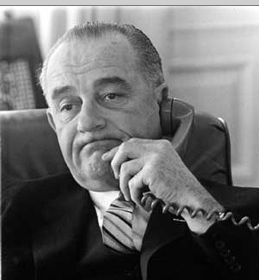

The Ebert Club would like to share the following Academy award-winning film while inviting non-members to join the Club and find action, romance and adventure!”It is entirely appropriate that Cyrano – whose very name evokes the notion of grand romantic gestures – should have lived his life bereft of romance. What is romanticism, after all, but a bold cry about how life should be, not about how it is? And so here is Cyrano de Bergerac, with a nose so large he is convinced everyone is laughing at him – yet he dares to love the fair Roxane. I have made it one of my rules in life never to have anything to do with anyone who does not instinctively love Cyrano, and I am most at home with those who identify with him.” – Roger, from his review of Cyrano (1990)
Montfleury: Sir, I will not allow you to insult me in this manner. Cyrano de Bergerac: Really? In what manner would you prefer?
Cyrano de Bergerac (1950) Directed by Michael Gordon. Based on the 1897 French Alexandrine verse drama Cyrano de Bergerac by Edmond Rostand. Starring José Ferrer, Mala Powers, William Prince. Synopsis: A charismatic swordsman-poet helps another woo the woman he loves. Note: José Ferrer received the Academy Award for Best Actor for his performance as Cyrano.
Even more thrills await you – join the Club and find out!
He had to flog himself to finish “Atlas Shrugged”
Here is the Mike Wallace interview Buckley mentions. It was her first TV interview.
var a2a_config = a2a_config || {};
a2a_config.linkname = “Roger Ebert’s Journal”;
a2a_config.linkurl = “http://blogs.suntimes.com/ebert/”;
a2a_config.num_services = 8;
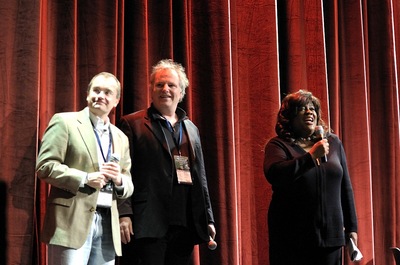
•Hank Sartin of Time Out Chicago, Guy Maddin and Chaz Ebert at Ebertfest 2009.
•
•
•Guy Maddin’s films look like no others I have ever seen, so why do they remind me of something? Why do they feel like I’ve seen them before? How do they remind me of memories I don’t have?
•
•
•
•
•
•
•
•
•
•
•
•
•
•
•
•
•
•
•
•
•
•
•
•
•
•
•
•
•
•
var a2a_config = a2a_config || {};
a2a_config.linkname = “Roger Ebert’s Journal”;
a2a_config.linkurl = “http://blogs.suntimes.com/ebert/”;
a2a_config.num_services = 8;
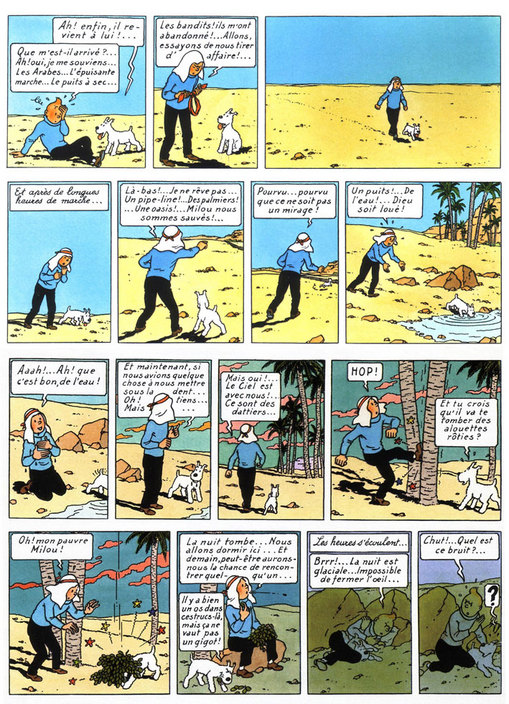
I find them addictive. Taught myself a little French after finding them in my daily paper at Cannes. The Europeans love him, but many Americans may not have ever seen one of Herge’s pages. I wonder if the Spielberg film will inspire sales of the English editions.
Here are all the book covers:
var a2a_config = a2a_config || {};
a2a_config.linkname = “Roger Ebert’s Journal”;
a2a_config.linkurl = “http://blogs.suntimes.com/ebert/”;
a2a_config.num_services = 8;