It felt good to be back. It’s been a couple of years since I’ve attended the Karlovy Vary International Film Festival (after going three straight times, last year, I had to cancel at the last second due to a personal emergency). But walking through the Neo-Renaissance Mill Colonnade, being in the Viennese-Bohemian Municipal Theatre, wandering the cobblestone roads that lead one down toward candy-colored villas that delightfully match the lush mountainous forest and the winding canals that hold the channels of the Teplá river—restored part of me. This year was the 60th anniversary of KVIFF, giving the always self-deprecating festival a celebratory mood.
The opening night, in fact, saw a highly produced song and dance number that witnessed several Czech singers perform covers of film music in a medley that included a stream of images of several figures, memories, guests, and movies that are intertwined with KVIFF’s long history. That night, Maggie Gyllenhaal and Jesse Eisenberg both received the President’s Award, while Dustin Hoffman was bestowed the Crystal Globe. The evening was heightened by the opening night film, Juan Cabral and Santiago Franco’s “The Match,” being a crowd-pleasing tip of the cap to the World Cup (many festival attendees tried to balance their movie watching with catching games at the local bars).
In the days that followed, more honorees and a bevy of films took their bows. Three-time Academy Award-winning cinematographer Robert Richardson, known for his work with Oliver Stone, Quentin Tarantino, and Martin Scorsese, not only took home a Crystal Globe. But he also witnessed the world premiere of Jana Hojdova’s raw documentary about him: “Robert Richardson: The White Devil.” During the festival, he sat down with RogerEbert.com to discuss the film and his career.
Harvey Keitel also appeared for his third visit to a festival that’s become a second home to him. In his speech, he said, “I’m one of you,” to the KVIFF crowd. During that day, in fact, I saw Keitel wandering the streets with two very tall, very muscular bodyguards (you can’t take any chances; the KVIFF attendees are understandably obsessed with him). By closing night, Jeffrey Wright had arrived to accept his President’s Award, an honor that became a full-circle moment when the festival announced it would screen “Basquiat,” the actor’s breakout role and the one that first brought him and Christopher Walken to Karlovy Vary nearly three decades ago. Wright also spoke with RogerEbert.com about the importance of “Basquiat” to his career. “I still do feel the influence of that experience,” explained Wright.
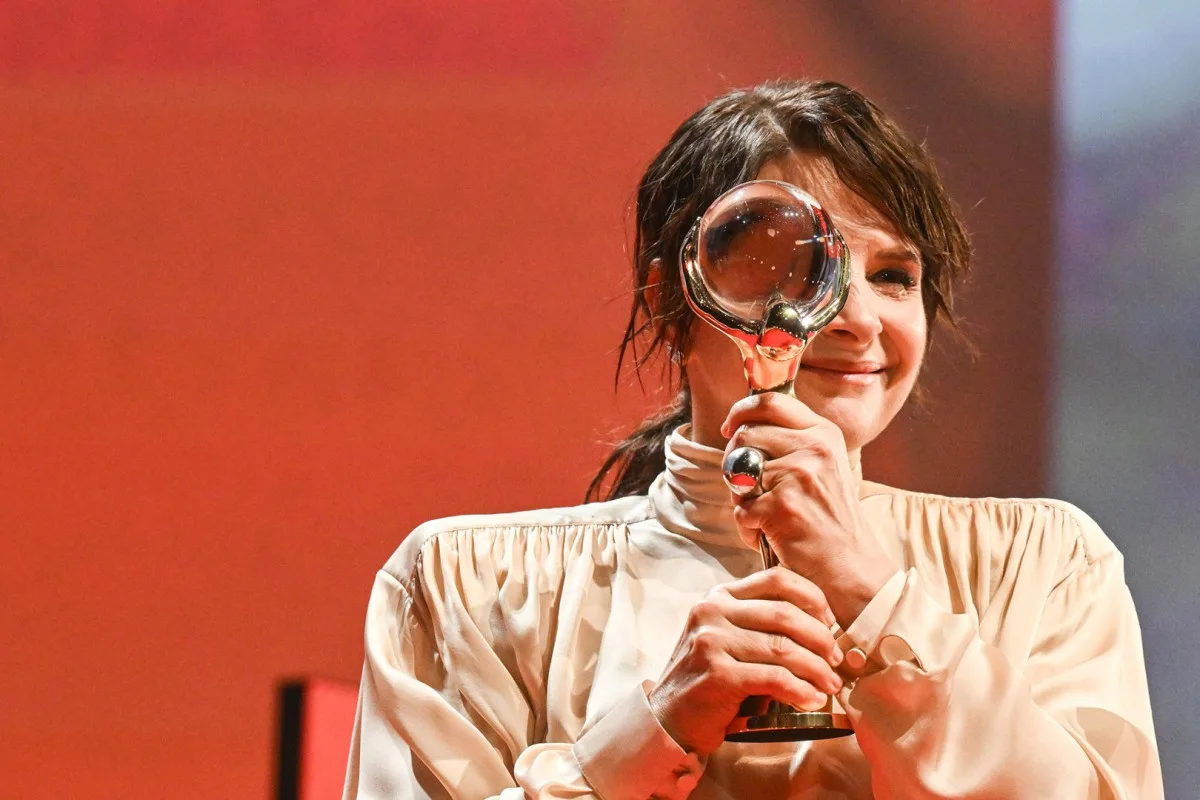
On the final night, Kevin Bacon and Kyra Sedgwick, who arrived with their film “Family Movie,” were also acknowledged. Actress Magda Vášáryová received her Crystal Globe, as did Juliette Binoche. I’ve rarely been affected by seeing a star, but I admittedly melted when I saw Binoche arrive before the ceremony. I’m sometimes reminded that light bends differently around some people.
And while the stars certainly provided KVIFF with added panache, the quality of the lineup assembled by Executive Director Kryštof Mucha, Artistic Director Karel Och, and the programming team is always surprising in its variety and scale. On top of seizing the biggest highlights of Sundance, Berlinale, and Cannes, the festival’s own premieres, drawn mostly from Central Europe, never fail to spotlight new voices and festival favorites. Many of the best works that played, in fact, balanced local filmmaking talent with creators from outside the continent.
In the Promixa competition, whose jury consisted of Estrella Araiza, Devika Girish, Dirk Decker, Marija Kavtaradze, Jakub Felcman—Isabelle Tollenaere’s intimate immigrant drama “Paris Paris” and Giovanni C. Lorusso’s Cambodia-set environmentalist slow-burn thriller “Homo Sive Natura” were personal favorites of mine. The section’s top prize, nevertheless, was awarded to the youthful Czech screwball comedy “Lover, Not a Fighter.” The Jury Award went to Shuntaro Uchida’s rich coming-of-age drama “Incernator,” and the Director prize was given to Efthimis Kosemund-Sanidis for “A Whole Person Almost.” Anna Domček and Šimon Domček’s “33 Steps” took home a special mention.
In the Crystal Globe competition, juried by Eskil Vogt, Pavel Rejholec, Amanda Nell Eu, Justin Chang, Nadia Turincev, my personal favorite was Petar Valchanov and Kristina Grozeva’s bleak tragicomedy “Black Money for White Nights.” And while that film was surprisingly shut out by the jury, that doesn’t mean any obviously puzzling decisions were made in what they did choose. They awarded Best Actor to Ghassan Saad for “Pipes” and Best Actress to Anna Schinz for the social issue drama “A Happy Family.” Mad Mengel’s tragicomedy “The Guest” felt like it could’ve easily swept the category, garnering a Best Director prize and the Special Jury prize. But the Crystal Globe ultimately went to Aung Phyoe’s intense queer romance “Fruit Gathering,” a film that hails from Myanmar (it’s the first picture from the country to appear in the main competition).
Not to be forgotten, Helena Třeštíková’s documentary “Bára – Diary of a Rockstar” also took home the Pravo audience award.
Because of the packed lineup, more than any other year at KVIFF, I felt time slipping away. I didn’t get around to many films in the Out of the Past section (though I did manage to catch Kaneto Shindō’s grim post-war melodrama “Children of Hiroshima”) and the Imagina section proved to be just out of my reach as well. I barely had enough time to do my yearly hike; this time, it was to the Diana Observational Tower, which I had to save for my last day.
Hiking through the Slavkov forest is one of my favorite things to do at the festival, if only because the higher you go into the hills, the less you hear the partying and crowds that tend to fill the town. Amid the towering trees, there is a humbling experience that always manages to re-energize me. And when I reached the summit, which allowed me to climb the steps of the Diana—there’s a gondola that’ll take you up the hill if you have limited mobility—I was once again amazed by how, from high, Karlovy Vary simply looks like a storybook: a picturesque small town with vivid architecture, nestled in a sea of verdant trees. It’s impossible not to be grateful that your human eyes can take in a panoramic view that always manages to put things in perspective, a quality the best movies also possess.
As I climbed back down toward the rush of the festival, I hoped it wouldn’t be another two years before I knew this feeling again.