A little more than a year ago, the Trump administration began implementing sweeping reductions across the federal government through the Department of Government Efficiency (DOGE). While public attention initially focused on agencies such as USAID, FEMA, and AmeriCorps, the effects soon reached the arts, humanities, and public media sectors.
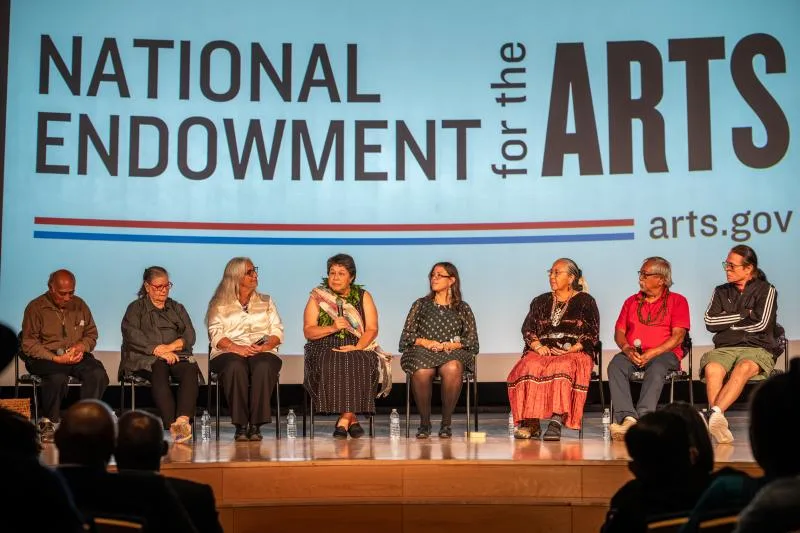
In March 2025, the administration targeted the Institute of Museum and Library Services, placing much of its staff on leave. In April, the National Endowment for the Humanities (NEH) terminated more than 1,000 grants and fired employees. In May, shortly after the administration proposed eliminating the National Endowment for the Arts (NEA), arts organizations across the country received notices that previously awarded grants had been terminated. Then, in July, Congress approved amendments to the Rescission Recovery Act of 2025, eliminating approximately $1.1 billion in funding for the Corporation for Public Broadcasting (CPB) and hundreds of millions in funding for other organizations.
The consequences extend far beyond individual filmmakers. Since its founding in 1967, the Corporation for Public Broadcasting has helped fund public television and radio stations, educational programming, investigative journalism, and independent documentaries. In 2024 alone, CPB invested $24 million in documentary production through organizations such as ITVS, Firelight Media, and other nonprofit media partners, according to an NPR report.
Critics of public media have argued that these cuts reduce government spending. Yet the scale of the savings is relatively small when compared to the federal budget. Combined reductions to the NEH, NEA, and CPB amount to roughly $1.4 billion. By comparison, that represents less than 0.02% of annual federal spending and less than 0.005% of the nation’s gross domestic product.
Elon carried out these cuts under the guise of saving $2 trillion in spending; however, “Many of the largest savings that DOGE claimed turned out to be wrong,” according to a December 2025 report from the New York Times.
Taken together, these actions represented a direct challenge to the public infrastructure that has supported documentary filmmaking, humanities research, educational programming, and public broadcasting for decades. For many documentary filmmakers, the impact was immediate. Overall, DOGE directly targeted 89 documentaries like “My Underground Mother,” “W.E.B. DuBois: Rebel with a Cause,” and a Ken Burns documentary already in production at the time.
Documentary filmmaker and NEH recipient Marisa Fox received a letter in April stating that her documentary about her mother’s ‘hidden Holocaust past’ no longer aligned with the administration. “I had been able to withdraw all of these funds before the cuts began, so my termination is more symbolic than impactful,” in her May 2025 essay with The Hollywood Reporter. This statement stood out to me because it makes clear that the concern was not entirely financial but rather ideological. The goal was to take away support from documentary filmmakers like her and others of diverse backgrounds who have made their careers investigating power and bringing truth to light for marginalized groups and forgotten history.
The loss of federal support is particularly challenging for independent filmmakers and organizations serving historically marginalized communities. Black Public Media, for example, has publicly discussed the financial challenges created by the loss of CPB support. Organizations that once funded multiple documentary projects each year now face difficult decisions about how many filmmakers they can continue to support. Stanley Nelson spoke about the impact of the federal cuts on his production company and nonprofit grant organization, Firelight Media, at the Independent Documentary Association (IDA) in August 2025. He states, “Even though they didn’t fund the whole production, they provided a solid bedrock,” he explains. “You could say, ‘I have half the money, and now I can get the other half later,’ but without that initial support, many productions struggle to move forward.
Federal arts and humanities funding has played a quiet but important role in that work. Grants have supported archival research, oral history projects, educational programming, public television broadcasts, and documentaries exploring Black history and culture. These programs helped create pathways for films that commercial distributors often considered too niche, too historical, or not profitable enough. A filmmaker may begin with a small humanities grant, receive mentorship from a nonprofit organization, secure additional support from public media partners, and eventually reach national audiences through PBS or educational distribution.
When one piece of that ecosystem disappears, the effects ripple outward.
The impact is especially significant for Black filmmakers and other underrepresented storytellers. Organizations such as Black Public Media, Firelight Media, and independent filmmaker collectives have spent decades building pathways into an industry that has historically excluded many voices. Films like Rita Coburn’s “W.E.B. DuBois,” pushed through with the support of Firelight Media and premiered on PBS on May 19th, 2026, in spite of devastating federal cuts.
The loss of that support arrives at a time when the documentary industry is already under pressure. Distribution opportunities are shrinking. Newsrooms are closing, and production budgets are tightening. Independent filmmakers are increasingly expected to do more with fewer resources. In 2026, survival alone is not enough. Audiences who value independent journalism, historical storytelling, and documentary filmmaking must become active participants in sustaining these institutions. That means supporting nonprofit media organizations, contributing to fundraising campaigns, attending screenings, and advocating for public investment in arts and culture.
The legal battles over many of these funding cuts are still ongoing. In May 2026, federal judge Colleen McMahon ruled that the cancellation of certain NEH grants “was unconstitutional, and the (DOGE) had no authority to end the funding”. Additional cases continue to move through the courts. Regardless of how those cases are resolved, the past year has revealed how fragile America’s cultural infrastructure can be. The question now is not only whether funding will be restored, but whether the nation still values the public institutions that preserve history, support artists, and ensure that important stories reach the public. For documentary filmmakers, that question has never been more urgent.