I’ve always been interested in travel, but as much as I wanted to go to these faraway locations, I found comfort in just staying put. Watching TV and later movies actually fed into this duality. On many TV shows, there were cities like New York and Paris that seemed exciting, but early on, I never saw people who looked like me in those spaces. I wanted to go, but wasn’t sure if those places would embrace me. Then there were areas where it was clear I wasn’t wanted, and growing up in Chicago had already taught me to avoid those neighborhoods that proudly said I wasn’t welcome.
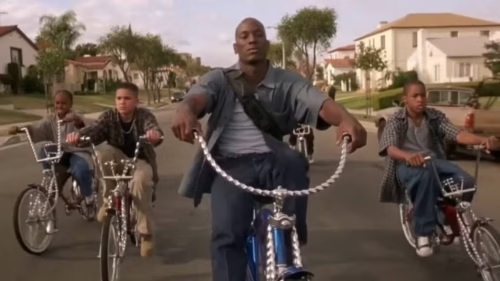
I grew up on 35th and King Drive on the South Side of Chicago, not far from where the White Sox played, and the neighborhood of Bridgeport was not known as a place for Black people, especially after dark. One could easily imagine that my longing to travel was overshadowed by the reality that I wasn’t accepted everywhere, leading me to choose to go nowhere. Movies changed that.
Films began to show Black faces in unfamiliar places. Many times, they showed the joy of relaxation and exploration, while other times, they showed the barriers and violence that came with going to areas where my skin color was unwanted. But movies gave me the permission to travel and the courage to go places where I was welcomed and not so much. For many of us, Black movies have been both a passport and a warning, shaping how we think about our next steps, both domestically and globally.
One of the films that stands out for me is “How Stella Got Her Groove Back.” Starring Angela Bassett as Stella Payne, a single mother who sends her son to live with relatives so she can rekindle her love life, it showed Black people meeting other Black people. It said the diaspora is waiting for you, that the beaches and the sun weren’t just meant for others, and this spoke to me. The filmmakers’ prominent portrayal of Black people as integral to the destination also made Jamaica appealing. Add to that the fun Delilah Abraham (Whoopi Goldberg) and Stella were having, and I was all in. In Jamaica, Stella found a respite from the mundane and the overwhelming to go along with magnificent views, beautiful people, friends, and romance. I wanted to tap into that groove.
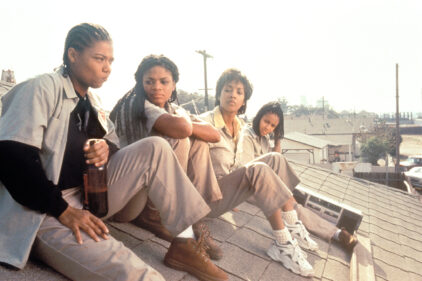
Part of that groove could be found in subsequent films like “Girls Trip” and “Last Holiday.” In “Girls Trip,” The Flossy Posse—composed of Regina Hall, Tiffany Hadish, Jada Pinkett Smith, Queen Latifah—gather in New Orleans to attend Essence Fest. Their reunion reminds us of the safety found in community, and like Jamaica, New Orleans is a bastion for Black love and Black power. “Last Holiday,” conversely, combines tragedy and dreams into a wild adventure. It follows Georgia Byrd (Queen Latifah), a department store worker in New Orleans, who, upon learning she may be dying, decides to take a trip to a famous spa town in the Czech Republic. Georgia’s journey is about not having regrets, like never traveling.
Unfortunately, not every excursion is what it appears to be in the brochure. We know, as Black people, there are places we go that will traumatize us, educate us, and even reject us, and movies have been there to map out the trials and tribulations of Black travel.
For many of us, we don’t have to be reminded of how the South is particularly traumatizing due to the brutality and unchecked biases associated with that part of the country. Our parents sent us there in the summers to connect with our families and educate us about our heritage, including the trials and triumphs. Movies like “Eve’s Bayou,” “The Color Purple,” “Johnson Family Vacation,” and “Madea’s Family Reunion” give us a taste of family gatherings and of traveling to reconnect and learn. These explorations are vital to our upbringing, but the experiences are not always pleasant. Nevertheless, we venture to these places and beyond to replenish and recapture our stories. Those first trips have a profound impact on our desire to travel and on the underlying reasons we choose where to go.
There was a reason people like James Baldwin, Richard Wright, and Josephine Baker left this country, and that reason is still evident in the ongoing migration of Black people to other countries. When I traveled to Ghana last year, over 500 Black Americans were sworn in as citizens. Be it luminaries or ordinary people, one study of Black travel found that Black tourists often travel “to escape day-to-day responsibilities, to seek novelty, and to feel a sense of belonging to family, ancestry, and racial community.”
Black folks are on the move to get away from racism, to find some peace of mind, or to flat out escape a situation that might kill us or lock us up. The latter is where Stony (Jada Pinkett Smith) found herself in the movie “Set It Off.” Like Stony, many of us have never even been outside our city or our neighborhood, for that matter. However, Stony’s predicament required her to make travel plans quickly so she could venture into Mexico as a life-saving measure.
When it comes to looking beyond America’s borders, I noticed that with “Black Panther,” people began to talk about Africa differently after its release. Instead of fear of the continent dominating the conversation, there was curiosity and pride in reconnecting with the motherland. A passport stamp to the Kingdom of Wakanda, for instance, can be purchased online. The movie excited Black people so much that even an imaginary trip to Wakanda was desirable. While we can’t tie the jump in tourism to sub-Saharan Africa to this one film, travel blogs rushed to offer Black Panther–inspired trips, connecting Wakanda’s look to real African landscapes. The film reframed Africa as a place of innovation, beauty, and possibility, changing how many of us thought about traveling there.
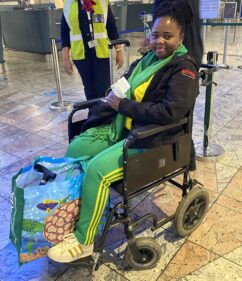
In my current travels, I encounter all of these emotions and experiences. I just returned from Paris, where I saw Black players from all over the world compete at the 2026 French Open: Gaël Monfils, Coco Gauff, Victoria Mboko, Naomi Osaka, Félix Auger-Aliassime, Frances Tiafoe, and Chicagoan Taylor Townsend, among others. I took a Black Paris tour and learned about the contributions and impact Black people have had on Paris culture. Having these players in the same city gave me comfort that I was not alone. Interestingly, Naomi Osaka received significant negative feedback for hosting a gathering for Black tennis players. Even as travelers, whether we are professional athletes or a curious traveler like me coming to celebrate, there is still a level of hateration. It is hard to explain to people who are not Black the totality of our feelings. Yet it would seem obvious, even to an outsider, that when people fail to see images of themselves in many spaces, they relish the opportunity to connect with their communities whenever and wherever they can.
And that’s what these films did for me. They made me want to commune with my people across the globe. When films started showing people like me in those spaces, those films gave me permission to travel. In turn, travel gave me the opportunity to see beyond my block, neighborhood, and city. The world became bigger and smaller at the same time. So what are you waiting for? Let’s plan that next trip, like now!
Wakanda Forever!