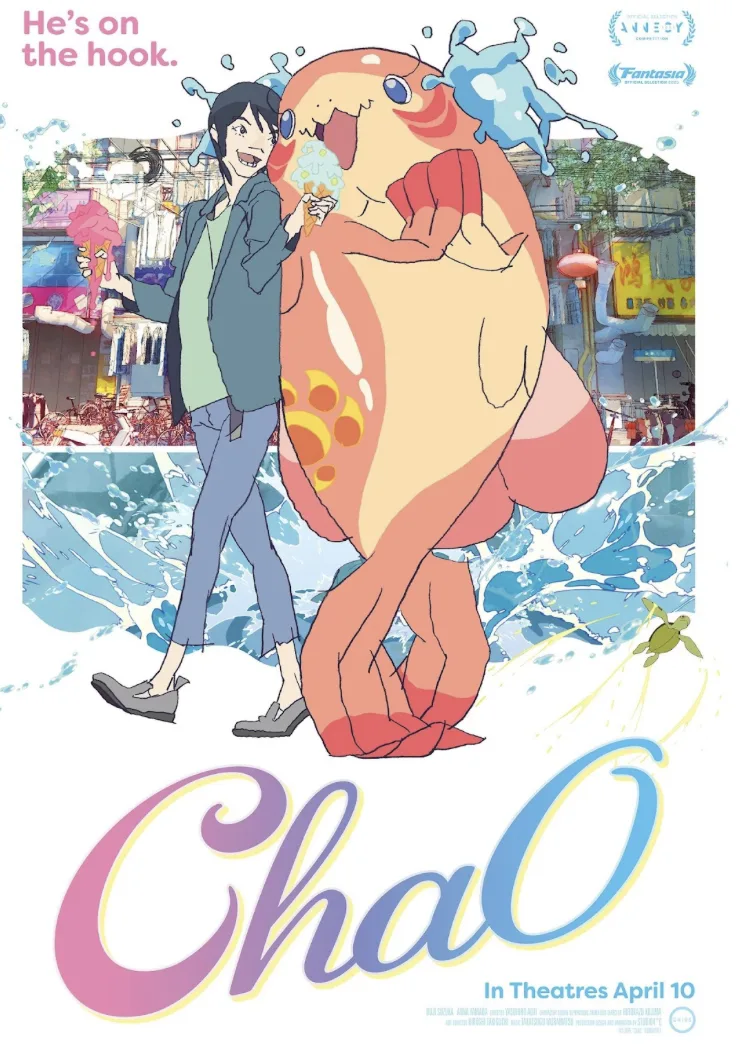

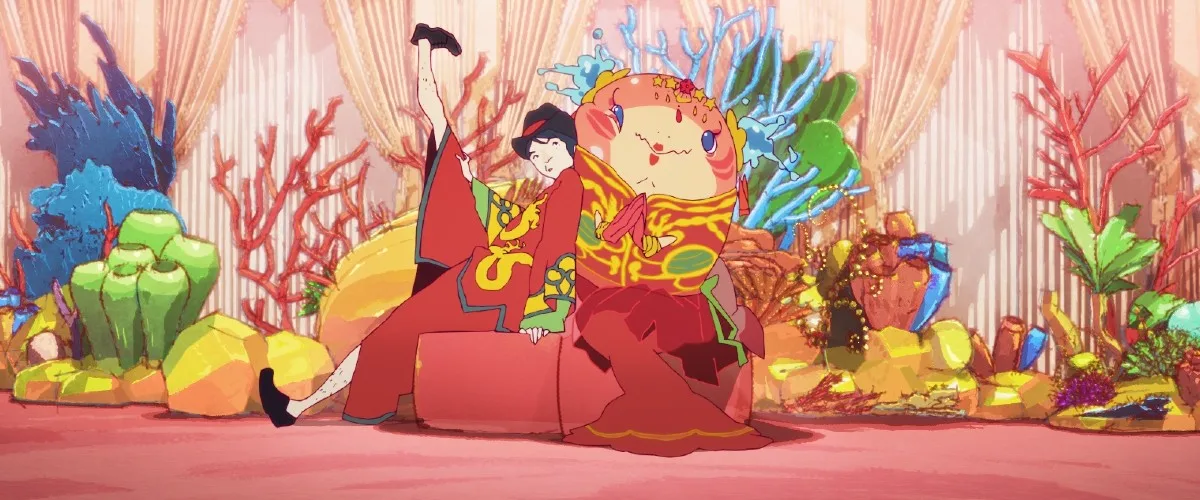
The first thing you’ll likely notice about “ChaO,” a Japanese animated rom-com fantasy about a mermaid princess and her human partner, is its unconventional, but beautiful synthesis of hand- and computer-animated linework. With alternately slinky and hard-edged character designs and backgrounds that emphasize an idiosyncratic and notably un-smooth sort of draftsmanship, this stylish and accessible fable often resembles an elaborate sketchbook drawing that somehow took on a life of its own.
The second thing you might notice about “ChaO” is that it moves like a rocket. A fairy tale framing device quickly sets up the official version of our story, paraphrased from the book on “Human-Merman Relations.” Merman ruler King Neptunus (Kenta Miyake) had a beautiful mermaid daughter named Chao (Anna Yamada), who rescued ship-building engineer Stephan (Ouji Suzuka), who then married Chao soon after surviving a fight with her father. Their marriage supposedly opens a new chapter in diplomatic relations between fish- and humankind, but the knottier truth will soon be discovered by harried reporter Juno (Shunsei Ota), who only accidentally runs into Stephan, but still recognizes him from his copy of “Human-Merman Relations.”
So a story that starts out with a sunny, picture-book flat history of a brave new amphibious world immediately becomes Stephan’s take on his erratic, but genial, courtship with Chao, a roly-poly chimera who mainly appears to Stephan as a giant fish. Later on, we’ll learn that Chao’s hiding her half-human form—with delicate, but angular features that bring to mind Milla Jovovich in “The Fifth Element”—because she doesn’t completely trust Stephan. But for a while, all we know about Stephan and Chao is that she loves him, based on a pledge of loyalty that he doesn’t even remember making, while he needs to keep up appearances to secure a grant for his environmentally-safe Air Jet shipping project.
Caught between two narratives—one ruled by corporate interests, represented by comedian Ryota Yamasato’s cheery, unnamed business tycoon, and the other by his giddy and naïve wife—Stephan ricochets like a pinball from one incident-fueled episode to the next. The movie’s breakneck pace is teasingly set by a metronome-like running gag involving a low-dangling skillet, which Stephan repeatedly flies into headfirst whenever he bursts out of his parents’ house. He runs everywhere and only really skids to a stop whenever one of his two masters makes him pause long enough to give them more face time.
Thankfully, while Stephan didn’t plan to marry Chao, he’s always been sympathetic enough, putting aside his Air Jet project, he really does seem devoted to Chao. Their budding marriage plays out like a lightly likable domestic farce, but its lightning-fast pace suggests that “ChaO”’s story, like its impressive audiovisual style, reflects a new way of moving through the world rather than emphasizing staid qualities like plot and character development.
It’s tempting to read into the movie’s Shanghai setting, and into the way human characters like Yamasato’s Humpty-Dumpty-looking President, as well as Chao’s half-human form, suggest cartoonish parallels between the human world and the underwater kingdom. The meeting of these two worlds is kinetic and unsteady, and while Stephan and Chao both try to normalize their shaky connection, she, like him, repeatedly bumps her head as they chase after each other.
“ChaO” is a real pleasure to watch and listen to, since both its sound and visual designs reflect Stephan and Chao’s uneasy union. Their dynamic’s familiar enough—she’s a klutz, and he’s trying to be patient with her, since they’re both essentially fish out of water—but also makes more sense when you see how fast-paced and tentative everything in their world is. The soundtrack is intricately layered with ambient sounds, like the soft whoosh of oncoming car traffic, and well-modulated voices, with some appearing closer or farther away than others.
The hand-drawn qualities of supervising animation director Hirokazu Kojima’s character designs also remind viewers that the movie’s artfulness is a product of human ingenuity. And if “ChaO” ever looks more sketchy than painterly, bear in mind that its nuanced color schemes and dazzling scale/proportion both go well beyond what most viewers might imagine a sketch looks like. It took seven years to complete “ChaO”, according to the movie’s production notes. Watching Stephan—and Juno and Chao—chase each other sometimes feels like watching an elaborate Escher-like tableau that only grows more vivid and detailed the more you stare into it.
Naturally, the one constant in the world of “ChaO” is the friends that Stephan and Chao make along the way. That might seem a little confusing since Kojima’s characters often resemble humanoid caricatures, but honestly, it makes a lot more sense in context. The most enchanting thing about “ChaO” isn’t necessarily its hyperpoptimism, but the many little ways in which its breezy and arresting style reflects its creators’ lightly held Utopianism.