

How does one find a throughline between the four disparate films in this dispatch? I’m not sure. There are two films about the censorship of the arts: one simply chronicles the effects of a woman returning to her Texas hometown, and the other is about Alzheimer’s disease and is set in a prison. They all possess wildly different tones, ranging from broad comedy to the downright heartbreaking. They’re even from different sections (the first two are part of Premieres, whereas the final two hail from the US Dramatic competition). It’s nice to have a collection of films that are so different that their inclusion here speaks to the richness of this year’s festival.
The opening of Josephine Decker’s “Chasing Summer” is a wonderful display of bravura. The romance begins with a woman orgasmically moaning as a montage of damaging floods and houses being ripped apart by tornadoes fly by. A disaster relief worker, Jaime (Iliza Shlesinger), is in Mississippi working on the wreckage of a tornado when she learns that she and her team have been selected to serve in Jakarta, which, as she explains, is sorta like the “Nobel Prize” of her profession. Within a few minutes, she also discovers that her boyfriend and partner are leaving her for a younger woman. Hurt and alone, Jaime returns home to Texas, where her genteel mother (Megan Mullally) chastises her rugged appearance and her now sober older sister (Cassidy Freeman) owns a skating rink that’s in need of repairs.
In some ways, Shlesinger’s hilarious script not only speaks to Decker’s own upbringing near Dallas-Fort Worth, Texas, but also recalls “Hope Floats.” That Texas-set film similarly follows a woman whose partner’s philandering causes her to go back home to mend the many burnt bridges she left behind. In “Chasing Summer,” Jaime left twenty years ago because her ex-boyfriend, Chase (Tom Welling), both cheated on her and supposedly started a vicious rumor about her, too. Upon seeing him again, she learns that old flames die hard. Nevertheless, Jaime eventually strikes up a relationship with a kindhearted and polite Colby (Garrett Wareing). Twenty years older than Colby, Jaime finds comfort in his buff arms. Between that relationship and her friendship with a young rink employee (Lola Tung), you get the sense that Jaime never quite grew up after the day Chase left her.
Though “Chasing Summer” can lean toward being predictable—there’s a twist that I personally saw coming from a mile away—that critique isn’t necessarily a knock against a film that treasures the predictability of life. So while the impulse is for one to crave that Decker pushed the film’s familiar tone and assured visual language toward the type of idiosyncratic territory that dominated “Madeline’s Madeline,” the filmmaker is more concerned with serving the comedic beats of this oddball woman than attempting those leaps.
Should Jaime stay to lay down roots with Colby or return to her job? Decker and Shlesinger—who’s quite charming as the free-spirited Jaime—find a unique solution to that question. So while the wild and fun “Chasing Summer” isn’t necessarily Decker at her best. It’s certainly her at her most content.

Petra Biondina Volpe’s caretaker drama “Frank & Louis” is a distressing, albeit distant picture that survives on its two lead actors. Here, Kingsley Ben-Adir is Frank, a driven, incarcerated man serving a life sentence who decides to participate in a program dedicated to nursing prisoners battling Alzheimer’s disease and dementia. Upon arrival, Frank is assigned to the volatile yet vulnerable Louis (Rob Morgan), which causes him significant stress and reveals his own vulnerabilities.
The topic, on first blush, is an odd fit for Vople—a Swiss director whose film “Late Shift” was submitted by Switzerland for the Academy Awards. But Volpe began researching the project back in 2014 when she visited California Men’s Colony in San Luis Obispo. It’s there that she learned about the Gold Coats (the name derives from the jackets they wear to distinguish their profession from that of the general incarcerated men) and their job as caretakers. That background is why Volpe approaches this program with such specificity, noting the mental health struggles that occur when someone must watch a person near them lose their memory. She also thoughtfully builds out the ensemble of Gold Coats by casting a present Residente as Frank’s colleague and friend.
Where Volpe somewhat slips up is in making a portion of Frank’s personal journey a fairly prototypical story. Part of the reason Frank becomes a Gold Coat, for instance, is the hope that the humanitarian project will look good for his parole hearing. That aim takes up considerable time as he communicates with his sister (Rosalind Eleazar) to bolster his case and emotionally prepares for the ordeal of pleading for an early release. You almost wish the carrot of leaving prison wasn’t hanging above him, and instead, he was a person who rediscovers his hope through this program.
Because the film is at its strongest when it focuses on Frank and Louis’ relationship. How does one maintain their personhood when imprisonment and a disease take away the signifiers of one’s humanity? Volpe sometimes asks that question through her lighting, which projects warmth away from the cells but coldness within the prison. She furthers that query through Ben-Adir and Morgan’s equally affecting performances. Both Frank and Louis—who are hardened men—melt in these actors’ hands as their once guarded frames loosen and their formerly combative tempers soften.
While “Frank & Louis” diverts far too much time away from these men’s difficult friendship and spends it on tangential arcs that distance and distract us from the quiet acknowledgment that’s happening, there’s enough genuine thoughtfulness by everyone involved to straighten the film’s needless diversions.

Set in Tehran’s underground art scene, Maryam Ataei and Hossein Keshavarz’s “The Friend’s House is Here” is a daring portrait of friendship and community whose Brechtian approach reveals the power of their separate voices. The film concerns two roommates—the dancer Hana (Hana Mana) and the actress Pari (Mahshad Bahram)—who must contend with an Iranian government intent on censoring the arts.
Hana, nevertheless, is mostly oblivious to that danger. She’s about to leave her boyfriend Ali (Farzad Karen), Pari, and her country behind for France. When she attends a performance staged by Pari and her theater troupe, a play that includes scenes in which Pari searches for a missing Hana, the work’s message about a community coming together to stave off a government-backed disappearance mostly goes over Hana’s head. Hana can only concern herself with staying up late with Ali or making dance videos in front of the Milad Tower. It’s not until Pari is jailed that Hana wakes up to the political realities surrounding her, which are often captured in an eloquent, guerrilla-style manner on the streets of Tehran.
In “The Friend’s House is Here”—the title is an answer to Abbas Kiarostami’s quizzically named film “Where Is the Friend’s House?”—Ataei and Keshavarz possess a considered sense of environment and pace. Their filming of Pari’s performance space, for instance, utilizes the white negative space of the large room to emphasize the juxtaposition between isolation and community. When an official interrogates Pari backstage, the blue curtain in the background also foreshadows the precarity of her situation. The deliberate camera movement, which is sometimes as minimal as a slight push-in or pull-out or pan, lends itself well to the script’s Möbius strip structure.
It’s the latter’s construction that somewhat slows this work. Once the bend of Ataei and Keshavarz’s film is clear, it’s not difficult to spot the film’s narrative slopes. Once charismatic Mana’s off-screen, more breaking occurs because her spark is so enchanting. Those critiques, nevertheless, are mostly quibbles. This is a powerful film about the importance of performance that perceptively knows what it wants to be and approaches its artistic goals with confidence and defiance.
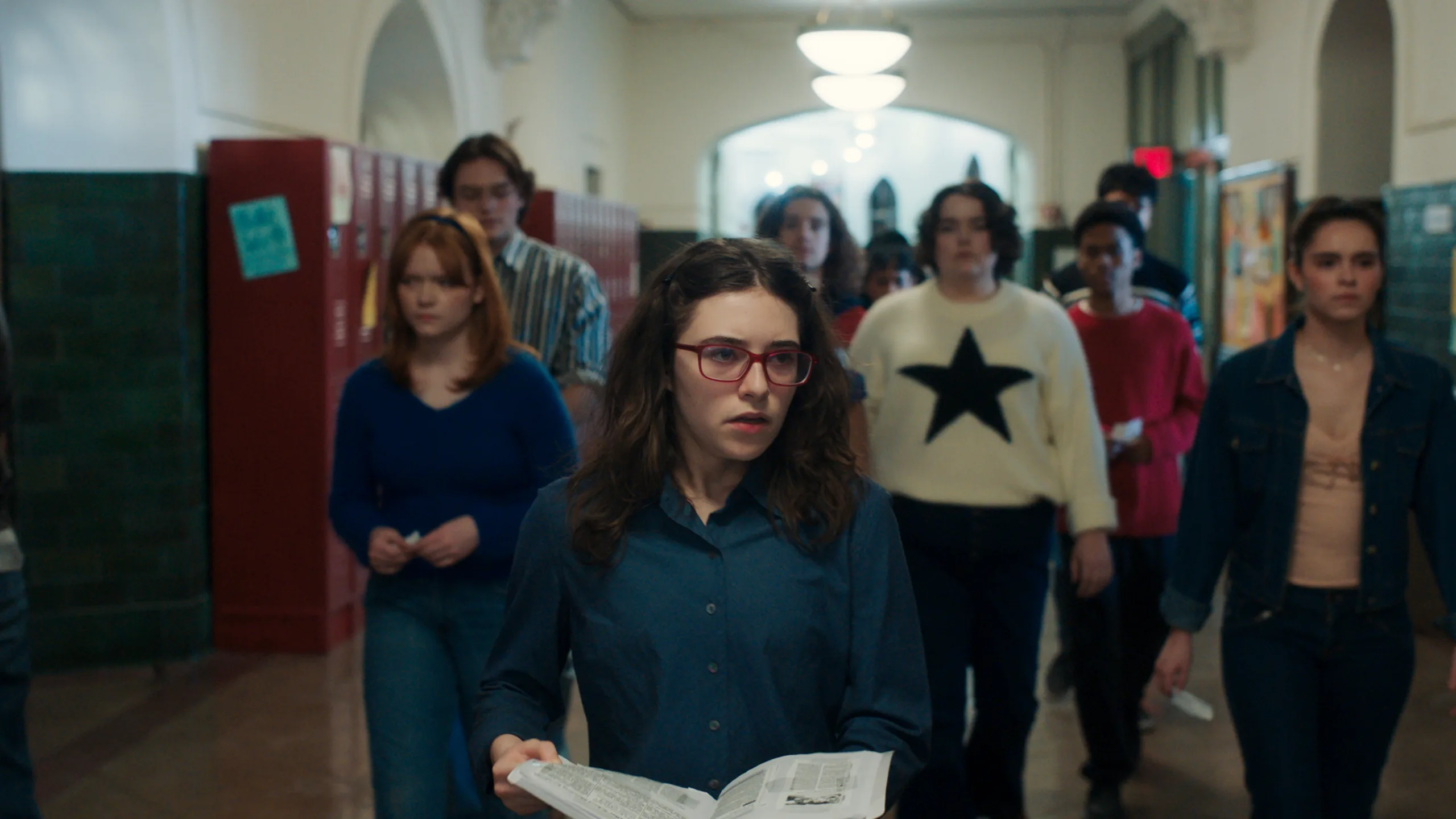
I so wanted to like NB Mager’s “Run Amok.” For one, its premise about a high school theater production staged to commemorate the ten year-anniversary of a school shooting is fascinating and bold. It’s also made with the best of intentions and wants to speak to this authoritarian moment. But the execution is so lacking due to its half-formed ideas and its grating tone that it all just crumbles before it comes remotely close to the finish line.
It begins gently with the teenage Meg (Alyssa Marvin) dragging her harp down a winding suburban street toward school. Though she asks for help, her cousin Penny (Sophia Torres), who was once in the theater but now plays lacrosse, drives off without her. When her teacher Mr. Shelby (Patrick Wilson) offers her a ride, Meg turns him down (tragedy has made Meg a self-sufficient person). A decade ago, her mother, an art teacher, was among several people killed by the school shooter. Now, all the teachers—like Mr. Shelby and the paranoid Mr. Hunt (Bill Camp)—carry guns armed with rubber bullets.
Nevertheless, with the anniversary of the tragedy fast approaching, Mr. Shelby, who’s regarded as a hero for killing the teenage gunman, commissions Meg to write a piece that he hopes will be healing. While the school’s principal (Margaret Cho) hopes Meg and Penny will perform “Amazing Grace,” the cousins have a far more elaborate presentation in mind: They want to re-stage the shooting as a musical.
Because of the film’s concept, there’s lots of theater kid earnestness that often lands like a thud—especially because Meg is a caricature of a good student. And though it’s a major irritation, I might argue that the annoyingness is intended. Often, “Run Amok” gestures toward being a dystopian story. Though she has a sad past, the happy-go-lucky Meg believes in the school’s system. As she begins to rebel against that system, it bites back, and she becomes more resolute.
Moreover, there’s an organization here called the PTAA (Parent Teacher Arms Association) that acts as the arm of an authoritarian leader; the school also begins leaning on censorship to stop Meg from finishing a musical whose rehearsals include covers of “Bulletproof” and “Hit Me Baby One More Time.”
These components would land well if Mager weren’t so totally on the nose on their symbolism. Likewise, the bid by Meg to understand the mother of the shooter, thereby granting empathy to his past and the mom’s current plight, would be a fascinating angle if it were more deftly and committedly explored. Mager also leaves Meg’s current relationship with her aunt (Molly Ringwald), who adopted her, relatively unmentioned, too. Worst yet, when faced with the difficulties of pulling off your art when an authoritative system attempts to control it, the film’s ending literally runs away from any concrete stand. The film instead curls back into the confines of its own cuteness, showing little progress in the process.