The Hangover Part III
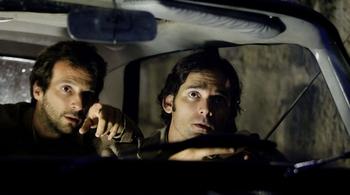
Better than “The Hangover Part II,” but equally as useless, “The Hangover Part III” plays more like a caper film than an outright comedy. The…
Families create their own narratives. Stories are passed on from generation to generation, and in this way the past continues to live, but it can…
"The Ballad of Narayama" is a Japanese film of great beauty and elegant artifice, telling a story of startling cruelty. What a space it opens…
Patrice Leconte's "Monsieur Hire" is a tragedy about loneliness and erotomania, told about two solitary people who have nothing else in common. It involves a…
Jerry Lewis returns to Cannes in a starring role in Daniel Noah's "Max Rose," which proves once again — as "The King of Comedy" did…
Alexander Payne's "Nebraska" brings black and white, to the competition, while "Omar" delivers moral shades of gray to the Palestinian/Israeli conflict and "Michael Koolhaas" looks…
Roger was a titan in the film community, but he was also a beacon for the seriously disabled.
Mother’s Day I awakened to spirited calls from my children and grandchildren. As Roger wrote in his memoir, “Life Itself,” I came from a large family of nine, and I had four brothers and four…
Roger was a titan in the film community, but he was also a beacon for the seriously disabled.
Ray Harryhausen told us, time and again, the story of how he saw the original "King Kong" (1933) on the big screen when he was…
The destruction of Vulcan, one of the most crucial planets in the "Star Trek" universe, should be at the core of J.J. Abrams’ "Trek" movies.…
Dear Roger,You emailed me the questions to this interview on March 15, 2013. In your March 16th reply to my email, you said: The piece…
Named after the David Cronenberg film, this is the blog of RogerEbert.com founding editor Jim Emerson, where he has chronicled his enthusiasms and indulged his whims since 2005. Favorite subjects include evidence-based movie criticism, cinematic form and style, comedy, logical reasoning, language, journalism, technology, epistemology and fun. No topic is off-limits, but critical thinking is required.


So many movies have opening shots that are like overtures, condensed miniatures of the whole film. In Guillermo Del Toro's "Pan's Labyrinth" you might even say it contains the entire movie in one shot. Not only does it begin with the ending, but the movement of the shot (together with the next one) takes us from underground (the land of the subconscious, the imagination) up into the light of day -- or, looked at another way, from political and psychological repression into the liberation of the open air. This presages the momentum of the entire movie.

"Pan's Labyrinth" is so locked into the emotional and fantasy world of its protagonist, Ofelia (Ivana Baquero), that the camera itself lies on its side next to her and is then plunges vertiginously into her pupil, entering her head, where the movie takes place. This initial dazzling sweep (actually a composite shot, but executed in once continuous motion) sucks us into the movie so quickly that we barely register what we've seen until the end, when we remember these prophetic first few seconds from the start of the movie.

"Pan's Labyrinth" is riddled with pupils and irises, holes and portals that lead to new worlds. In this first shot, we appear to rise out of the ground (although it's a right-to-left movement, reversing time), into Ofelia's eye into a fantasy realm of her own creation, and then moves back to the right (setting the story into forward motion), following a running figure (Ofelia herself) up a circular stairway and through another doorway, into another chamber, with another stairway. The next shot follows her up the stairs, leading through a reverse of the opening pupil-shot: an eye-hole flooded with white light. And, with that, the movie-proper begins...

Roger Ebert has published a Great Movies review of "Pan's Labyrinth. My own review, originally in the Chicago Sun-Times, is at RogerEbert.com, too, in the Editor's Notes section.
Next Article: More sex, please. We're American. Previous Article: Leonard Maltin: Still "Movie Crazy"
Saturday, May 4, was one month to the day that Roger left this earthly plane. In honor of Kentucky Derby weekend I ...
Michał Oleszczyk
When Chaz has gone to Cannes without Roger in the past, she has written about the festival n the form of letters and ...
View image A graffito on Norah Jones. It's confession time again here at Scanners: I've never go...