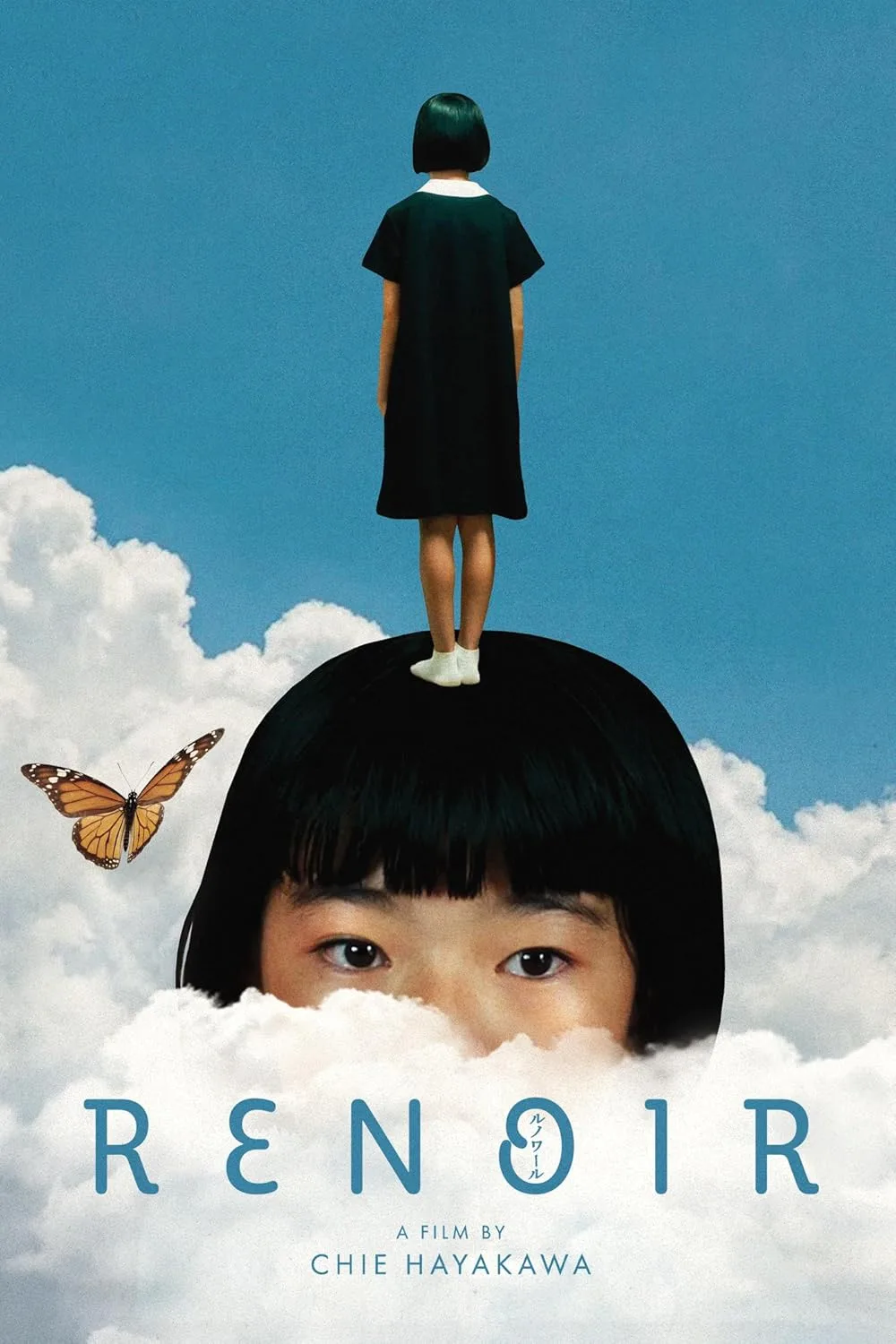
Within the first few minutes of her time on screen, 11-year-old Fuki (Yui Suzuki) makes a grim impression. In front of her class, Fuki shares a dream where she’s murdered. Death and the woes that plague adulthood seem to both fascinate and puzzle the young heroine, whose default mode is a nonchalant contentedness. Throughout “Renoir,” a film of morbid whimsy by director Chie Hayakawa, Fuki’s imagination fabricates moments that, in context, are fantastical but, at face value, appear relatively grounded. It’s magical realism that feels more plausible than otherworldly, which makes for a disorienting experience.
From Fuki’s point of view as a prepubescent child in the 1980s, grown-ups seem bizarre in how they relate to each other and in the ways they conceal their true sentiments. In her diary, she writes that her mother, Utako (Hikari Ishida), is waiting for her father, Keiji (Lily Franky), suffering from cancer, to die. When Utako reads this, she is upset not because her daughter is lying, but because she feels exposed. There’s a clarity to how Fuki interacts with others that can feel uncomfortable. She doesn’t entertain facades; she opts for directness.
Hayakawa’s most accomplished choice is casting Suzuki, who plays someone almost immune to sadness or anger. There’s something particular about Fuki that the filmmaker neither names nor diagnoses, but that Suzuki expresses in a performance that’s at times so subtle one might miss its effective modulations. Often, Fuki’s precocious curiosity leads her to situations dangerous for someone her age, and when those scenes arise, we are never certain whether she understands the predicament she’s put herself in or not. One such moment involves a meeting with a psychology student she meets on a phone dating line.
Part of the reason why “Renoir” never fully loses touch with reality is Hideho Urata’s cinematography. For the most part, there’s a pleasant, recognizable normalcy in how he walks alongside Fuki. Yet, the visual language is far from erratic; on the contrary, the frames are highly composed, and on occasion, the delicate flourishes are what establishes a sense of heightened existence, like when Fuki stays still on her bicycle, walk-man on, and a striking open sky behind her as the camera rotates around her or the luminosity of a passage where she imagines herself partying on a yacht with people much older than her. Hayakawa titled her film after the French impressionistic painting (his “Portrait of Irène Cahen d’Anvers” briefly catches Fuki’s attention on screen), which resonates with the film’s commitment to evoking what the girl thinks and feels instead of adhering to rigid verisimilitude. Still, after a few of these vignettes, one wonders if the parts can produce a satisfying outcome. The one element that guides “Renoir” towards a conclusion is Keiji’s deteriorating health.
Beyond Fuki’s immediate family, the adults she encounters elsewhere also radiate instability and a lack of confidence in who they have become—even those who at first command admiration for their apparent self-actualization. When she visits a friend, the girl’s mother blames herself incessantly for choosing the wrong cake, an overreaction that Fuki registers. Later, as Fuki becomes fascinated with the occult, magic tricks, and telepathy, she “hypnotizes” a neighbor who reveals a traumatic episode. If these unconnected scenes amount to something greater, it confirms that Fuki’s behavior, including her ability to imitate animal sounds, is genuine and not just a cry for attention.
Conversely, her parents are adrift, one desperate to save his own life with miracle cures, and the other finding fleeting refuge in an illicit romantic prospect who turns out to be just as broken as she. At one point, through this false-prophet type who enamors Utako, the director makes a point about how Americans and Japanese people handle their inner preoccupations differently, with the latter prioritizing modesty. In that sense, Fuki doesn’t fit the mold of her compatriots. She gives in to her impulses and ignores what doesn’t suit her mood. Her parents can be arguing aggressively in the kitchen while she draws and laughs.
In “Renoir,” more uncanny character study than coming-of-age story, the same component serves as both an intriguing asset and an alienating liability: Fuki. Her indecipherable personality and unspoken worldview (she is not one to spell out how she feels) turn each event into an opportunity for something unexpected. But it can also be perceived as a flaw on Hayakawa’s part for failing to make her more traditionally palatable. Whatever one’s opinion is of Fuki and how the director and Suzuki conceived her, it’s bold and admirable to make a film centered around a complicated child protagonist that doesn’t strive to appease what audiences have come to expect from these types of stories.