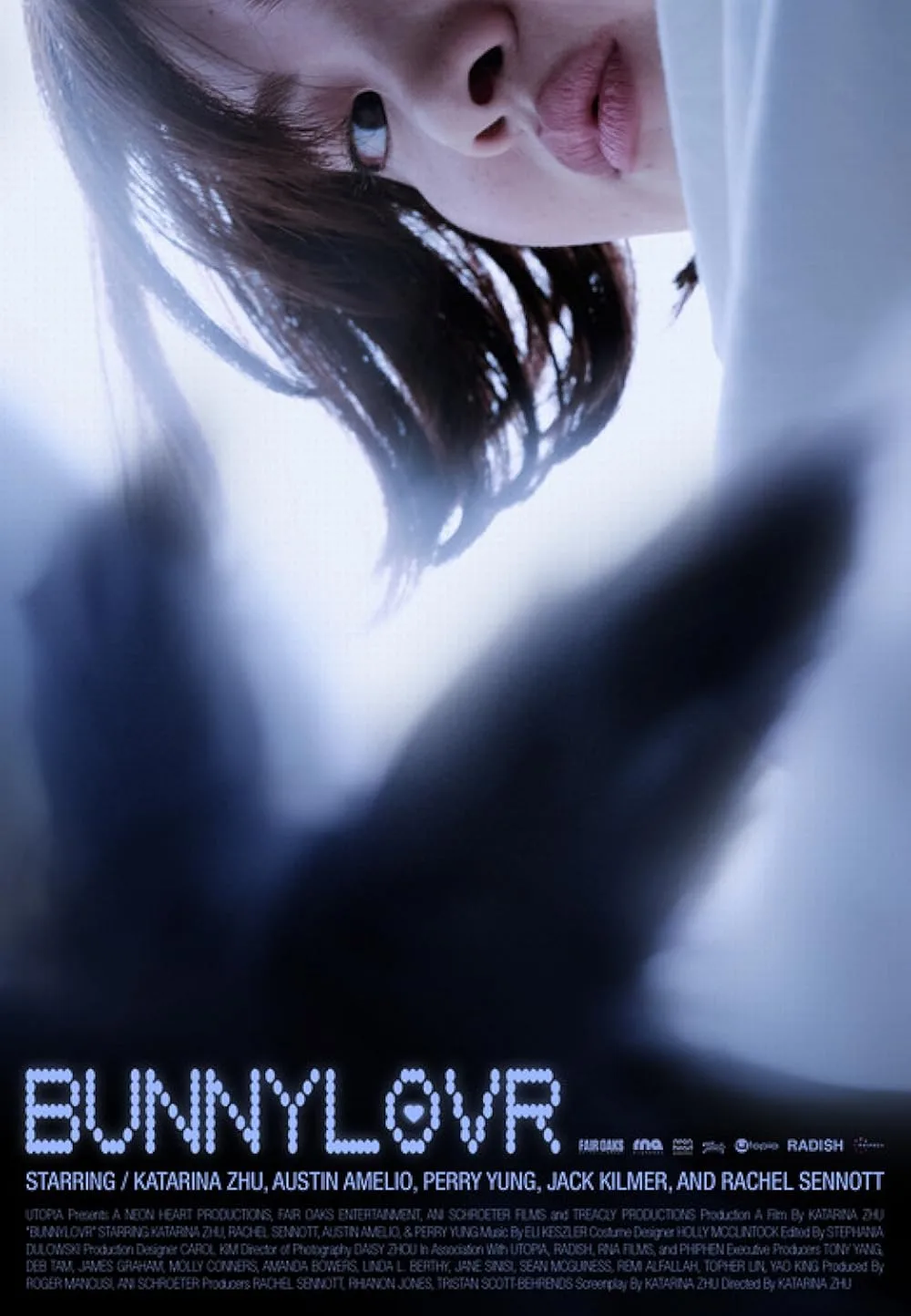


The first image you see in writer/director Katarina Zhu‘s debut feature, the intriguing if aimless “Bunnylovr,” is of Zhu’s own ass, covered in white fishnets, lit only by the LED glow of a laptop screen. The opening shot, like many of the intimate, almost invasive close-ups we see courtesy of cinematographer Daisy Zhou, is zoomed in so tightly that you can barely make out which part of her body it is. Then we hear a loud smack, a giggle, and we’re slightly more attuned. That’s the feeling of watching Zhu’s 86-minute character study, for both good and ill: we feel trapped in the life of a woman who feels similarly caged, even as we’re pressed a little too tightly to her to truly see the full picture.
Zhu plays Rebecca, a down-on-her-luck Chinese-American twentysomething who, typical for someone her age, has no idea where her life is headed. “I don’t do anything,” she confides in her best friend Bella (Rachel Sennott); her days are spent at a dead-end job working for a brusque older gentleman who always seems disappointed in her, while she spends her nights catering to lonely men as a camgirl in her sparsely-furnished apartment. Neither scenario feels like it fulfills her: She takes little pride in her sex work, seeming furtive and a little bashful when dealing with her clients. (Granted, there’s also an element of performance there, which ties into the smallness and submission that customers might expect of someone like Rebecca.)
Both in and out of the bedroom, she reeks of people-pleasing, an attitude that leads her to feel deeply alone and isolated. Her only connections outside of camming, besides the seemingly vapid Bella, are her deeply casual hookup Carter (Jack Kilmer), and her estranged father William (Perry Yung), who bumps back into her by circumstance and wants to reconnect—motivated, partly at least, by a terminal illness.
Rebecca’s heartbreaking isolation, to say nothing of her financial woes, also explains why she allows one of her most loyal clients, who frequently pays her extra for cam-to-cam sessions, to send her something in the mail to “make [her] less lonely.” The gift in question is a fluffy white bunny, which Rebecca is initially loath to keep; she’s in no position to care for another being right now. But after a time, she comes to accept it and names it Milk, a move that begins to deepen her connection with her mysterious benefactor (whom we eventually see, played by Austin Amelio of “Hit Man”).
These developments are far less important than Zhu’s handling of Rebecca’s movement through them, whether as a protagonist or a performer. In front of the camera, her work feels effortless, playing Rebecca with probing eyes and uncertain smiles as we see her nervously navigate one mistake or submission after another. “Bunnylovr” is refreshingly concerned with the way people who’ve lived their entire lives online have to navigate the differences between those two worlds; the risks of checking your cam site on the job, the inability to tell friends and family what you really do for a living, the risks of exposing yourself in real life to people who only know a certain you through a webcam and will ask you to do degrading things to help you secure financial stability. As a performer, Zhu spins these plates with remarkable openness and vulnerability.
But these deft choices frequently feel lost in the film’s structural aimlessness, as evidenced by its elliptical editing, the weightlessness of its script, and Zhou’s all-too-disorienting handheld camerawork. The latter is its greatest sin: the wobbly camerawork zooms far past cinema verité and into redundancy, overstating the script and the cast’s work to sell us on Rebecca’s loneliness. (There is one brilliant shot midway through the film, a simple time-lapse of Rebecca going about her day, shot surveillance-style from the ceiling of her cramped, unadorned apartment, that sells her alienation better than a film’s worth of jittery close-ups.)
Then there’s the titular bunny rabbit, who’s adorable as hell but serves as a too-neat metaphor for Rebecca’s own helplessness. Milk brings a small sense of comfort to Rebecca, but as the film progresses, Amelio’s John makes increasingly bizarre requests of Rebecca about what to do with Milk during their cam sessions that make it feel like just another method of control. These moments with John, culminating in an awkward date with a “Taxi Driver”-esque encounter in a movie theater, are among “Bunnylovr”‘s most exciting moments.
I just wish, though, that all of these narrative threads about work-life balance, personal boundaries, and the malaise of early adulthood were explored in greater depth. (The film’s treatment of sex/cam work as the aimless exploitation of women with low self-esteem, at least through Rebecca’s case, also feels reductive.) As is, “Bunnylovr” feels like a stone skipped across the surface of a pond; we could go deeper, but instead we choose to skim the surface. It’s a glossy, moody surface, mind, but surface nonetheless.