Opening Shots: Shotgun Stories

Through an open doorway we see a man without a shirt sitting on an unmade bed. In his hand is a white piece of paper. On his back is a spattering of circular, scarred-over wounds, like craters of flesh. Both membranes have stories inscribed on them. We just don’t know what they are yet. Maybe we’ll find out. Maybe we won’t. The man, Son Hayes (Academy Award-nominee Michael Shannon), reads the unfolded note, nods in acknowledgement, and looks up, as if to face himself in an off-screen mirror.

December 14, 2012

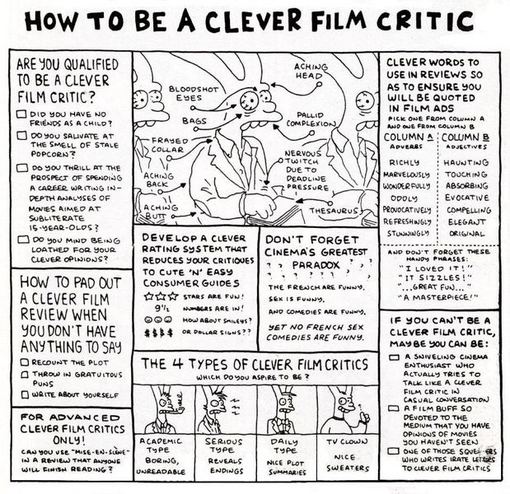
Continuing to argue for the irrelevance of my own opinions

Above: Life in Hell © 1985, Matt Groening

If I had to make a Charles Foster Kane-like “Declaration of Principles” for Scanners (and if I haven’t already done that sometime in the last seven years, then maybe I should), it would include such fundamental tenets (all-too-familiar to regular readers) as:

* Whether somebody “likes or dislikes” something is not something anyone else can do anything about, and therefore is not a fit subject for criticism.

* Neither is speculation about somebody’s motives for “liking or disliking” something. All that matters is what they say, not what you guess their motivation is for saying it — just as all that matters to criticism is what’s in the movie, not what you imagine the filmmakers’ intentions were. Is it there, or not? If it is, it can be talked about. If it isn’t, when where’s the evidence? Even speculation has to be based on something.

* A movie is always to some degree about what happens to you as you are watching it. (Which means, the questions and suppositions and emotions you have are part of the experience.)

December 14, 2012

Descent imagery #1

Now that “The Descent” has passed its second weekend, I thought I’d begin posting some of the visual quotations I’d promised. But first, there’s one auditory quote that should be mentioned. When Sarah goes off to explore inside the cave, she hears — or thinks she hears — the laughter of a child, reminding her of her dead daughter. That’s a direct reference to Nicolas Roeg’s “Don’t Look Now,” maybe the scariest movie I’ve ever seen, and definitely one of the finest psychological horror pictures that wasn’t directed by Roman Polanski.

“The Descent” invokes an ineffably unsettling moment from Peter Weir’s best film, “Picnic at Hanging Rock.” On the climb up to the cave, Juno simply stops and looks at the wilderness around her. There’s something strange, wild, and mysterious in the air — something beyond the ken of these women as they are about to begin their descent.

After the jump: “The Shining.”

December 14, 2012

TIFF: What Is This Thing Called Sex?

Come blow your horn: Justin Bond sings “We All Get It in the End” at the end of “Shortbus.”

The camera soars over a wonderfully colorful handmade model of New York City, popping into one window after another. At the tip of Lower Manhattan is a blood-red scar with two square lesions: Ground Zero. “Shortbus,” John Cameron Mitchell’s feature follow-up to “Hedwig and the Angry Inch,” takes place in a fantasy New York — a place of sexual healing and forgiveness — located not in any precise geographical zone or erogenous zone, but between two temporal landmarks: September 11, 2001, and the blackout of 2003. In between, through brownouts and breakdowns, Mitchell posits a place of healing and humor and light and lots and lots of sex.

I suppose it wouldn’t be wrong to say “Shortbus,” the most celebratory and least prurient of movies, is about sex as a metaphor, but I think that’s looking at it through the wrong end of the telescope. (Speaking of which, voyeurism — and therefore, cinema — is an essential component; as our host, or Brothel Madame, Justin Bond says, welcoming a newcomer to his multi-chambered orgiastic party for the sexually gifted and challenged: “Everybody must participate. But don’t be afraid to watch. Voyeurs are participants, too!”) This really is a movie about sex — and essentially a comic movie about sex (because nothing we do is more ridiculous or fraught with anxieties) — but it’s not sex as a stand-in for something else; it’s sex as everything else that sex is.

There’s full nudity and hardcore sex galore, but the movie’s attitude toward all things sexual is less dirty than those twin beds in Rob and Laura Petrie’s bedroom, precisely because nothing is prohibited, everything is permitted — if you feel like it at the moment. Bond puts it this way: “It’s like the sixties, but with less hope” — a line that’s already (and justifiably) become famous.

If you recall “The Origin of Love” from “Hedwig,” the myth about how people were originally split in two and spend their lives looking for their missing halves, then you get the idea. Whatever it is these people are looking for — love, liberation, intimacy, orgasms — it’s about yearning to find some form of completion, or resolution, through sexual congress.

December 14, 2012

The Hollywood studio mentality in one paragraph

Kimberly Peirce.

The first time I interviewed Martin Short (one of my “SCTV” idols) in 1987, he told me an anecdote about his experiences in Hollywood. A typical encounter with studio executives would begin with something like, “Wow! We love you! You did this and you did that and we think you’re great!” Followed, almost immediately, by, “And now that we’ve hired you, don’t do that stuff anymore because that’s not what we want from you. Just do it our way.”

Here’s director Kimberly Peirce on why nearly ten years elapsed between her last feature, “Boys Don’t Cry,” and her latest one, “Stop Loss”:

… After “Boys Don’t Cry,” Hollywood came and offered me some very expensive projects, some very good stuff…. I had one project that I got almost to fruition, “Silent Star,” about the unsolved murder of [the silent movie director] William Desmond Taylor in the 1920s. It was wonderful – the story of how Hollywood was built on an unsolved murder and a cover-up. We had it cast and ready to go, and the studio ran the numbers and they said, “We want to make it for x amount of money.” And I said, Uh, all right. But then they said, “We don’t want to spend that much, we want to spend 10 million dollars less.” I said, Well, I don’t know if that’s a good idea, but I’ll go ahead and make the adjustments I can. And they said, “Well, we don’t want to see the version of the movie that we’re prepared to pay for. We want to see the version we’re not willing to pay for.”Perfectly circular bureaucratic logic — so beautiful in its impeccable shape that Franz Kafka and Joseph Heller must be laughing so hard they’re crying….

December 14, 2012

TIFF 2007: Movie bloggers EXPOSED!

View image Me with post-festival headcold, after just getting back home and sinking into the comfort of my den-like Man Chair. (all photos by Jim Emerson, except as noted)

My taxi driver to the airport yesterday (he was Ethiopian, but had lived in Toronto for 18 years) asked me if I’d seen any “movie stars” at the film festival. I had to admit I hadn’t — although I’ve encountered people I consider to be movie stars on the street in past years: Luis Guzman, Liev Schreiber, Brian De Palma, Sara Polley, Stephen Rea, Jean-Pierre and Luc Dardenne…

View image

The ubiquitous (and deservedly so) Girish. A man with cinecurean tastes. (That’s a neologism of my own invention that is related to “epicure” and has nothing to do with “sinecure,” I don’t think.)

Toronto, at least at festival time, is a celebrity-mad city like no place I’ve ever seen. Celebrities make the front pages of the newspapers just because they’re celebrities and they’re in Toronto. Rogers cable used to have a non-stop TIFF schedule of celebrity gossip, celebrity interviews, off-the-cuff “reviews,” and celebrity press conferences. I don’t know if they did that this year, because I never turned on the television in my hotel room. (Meanwhile, TiVo was covering other necessities for me at home.)

View image Andy Horbal plays Mephisto at the foot of the Stairway to Heaven (the escalator to the Varsity Cinemas).

View image The House Next Door’s Keith Uhlich took this shot of himself with his MacBook, outside the press office at the Delta Chelsea.

Some journalists and critics were doing celebrity interviews in addition to going to movies, with stars like George A. Romero (whose girlfriend was the bartender at my hotel!) or Jodie Foster or Brian De Palma or Bela Tarr — in gang-bang roundtables or 15-30-minute individual sessions. The people I was most excited about getting to meet were my fellow movie bloggers. I had lunch with Girish Shambu between screenings in Toronto last year, and it was a pleasure to see him again, particularly since he enjoyed the oblique, androgynous eroticism of the luminous Eric Rohmer movie as much as I did. His highest recommendation was for Barcelona-born director Jose Luis Guerin’s “Dans la ville de Sylvia” — which, unfortunately, I missed. We also thought Lee Chang-dong’s “Secret Sunshine” was among the very best things we’d seen.

View image Frames within frames within frames — and film-festival bedhead. Me at work in my Toronto hotel room.

Keith Uhlich, editor of “The House Next Door,” organized a mid-fest critics’ roundtable podcast, ’round a tiny round table in Nathan Lee’s hotel room with Nathan (whose byline should be familiar from the Village Voice, Film Comment, The New York Times), Torontonian eyeWeekly critic Adam Nayman, Keith, and me. It was too much fun — we ran out of time long before we ran out of stuff we wanted to talk about. Of course, that was the morning I forgot to bring my camera. Too bad, because if you saw Nathan’s new-mown haircut, you’d want to rub his head. It’s that cool. (I’ll post a link to the podcast when it’s available, if you want to hear us go on about the trials of film critics filing reports and interviews from festivals, our indelible images from TIFF, Brian De Palma, Bob Dylan, Todd Haynes, semiotics [not much!], and I forget what else.)

View image Christopher Long, in Philly Eagles t-shirt, who has a woman on his right shoulder saying: “Come, have another cup of coffee!” and a man on his other shoulder saying: “No, there’s a huge schedule of films to see — what’s next?”

I also got to meet up with Christopher Long, a frequent and valued contributor to Scanners comments, and reviewer for DVDTown and other sites. Chris claims to loathe Paul Haggis’s “Crash” (and Sam Mendes’s “American Beauty” — two peas in a pod) even more than me. I don’t know if that’s possible, but I found him convincing. They both do the same morally corrupt thing, anyway: taking grotesque clichés and then flipping them around so that that they are… even more insulting clichés. All in the name of “enlightenment.” We had a nice talk about our mutual admiration for Divine, too. Don’t recall how that one came up.

I’m delighted to have more faces to put with the words I’ve appreciated from these folks for so long.

December 14, 2012

To spoil or not to spoil? (Don’t worry.)

The guy in the black suit is really the millionaire playboy Bruce Wayne who became a caped crusader after his parents were killed. And he’s played by Christian Bale, just like in the previous movie, “Batman Begins.” Ooops. Is that giving too much away?

Note: There are no “Dark Knight” spoilers in this post. None whatsoever.

There, I said it. Really, what’s so difficult about adding a spoiler warning to a review? Ken Tucker, “critic at large” for Entertainment Weekly, is just indignant about the whole idea:

Whether I’m writing a review or reading one, I don’t want any held-back information to prevent that review from being the most interesting, thought-provoking one possible.

If that means a movie critic reveals a crucial plot point in order to lay out an argument for a film’s greatness or its hideousness, so be it.

OK, remember we’re talking about a deadline-driven review here — something relatively brief (usually more than seven words and considerably less than 1,000 words in EW) shortly before or after a movie or TV show first becomes publicly available in one or more US cities. Not a longer critical essay targeted at a reader who has already seen the work in question. (See David Bordwell’s recent piece about the differences here.)

I feel there are two kinds of ideal readers for release-date-dependent reviews:

December 14, 2012

“That’s funny…That plane’s dustin’ crops where there ain’t no crops.”

Alfred Hitchcock’s “North By Northwest” is just about my favorite movie. No film has ever been more entertaining. (See Glenn Kenny’s personal paen to the picture, “Obviously, they’ve mistaken me for a much shorter man.”) And a piece of it is still alive and well in Lake Forest, IL. From The Lake Forester:

“I bought it about five years ago,” Knauz, 81, said of the fully restored Navy N3N that he keeps in his hangar at the Kenosha Regional Airport.

The appeal of owning the plane used in the film — named by the American Film Institute as the 7th greatest American mystery movie in history — intrigued Knauz.

“It sat in a hangar in Bakersfield, California until I found it,” Knauz said during an interview at his hangar, “Stick and Rudder,” in Kenosha.

“The guy I bought it from actually restored it in Hawaii,” Knauz said, explaining that the surplus Naval planes built before World War II were later converted to crop-dusters.

(photo by Michelle LaVigne)

December 14, 2012

Michael Jackson, transformer

I saw “The Wiz” (1978) and I saw “Captain EO” (1986) and I never saw Michael Jackson the movie star. For the longest time, it seemed, he was supposed to grow up to become one, but it didn’t happen that way. Not long after 1982’s Thriller he began transforming into something almost unrecognizable, unphotographable — something that allegedly had to do with Diana Ross, hyperbaric chambers and, perhaps, the Elephant Man’s bones. Whether an illness or a form of self-mutilation, it was a shame. The appealingly handsome young man on the cover of Off the Wall and Thriller morphed (as in the famous “Black or White” video) into a synthetic science-fiction construction that could only have inhabited an artificial universe like those of his two best-known big-screen appearances. He still worked for large crowds on stage, but — for cosmetic and psychological reasons we may never understand — close ups came to seem like a very bad idea.

As alien and unreal as he presented himself by the mid-1980s, the one thing that seemed genuine about him was his damage. His music became as polished and mask-like as his visage, and equally devoid of mature emotion. It may have been pop music for theme parks, but it wasn’t for adults — and he didn’t seem to want to be thought of as one.

December 14, 2012

Paul Rudd: Sexiest white man in America

This is how you promote a movie. As for The Dance: It’s not just Molly Ringwald in “The Breakfast Club,” Duckie (in “Pretty in Pink”), Carmen Miranda and Jimmy Carter. There’s definitely an element of Elaine in “Seinfeld”…

December 14, 2012

You, Me and ‘You, Me and Dupree’

View image: ANY movie is good as long as Seth Rogen is on the screen. When he isn’t… no guarantees.

While Roger Ebert is on the mend, I’ll be chipping in and doing occasional reviews for the Chicago Sun-Times (and RogerEbert.com, under my “editor’s notes” banner). So, prepare yourself. This week it’s… “You, Me and Dupree” — bigger, longer and uncut!

December 14, 2012

TIFF 2007: Grizzly boy

View image Emile Hirsch as Alexander Supertramp. A star is (re)born.

Ladies and gentleman, writer-director Sean Penn has not ruined the story of Christopher McCandless, aka Alexander Supertramp, in his big-screen adaptation of Jon Krakauer’s nonfiction book, “Into the Wild.” The movie has awkward patches (is it too late to get rid of the strident Eddie Vedder songs?), devices that just don’t work (lose the distracting handwriting from Alex’s diary scribbling across the screen), and it leans toward romanticizing what is known about a life that is more ambiguous and mysterious in Krakauer’s necessarily fragmentary, journalistic chronicle.

View image The last known photo of the real Chris McCandless.

But Penn’s empathy with his driven hero is unmistakable and deeply felt. Alex (as he renamed and introduced himself to those he met on the road) was a kind of Holy Fool, a young man whose rebellion against his parents’ values — indeed, their very lives — grew into a wholesale rejection of society and the culture of materialism that he found empty and meaningless. His contempt for the hypocrisy of the world into which he was born transcended the teenage bellyaching of Holden Caulfield. Alex’s literary models are Thoreau, Tolstoy and Jack London. Shortly after fulfilling his parents’ expectations by graduating from Emory University in 1990, he donated all his savings (about $24,000) and disappeared into the wild, heading west to Colorado and California, south to Mexico, and eventually north to Alaska, as a “leather tramp.” Shoe leather, that is.

His journey — like most quests — was as relentlessly internal as well as geographical. He was driven, in every sense of the word. Was he running away from something or in search of something, or both? And was that thing, in either case, himself?

Of course, the answers to these questions are unknowable — as, fundamentally, was Chris/Alex, perhaps to himself and to all who met him. But his idealism, his motivation, his disillusionment and disgust with convention, animated him and sparked a flame in others, who tended to see part of their better selves in him. Penn’s adaptation falters when it tries to simplify the character, to suggest answers to questions that, to be honest, must be left open.

The film attempts to draw a direct “through-line” (or, if you prefer, “character arc”) from a philosophical youngster who tells an old man that the value of life does not come from human relationships, to a supposedly wiser (but not much older) young man, isolated in the wilderness, writing between the lines in a Russian paperback novel that happiness is meaningless unless it is shared.

By then we already know that some of Alex’s happiest moments were when he was alone, and that while he cared for other people, he didn’t rely upon them to give his life meaning. (And who says he was primarily interested in finding “happiness,” rather than some kind of larger truth or awareness?) I think the movie presents this notion of “shared happiness,” in the section captioned “The Getting of Wisdom,” as a breakthrough, a moment of enlightenment, rather than simply a moment — one of many notes to himself Alex left behind. This is not simply a story of Christopher McCandless reinventing himself as Alexander Supertramp, only to better understand and accept his identity as Christopher McCandless again. To see it that way is to mistake fractional evidence for a shapely scenario (think of the case for invading Iraq, SP).

I read Krakauer’s book about ten years ago, but I don’t recall any evidence to indicate Alex refused to have sex with a girl he befriended because she was underage. Chris/Alex’s apparent lack of interest in sex was a mystery to everyone. He seems to have channeled his drive into other areas. At any rate, the way the scene is presented here (girl undresses and presents herself to him on a mattress) doesn’t play. It feels like a development presented explicitly to explain or illustrate, to address a particular question about the character rather than to explore it.

Now I realize I’ve spent four paragraphs about what I don’t think works in the film, when I started off by announcing that it I liked it, was moved by it, and that it wasn’t the misfire I had feared. I say that not because I had any reason to think it would fail, just that I felt so strongly about the source material that I really, really didn’t want to see a disservice done to it.

View image The abandoned bus in the Alaskan wilderness where the real McCandless camped.

Two things immediately impressed me about “Into the Wild”:

1) The diversity of the locations so vividly (and often spectacularly) captured by Penn and cinematographer Eric Gautier. Each place registers an emotional and psychological impression. These aren’t just landscapes Alex happens to pass through; we seem to be entering them through his experience, and to absorb something from them as he does. Appropriately, the place that seems the least distinctive is the one he left behind, the world of his parents (school, suburbia) that he rejects.

2) The equally vivid, lived-in feel of the performances. Emile Hirsch has never quite registered with me before, but this is a star-making role. He has to hold the entire movie together, while everyone else passes through his life. Hirsch may now be where Leonardo DiCaprio was around the time of “What’s Eating Gilbert Grape” and “The Basketball Diaries.” The movie goes right to the verge of making Alex/Chris too saintly, but Hirsch suggests the naivete and self-possession/selfishness of a young man who, perhaps, can’t accept love and doesn’t know quite how to express it. But he does recognize its expression in others.

View image North to Alaska, deeper into Denali.

From the moment Brian Dierker appears, I figured he was either a great actor or not an actor at all. Turns out this is his first screen credit, and he’s a veteran Grand Canyon river guide. Penn must have recognized the real thing when he saw it. As Rainey, one of the “rubber tramps” (on tires, in an RV) who picks up Alex, he’s startlingly authentic, an old hippie who’s learning that life isn’t what he’s thought it was, or would be. This is one of those rare nonprofessional turns that is so real, so lived-in, that it deserves recognition — even if the guy isn’t “acting.” He’s absolutely genuine in his own skin. Many professionals would give their eye teeth to achieve this level of authenticity on the screen.

Of course, Catherine Keener, as his old lady, is one of the few pros who can match this level of unforced naturalness, and her scenes with Dierker are heartbreaking. She is the emotional center of the movie: Alex is the son she lost, and she’s the mother he wishes he had had. They both recognize this bond subconsciously from the moment they meet, and it’s as if they’ve each found a missing part of each other.

Alex is blessed with a series of influential, much-needed father figures. In addition to Rainey, there’s Vince Vaughn (funny and poignant) as a factory farmer, and Hal Holbrook (eloquent beyond words) as a widowered leather-worker. It seems trite to mention Hollywood awards in the face of such affecting work, but when the Screen Actors Guild nominates their “best ensemble cast,” everybody here deserves to be in the running.

December 14, 2012

Take the ‘WTC’ litmus test

Stephen Dorff plays a rescuer in Oliver Stone’s “World Trade Center.”

Reading today’s critical responses to Oliver Stone’s “World Trade Center,” I find it fascinating that the positive reviews and the negative reviews are saying essentially the same things. People have interpreted the movie in different ways, as a disaster picture and as a political picture, but if you look at the specific observations about the film, it’s not as easy as you’d think to distinguish the favorable notices from the unfavorable ones.

I saw “WTC” with three other people: two of us thought it was an honorable memorial, two of us thought it was phony and formulaic, but we all thought it was more or less emotionally inert. (I thought Stephanie Zacharek at Salon hit the nail on the head: “Even when Stone is clumsy, he at least seems to recognize that he can’t possibly re-create the experience of these policemen: The best he can do is put it onstage, reminding us that this happened to someone else and not to us.” That perfectly describes the sense of distance I felt in, and from, the film.)

One of my friends (also a film critic) who was favorably impressed said she thought the portrayal of the heroic Marine at the end was sad, because he was deluded into thinking the war in Iraq was about avenging 9/11. I don’t know if that’s what Stone intended. I didn’t see it that way. But it’s a legitimate interpretation of what’s up there on the screen. And make no mistake, this is a political movie. It makes choices about what to show and what not to show (including worldwide reactions on television), and in 2006 those choices in a film about 9/11 can’t help but be political as well as dramatic or cinematic.

Now, here’s a test (the movie itself is a test). What follows are excerpts of “WTC” reviews. See if you can guess which ones are considered “fresh” (by Rottentomatoes.com) and which are “rotten.” Answers, and the identities of the reviewers, after the jump. Ready? Begin…

1) [‘WTC’] wields a simple, blunt emotional instrument. It is a film about an American tragedy done up in the trappings of honorable, well-meaning melodrama…. ‘World Trade Center’ is the second major studio picture to weigh in on the events of Sept. 11, 2001. It is a more limited achievement: a comfortably unsettling drama.”

2) “In this screen version of the Sept. 11 story, however, we see only two people die, the same number that the movie shows being rescued. By creating a kind of equivalency between the living and the dead, the picture always feels as if it’s laboring to arrive at a Hollywood ending. ‘World Trade Center’ delivers to its audience a calculated dose of uplift and gooses us along to feel suspense here, compassion there and hope at the end.”

3) “The filmmaker and his colleagues have brought the sensibility of an old-fashioned Hollywood disaster movie…”

4) “Stone’s film bears some thematic resemblance to ‘Alive,’ Frank Marshall’s 1993 chronicle of a plane crash in the Andes. Both offer a tribute to human endurance under unimaginable conditions, but watching young guys huddle together trying not to freeze to death or two cops pinned under tons of debris isn’t exactly a cinematic thrill ride.”

5) “Attempting to convey a macro vision of Sept. 11 through a micro lens, Oliver Stone is to be credited for presenting this challenging, fact-based story with admirable restraint, a quality that has not always characterized his past directorial efforts….”

6) “‘WTC’ is not a definitive statement about 9/11, or one that is likely to make you see that day any differently than you do now. And there’s nothing wrong with that.”

7) “The surprising thing about this commission job, directed from Andrea Berloff’s script, is not its factuality but its restraint…. As befits a new-style disaster film, spectacle is subsumed in subjective experience—in this case, being buried alive.”

8) “Stone has dutifully repeated his studio-given mantra that ‘World Trade Center’ is “not a political movie.” (As if that were possible: Even the musical cues suggest the mawkish piano doodling that’s been a campaign ad staple since Reagan ran for re-election.)”

9) “In some ways, it’s a typically unsubtle Stone movie. Stone can’t show New Yorkers (civilians as well as firefighters, policemen and Marines) helping one another through the disaster without later adding a voiceover about how everyone helped each other that day…. Over and over in “World Trade Center,” Stone acknowledges the importance of showing, as opposed to telling, and then goes ahead and tells anyway.”

10) “It’s impossible to watch Oliver Stone’s ‘World Trade Center’ without being moved…. Although ‘World Trade Center’ doesn’t fuel anyone’s political agenda, it lends itself to the kind of romanticized view of ordinary men that found its way into ‘Platoon.’ Stone can’t conceal his admiration for these salt-of-the-earth cops.”

11) “For the reality of what took place on the streets of Lower Manhattan is such an overwhelmingly sad and troubling story that simply re-creating those horrific events, as this film does, guarantees that your work will have moments of power and emotion. A person’s heart would have to be made of stone if he or she weren’t at least a little affected by the against-all-odds rescue of two Port Authority policemen, played by Nicolas Cage and Michael Peña, from beneath crushing piles of rubble, as their despairing wives, played by Maria Bello and Maggie Gyllenhaal, cry literal tears of joy.”

12) “The unthinkable has happened. Oliver Stone has made a film that is unrecognizable as an Oliver Stone film…. Most of all, it exhibits no political slant whatsoever, injecting only heartfelt empathy for the day’s many victims and heroes.”

13) “The films of Oliver Stone are the ongoing cry of a distressed romantic. Romantic, because the best of them are animated, and the worst marred, by the same simple dialectic of good versus evil…. Here, evil is a ‘yeah, sure’ given, unnecessary to cast and too obvious to show as anything more than a plane’s fleeting shadow, hovering above a valley of death where goodness and mercy abound. Such is the heroic myth that now permeates the hours of that fateful day.”

14) “As a tribute to those who died, and survived, on Sept. 11, World Trade Center is a scrupulous and honorable film. Yet it never comes close to being a revelatory one; it sentimentalizes more than it haunts.”

Answers next…

December 14, 2012

Dina Martina’s Oscar Entertaining Party Hints!

View image Dina Martina shows you how to organize, glamorize, accessorize, extemporize and festivize for Oscar. (photo by David Belisle)

A year later, Dina Martina is back to remind you of how you can make this year’s Oscar festivities the most memorable ones of the year!

– – CLIP-‘N’-SAVE – –

It’s all about the party, people. This year, once again, I have turned to one of my eldest and dearest friends in the biz that we call show, the sparkling professional veteran entertainer Dina Martina (freshly returned from a USO Tour of P-Town), for party tips, decorating pointers, fashion commands and recipe notions. The GLAAD Media Award-nominated celebrity for Best Person in an Off-Off-Broadway Show (because she is glad, for “Dina Martina: Sedentary Lady”), Dina Martina can always be relied upon to present the finest advice in your area. Ladies and Gentlemen, the act you’ve known for all these years: The Oscar expertise goes to… Ms. Dina Martina!

* * * Dina Martina: Your Haute Guide to Entertaining Oscar-Style! * * *

by Dina Martina

It is now a very short time before the 2007th 2008th annual Academy Awards telecast graces billions of tiny silver screens around the world, and I’m as antsy as a kid in a china shop. I’ve made quite a reputation for myself over the years as a hostess who throws parties, and I’d love to share with you some of the finer points of how to throw an Academy Awards party that will leave your guests talking all the way through the Barbara Walters Special. Ready? Here goes!

1) Plastic Surgery.

All the stars are doing it (heck, Kenny Rogers is doing it and doing it and doing it), so why not you? I say, treat your face like you’d treat the fabled Red Carpet – remove the unsightly wrinkles by pulling it nice and tight before your guests arrive. Below the neck, however, I’m going against the grain this year by foregoing the requisite liposuction. All the other girls can be underfed fish in big ponds, but not me; I’m getting a tummy augmentation! The only way to stand out in sea of skin and bones is to fight lank with lard, and if it means I’ll be noticed — and remembered — I’ll be proud to resemble the Hindenburg, surrounded by skeletal, radio tower-looking waifs. Goodbye size 2, hello sleep apnea!

View image Dina Martina, America’s Sedentary Lady of Technicolor, Alive! In Performance.

2) Host your own “Red Carpet” segment on the front lawn.

Surprised? Excited? Confused? Well, my friend, studies reveal that the red carpet segment is everyone’s fave part of the show anyway, and since I began including this Oscar staple in my party plan, attendance has steadily increased each year by an average of .8%! It makes your guests feel truly glamorous, and your PHQ (Party Host Quotient) just goes bonkers! But before you freak out over just how to successfully pull off this crucial portion of your gala, let me first plant a few seeds in your cranny regarding what I refer to as “RCNs,” or Red Carpet Necessities:

December 14, 2012

Opening Shots: ‘Aguirre, the Wrath of God’

From Nadia Aboufariss:

“Aguirre, the Wrath of God” begins with a shot of a huge, wooded mountain side, shrouded in the mist. We can just barely make out the figures who are slowly descending the slope, little bigger than specks on the screen. As in other Werner Herzog movies (such as his recent film “Grizzly Man” ) this opening shot suggests the utter indifference of the natural world to the exploits of man. The Spanish conquistadors who are descending the mountain, with their priests, women, and slaves are embarking on a noble quest to find the lost city of gold, “El Dorado,” while simulataneously bringing the grace of God to the local savages.

December 14, 2012

Watching movies again. And again…

“Blade Runner”: I could watch it again right now just for the pretty colored lights.

I’ve fallen behind on my movie blog reading in recent days, so now I’m catching up on some good stuff. Like this, from girish:

I’m curious about the nature and degree of re-viewing practices. I tend to re-view films a lot. I noticed that last year, about one out of every four films I saw was something I had seen before.

One reason for re-viewing is to get closer and deeper into films or filmmakers whose work we already feel a strong degree of comfort and familiarity with. These are works whose cinephilic pleasure is more or less assured. Our previous, pre-existing response to the work is not likely to be seriously questioned. But these repeat visits are nevertheless valuable. They take us further, each time, into the work and its constituent details (its very ‘molecular structure’), allowing us a greater intimacy and thus fluency in thinking and talking about it. For me, some examples here might be: Hitchcock, Hawks, Renoir, Fassbinder, Lang, Lubitsch, Demy, Wong, Wes Anderson.

Sometimes, this can be taken to obsessive extremes. There are films one has watched more times than one really needs to, chiefly because their pleasure-giving capacity is endless, even if (at this point) each subsequent viewing yields diminishing returns in terms of critical insight. Nevertheless, these films are evergreen, hard to tire of. I know I’ve probably done this with: e.g. Demy’s “The Young Girls of Rochefort,” Sirk’s “All That Heaven Allows,” Wong’s “Happy Together, “Hartley’s “Surviving Desire, “and (idiosyncratically) Roman Polanski’s “Frantic.”

No qualifiers necessary for “Frantic,” girish — I love that movie. It’s Polanski’s “North By Northwest” and it’s almost as funny, perverse and thrilling.

I have certain movies I never tire of watching over and over again, mostly because they’re always fun and exhilarating experiences for me — the aforementioned “North by Northwest,” Lubitsch’s “Trouble in Paradise” (a perfect movie), “Ball of Fire,” “Stop Making Sense,” “Do the Right Thing,” “Waiting for Guffman,” “Dazed and Confused,” “The Big Lebowski” and (yes) “Kids in the Hall: Brain Candy,” for example.

The damdest thing I ever saw — and I never get tired of seeing it.

And there are others I return to because I find them endlessly renewing and I always discover some little detail or connection I hadn’t picked up on before: “Nashville” and “Chinatown” (of course), but also “Vertigo” and “Barry Lyndon.” The last four (and the Lubitsch) are among my very favorite films, and even after all these years I don’t consider them “easy” viewing. I’m fully engaged with them every time, because they’re alive to me. I can fasten onto one thing — a color, or a character, or a visual motif — and watch each of them from a whole new angle for a change, so that I never feel like it’s exactly the same experience as the last time I saw it (no matter how much I love to sing along with every nuance in every song in “Nashville” — especially Haven Hamilton’s).

Still others I’ve watched repeatedly because I want so much to appreciate them more than I do, and I keep waiting to discover some unifying Eureka! vision that will lift the veil between me and the movie and allow me to see it as the masterpiece others claim to see. I had this experience only the second time I saw “Eyes Wide Shut” (my initial viewings of Kubrick movies since “A Clockwork Orange” have often been unreliable or self-deceiving). I’ve seen “Blade Runner” (in all its various versions) umpteen times and (although the versions have improved) it’s never cohered into the masterpiece I’ve always wanted it to be. But it is gorgeous, even if it doesn’t quite hold together. Am I repeating the same behavior expecting a new result? Maybe. But Ridley Scott says he’s got a definitive director’s cut of the movie coming out this year…

December 14, 2012

“Just look at how far we’ve come…”

Can Tina Fey get an Emmy just for this? I know, it’s almost too easy. But she’s flawless. I knew she was a terrific writer and comedian (er, “comedienne”?), especially from “30 Rock,” but I don’t think I ever fully realized what a brilliant actor (er, “actress”) she is.

And now, conservative columnist David Brooks of the New York Times on a word familiar to “SNL” viewers: “prudent”…

December 14, 2012

Why bad endings don’t ruin everything(we just remember them that way)

“Why do we put so much weight on memory relative to the weight that we put on experiences?”

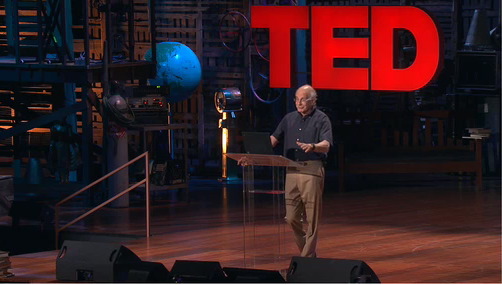
Think of the implications of that question, and how it affects how we think about our lives. I’m tickled and intrigued by some of the things psychologist and Nobel laureate Daniel Kahneman has to say in this TED talk, “The riddle of experience vs. memory,” and how they apply to our experiences (and memories) not only of our lives, but of works of art. He tells a story of someone who said he had listened to a wonderful symphony, but how a “dreadful screeching sound” at the end “ruined the whole experience.”

But it hadn’t. What it had ruined were the memories of the experience. He had had the experience. He had had 20 minutes of glorious music. They counted for nothing because he was left with a memory; the memory was ruined, and the memory was all that he had gotten to keep.

December 14, 2012

The curious coolness of Benjamin Button

Todd McCarthy of Variety, who’s old enough to know better, writes at the end of his review of “The Curious Case of Benjamin Button”:

Still, for what is designed as a rich tapestry, the picture maintains a slightly remote feel. No matter the power of the image of an old but young-looking Benjamin, slumped over a piano and depressed about his fading memory and life; it is possible that the picture might have been warmer and more emotionally accessible had it been shot on film. It has been argued that digital is a cold medium and celluloid a hot one and a case, however speculative, could be made that a story such as “Benjamin Button,” with its desired cumulative emotional impact, should be shot and screened on film to be fully realized. These are intangibles, but nor are they imaginary factors; what technology gives, it can also take away.

[Don’t worry — no spoilers.]

This makes about as much sense to me as blaming the weather on Doppler radar pictures. It may be the second-most misguided thing I’ve read about movies all year (after Patrick Goldstein’s assertion that a “dumb summer comedy” is more worthy of contempt that a dishonest or inept film that expects its ambition to be taken more seriously).

OK, let’s say the movie feels “cold” to you, and you attribute this feeling to something in the film. You could acknowledge the movie’s predominantly wintry settings and sepia color pallete (exemplified by the fully digital image, set in the dead of night in an empty hotel lobby in the middle of the Russian winter, above). Or contemplate the loneliness of the emotionally detached title character/observer/narrator, who is born an old man in a decrepit body and is cursed to grow physically younger while watching everyone around him age and die.

And you might very well consider the Kubrickian sensibility of the director, David Fincher (“Se7en,” “Fight Club,” “Zodiac”), the most deliberate and precise of filmmakers. Not known as Mr. Warm ‘n’ Cozy — even when working from a Gumpian screenplay by the writer of “Forrest Gump.” If the film is dark and cool in tone, it’s not because Fincher chose digital technology. It’s because Fincher chose to make it dark and cool. You may dislike the countless ways in which the movie emphasizes these qualities (in every composition, every cut, every performance), but don’t pretend it’s the video that’s doing it.

December 14, 2012

Where I’ve been

My father died unexpectedly the first week of April, three days before I was scheduled to leave for the Conference on World Affairs. The day before I left, my dog Frances surreptitiously ate two containers of dog treats in my parents’ garage and nearly exploded, but after an emergency trip to the vet she’s now OK (and seven pounds lighter). At my mom’s insistence I went to Boulder (with “Chinatown”) and then we had the reception for my dad at their house (there was no funeral or memorial service — he didn’t want ’em) when I got back. Two days after that, it was off to Ebertfest, where I was greatly heartened to see Roger Ebert in such high spirits. So, that’s what’s been going on. Hope to get back to posting regularly now…

December 14, 2012
subscribe icon

The best movie reviews, in your inbox